

More than just a pretty design, a butterfly tattoo is a global symbol for change, resilience, and new beginnings. Its meaning runs deep, drawing power directly from its incredible life cycle—a perfect metaphor for personal growth and clawing your way through tough times. This isn't just about getting ink; it's about telling your own story of transformation.
Why the Butterfly Tattoo Resonates So Deeply
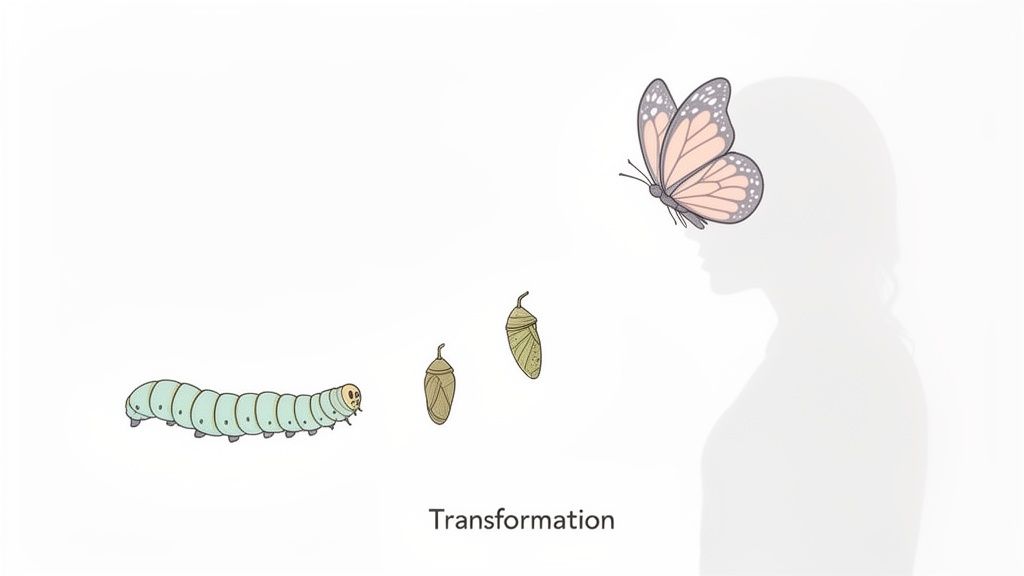
Of all the symbols in the tattoo world, few connect with people as universally as the butterfly. This isn't some fleeting trend; it’s a timeless design that taps into a core human experience: radical change. The journey from a slow-moving caterpillar to a soaring butterfly is one of nature’s most powerful stories of reinvention.
But this process, called metamorphosis, isn't some gentle evolution. The caterpillar literally dissolves into a liquid mess inside its chrysalis before it re-emerges in a completely new form. This intense, almost violent reconstruction is why the meaning of a butterfly tattoo goes way beyond simple "change." It represents a total rebirth after a period of struggle, darkness, or personal challenge.
The Power of a Shared Symbol
This deep symbolism has made the butterfly a dominant force in tattoo culture. It's not just an iconic look; it’s statistically the most searched tattoo design on the planet. A 2023 analysis found an average of over 428,000 searches per month worldwide for “butterfly tattoo,” which shows just how strongly its message hits home on a global scale. You can learn more about tattoo trend insights in this in-depth market analysis.
For so many people, getting a butterfly tattoo marks a pivotal moment. It becomes a permanent reminder of their own strength and their ability to emerge from hard times not just in one piece, but transformed into something new and beautiful.
The butterfly doesn't just represent change; it embodies the idea that you can completely dissolve who you once were and rebuild yourself into someone stronger, freer, and more aligned with your true potential.
A Story Etched in Ink
Ultimately, the power of the butterfly is in the story it helps you tell. It’s a symbol that can be molded to fit countless personal journeys, which makes it both universal and deeply individual at the same time. Throughout this guide, we're going to peel back the many layers that give the butterfly tattoo its profound meaning.
We’ll cover everything you need to know:
- Historical and cultural roots that give the symbol its weight.
- Core symbolic themes like resilience, freedom, and love.
- The role of color and placement in shaping your tattoo's story.
- Artistic styles that translate your vision into a unique piece of art.
By understanding these elements, you can go beyond just picking a pretty picture and start designing a butterfly tattoo that truly reflects your own unique path.
Unpacking a Century of Ink and Rebellion
While the butterfly tattoo feels like a modern staple you see everywhere, its roots run surprisingly deep, woven into a cultural story of rebellion and self-expression that’s nearly a century old. This delicate symbol actually has a tougher history than most people realize, first showing up as a quiet badge of independence long before tattoos were ever mainstream.
Its journey from a hidden mark to a global icon tells a powerful story about shifting cultural tides, feminism, and the enduring power of visible ink.
The story really begins not in the bright, bustling tattoo parlors of today, but in a much more buttoned-up era. Butterfly tattoos were already being inked in England back in the 1930s, a time when women were just starting to cautiously experiment with cosmetic and decorative tattoos. These were often small, subtle pieces that could be easily hidden—more like personal secrets than public declarations.
This early adoption quietly marked the butterfly as a symbol of personal autonomy for women in a world that often tried to make their choices for them. That connection to female identity and independence only grew stronger over the decades, turning the butterfly into an emblem for those claiming ownership of their bodies and their stories.
The American Tattoo Renaissance
The real explosion in popularity, though, came during the American tattoo renaissance. This period saw a massive cultural shift in how people viewed ink, transforming it from a subcultural marker into a legitimate art form. The numbers tell the story: from 1960 to 1995, the number of tattoo artists in the United States skyrocketed from roughly 500 to over 10,000. You can get a better sense of these historical trends and the full scope of this cultural evolution here.
During this boom, the meaning behind a butterfly tattoo evolved. It was no longer just a private symbol; it became a go-to choice for people celebrating newfound freedoms and personal breakthroughs. It was the perfect visual metaphor for the era’s spirit of transformation and self-discovery.
The butterfly tattoo became a way to wear your personal evolution on your skin. It was a symbol that could be both delicate and strong, pretty and profound—a duality that resonated deeply with a generation busy redefining itself.
Global Symbolism Beyond Western Culture
While its Western history is tied to rebellion, the butterfly carries different but equally powerful meanings all over the globe. Understanding this broader context adds incredible depth to any design, connecting your personal story to a timeless, cross-cultural narrative.
In many cultures, the butterfly is seen as a direct representation of the soul itself.
-
Japanese Culture: In Japan, a single butterfly can represent womanhood or a young girl. But when you see them in pairs, they become a powerful symbol of marital bliss and lasting joy. The focus here is on the butterfly's graceful movement and its deep connection to love and partnership.
-
Spiritual and Folk Traditions: Across countless spiritual beliefs, butterflies are often seen as the souls of ancestors or departed loved ones returning for a visit. A butterfly landing on you might be interpreted as a message from the spirit world, offering comfort or guidance.
-
Aztec Warriors: In ancient Aztec culture, the butterfly had a surprisingly fierce meaning. It was directly associated with the souls of warriors who had fallen in battle. This linked the creature not to delicacy, but to honor, sacrifice, and the promise of rebirth after a valiant struggle.
Choosing a butterfly tattoo means you're tapping into a rich and incredibly diverse symbolic language. It’s a design that has represented everything from a 1930s woman’s quiet act of independence to an Aztec warrior’s immortal soul. This historical and global weight is what elevates the butterfly from a simple trend to a piece of art with a truly enduring legacy.
Decoding the Language of the Butterfly

A butterfly tattoo is more than just a beautiful image; it’s a language written in ink, a piece of storytelling etched onto the skin. To choose a design that truly resonates, you first have to understand this language.
At its core, the butterfly tattoo meaning is anchored in four powerful concepts that reflect the deepest parts of the human experience. These themes are the foundation for nearly every personal story told through this iconic imagery.
Transformation: A Journey of Radical Change
The most universal meaning of a butterfly tattoo is transformation. And we’re not talking about small, gradual adjustments. This is about profound, ground-up reinvention.
Think about the caterpillar’s journey. It doesn’t just grow wings. It has to dissolve into a soupy liquid inside the chrysalis, completely deconstructing its old self before it can emerge as something entirely new and beautiful.
This is a potent metaphor for anyone who has navigated a life-altering experience. A butterfly tattoo can honor overcoming addiction, healing from a painful past, or celebrating a major personal breakthrough. It’s a permanent reminder that you can endure a period of total darkness and emerge reborn.
Resilience: The Strength to Endure
Tied directly to transformation is resilience. That chrysalis phase? It's a period of intense vulnerability and total isolation. The caterpillar is completely defenseless as it undergoes its metamorphosis, surviving on nothing more than quiet, inherent strength.
For many, a butterfly tattoo symbolizes their own "chrysalis" moments—the times they had to retreat, face their struggles alone, and trust in a process they couldn't control. It represents the grit required to endure hardship and the courage to believe in the person you're becoming.
A butterfly tattoo isn't just a symbol of the beautiful outcome; it's a tribute to the messy, difficult, and often unseen work that happens in the middle. It honors the struggle as much as the flight.
Freedom: Taking Flight on Your Own Terms
Once the butterfly finally breaks free, its first act is to fly. That single moment captures the pure essence of freedom.
A butterfly tattoo often signifies breaking away from constraints, whether they're physical, mental, or emotional. It can represent leaving a toxic relationship, finding hard-won independence, or simply embracing a new, unburdened chapter in life. The design speaks to a lightness of being and the sheer joy of finally soaring after being grounded for so long.
Love and Connection: A Symbol of the Soul
While a single butterfly often tells a personal story, two butterflies together introduce a new layer of meaning: love and connection. In Japanese tradition, for example, two butterflies fluttering together are a classic emblem of marital joy and harmony.
This symbolism also extends to the soul itself. In many Indigenous and folk traditions, butterflies are seen as the spirits of departed loved ones. A butterfly tattoo can become a deeply personal memorial, symbolizing an unbreakable bond with someone who has passed on. This even aligns with Christian iconography, where the butterfly’s lifecycle mirrors the resurrection—a powerful message of hope and new life.
A quick look around the world shows just how universal, yet varied, this symbolism is.
Butterfly Symbolism Across Cultures and Beliefs
| Culture or Belief System | Symbolic Meaning | Common Visual Representation |
|---|---|---|
| Ancient Greek | The soul or psyche ("psyche" means butterfly) | Psyche, the goddess, depicted with butterfly wings |
| Japanese | Marital bliss, young womanhood, souls of the living and dead | Two butterflies flying together, single butterfly on a family crest |
| Aztec | Souls of fallen warriors, fire, and transformation | Butterfly associated with the goddess of beauty, Xochiquetzal |
| Christianity | Resurrection, new life, and spiritual rebirth | Butterfly emerging from a chrysalis, symbolizing Christ's tomb |
| Native American Tribes | Change, hope, communication with the spirit world | Often used in storytelling, dance, and traditional art |
| Celtic | The soul, immortality, and rebirth | Stylized butterfly motifs in knots and jewelry |
Understanding these layered meanings is key to crafting a design that speaks your truth, much like knowing the specific attributes of other symbolic objects. For instance, the Tiger Eye crystal is celebrated for meanings associated with courage and clarity.
By decoding these core themes, you gain the vocabulary to tell your own story and collaborate with an artist to create a tattoo that isn't just beautiful, but profoundly meaningful.
How Color and Placement Shape Your Story
So, you’ve connected with the core meaning behind the butterfly. The next step—and this is where the real artistry comes in—is figuring out how to tell your specific story. The two most powerful tools you and your artist have are color and placement.
These choices aren't just about what looks cool. They're what give the tattoo its voice. Think of it this way: if the butterfly is the main character, color sets the mood, and placement decides where the story happens on the canvas of your body. When you choose them with intention, you turn a beautiful image into something deeply personal.
The Emotional Language of Color
Color hits you on a gut level, communicating feelings faster than words ever could. Each hue you weave into your butterfly tattoo adds a specific emotional filter, amplifying its message of transformation, freedom, or remembrance.
- Black & Grey Tattoos often bring a sense of elegance, gravity, and timelessness. A solid black butterfly can feel incredibly powerful, symbolizing the overcoming of a dark time, a memorial for a loved one, or simply a classic, bold statement.
- Blue Butterfly Tattoos just feel hopeful, don't they? Blue connects to serenity, spirituality, and calm. It’s the color of the sky and the deep sea, perfect for representing the peace and boundless freedom you feel after a long struggle.
- Red Butterfly Tattoos are pure passion and energy. This isn't a subtle transformation; this is a fiery, impossible-to-ignore change. Red speaks of intense love, raw emotion, and undeniable strength.
- Yellow or Orange Tattoos practically radiate joy and optimism. The monarch butterfly, with its iconic orange wings, is the perfect example. It represents not just change, but a long, determined journey filled with purpose.
- Watercolor Designs, with their flowing, blended colors, capture the beautiful chaos of life. This style is perfect for stories that aren't so black and white—it speaks to emotional fluidity, creativity, and embracing the unpredictable.
The way colors add layers of meaning here is a lot like how it works in other classic tattoo designs. Just as different colored roses tell different stories, the palette you choose for your butterfly will profoundly shape its narrative. To dive deeper into that idea, check out our guide on The Timeless Elegance of Rose Tattoos: Unraveling the Layers of Symbolism.
Where You Place Your Tattoo Matters
Placement is the final, crucial piece of the puzzle. Where you decide to put your butterfly tattoo changes everything—how you see it, how others see it, and the personal significance it holds for you.
A tattoo's placement isn't just about aesthetics; it's about its relationship to you. Is it a public declaration on your forearm, or a private reminder behind your ear? That decision fundamentally alters its meaning.
Think about how different spots on the body add a specific layer to the story:
- Wrist or Hand: A butterfly here is a constant companion. It's a visible, daily reminder of your journey, grounding you and reinforcing your strength with every move you make.
- Arm or Forearm: This is a classic spot for a reason. It’s a confident placement, easily shown or covered. It’s a way of saying, "I went through this, I've changed, and I'm proud of it."
- Back or Shoulder Blade: There's something powerful about putting wings where wings would naturally be. A butterfly here can symbolize a foundational change that supports you, even when you can't see it. It’s the story that, quite literally, has your back.
- Ankle or Foot: This placement ties your transformation to the very ground you walk on. It can represent moving forward, step by step, after a major life event, grounding your new beginning in every action you take.
As you can see, color and placement are essential parts of the design process. Exploring different visual storytelling examples can spark some incredible ideas for combining these elements in a unique way. Ultimately, the right combination will create a butterfly tattoo that doesn't just look amazing—it will feel like a true extension of you.
Finding the Right Artistic Style for Your Vision
The artistic style you choose for your butterfly tattoo is just as important as the symbolism itself. It’s the visual language that brings your personal story to life, turning a powerful concept into a piece of art that feels like it’s always been a part of you. Each style has its own voice and brings out different shades of the butterfly’s meaning.
Think of it like choosing a font. The message stays the same, but the delivery—bold and classic versus delicate and script-like—completely changes its emotional weight. The right style makes sure your tattoo not only looks amazing but tells the exact story you want it to.
Getting a feel for these different artistic approaches will help you lock in on the style that captures your vision and makes collaborating with your artist a breeze.
American Traditional: Boldness and Resilience
The American Traditional style is all about strength. It’s defined by its powerful, clean black outlines, a classic and punchy color palette (think bold reds, yellows, and blues), and straightforward shading. An American Traditional butterfly isn't just a design; it's an anchor. This style is built to last, with lines that hold their own for decades.
This aesthetic is perfect for anyone wanting to convey timeless strength and resilience. The bold, unapologetic look of the design mirrors a transformation that is confident and permanent. It’s less about a delicate change and more about a fundamental shift in who you are.
Japanese Style: Harmony and Spirituality
Japanese tattooing, known as Irezumi, is an art form steeped in centuries of tradition and symbolism. A Japanese-style butterfly is rarely shown alone. It’s almost always part of a larger scene, depicted with dynamic flow and integrated with natural elements like cherry blossoms, water, or wind bars. The style is all about balance, harmony, and a deep connection to the spiritual world.
In this context, a butterfly can represent the soul's journey, marital bliss (when shown in pairs), or the beautiful, fleeting nature of life itself. By weaving it into a larger composition, the tattoo tells a richer story—perfect for those who see their own transformation as part of a bigger, interconnected narrative.
Black and Grey Realism: Depth and Emotion
Black and grey realism strips everything down to light and shadow. Artists use only black ink, white highlights, and a spectrum of grey washes to create stunningly lifelike, three-dimensional images. This style captures the delicate, almost powdery texture of a butterfly's wings with incredible detail, giving the piece a real sense of depth and emotional gravity.
This approach is often chosen for tattoos that serve as memorials or represent a more introspective, profound personal change. With no color to distract the eye, the focus is entirely on the raw emotion and significance of the symbol. It’s all about form and feeling.
A tattoo style does more than just define the look of your butterfly; it sets the tone for its meaning. A bold traditional design shouts its story of resilience, while a delicate fine-line piece whispers a more private tale of personal evolution.
Fine-Line and Minimalist: Understated Elegance
In recent years, fine-line and minimalist styles have become incredibly popular for their subtle, elegant look. Using thin, precise needles, artists create delicate designs—often with a single continuous line—and little to no shading. The entire focus is on simplicity and understated beauty.
A minimalist butterfly is the perfect way to represent a quiet, internal transformation. It’s a personal reminder, a little secret meant just for the wearer, not the whole world. This style is ideal if you’re after a modern, discreet, and sophisticated piece that carries its meaning with quiet grace.
To help you visualize how these different styles come together, we've put together a quick guide comparing their core feelings and characteristics.
Choosing Your Butterfly Tattoo Style
| Tattoo Style | Key Characteristics | Best For Conveying |
|---|---|---|
| American Traditional | Bold black outlines, limited vibrant colors (red, yellow, blue), minimal shading. Built to last. | Timeless strength, resilience, and a confident, enduring transformation. |
| Japanese (Irezumi) | Dynamic flow, integrated with natural elements (flowers, water), rich symbolism, and narrative depth. | The soul's journey, harmony with nature, and life's fleeting beauty. |
| Black & Grey Realism | Lifelike detail, soft shading, uses only black, white, and grey tones to create depth. | Profound personal change, memorial pieces, and raw, introspective emotion. |
| Fine-Line / Minimalist | Thin, precise lines, often single-needle work, with little to no shading. Understated and elegant. | A quiet, personal transformation, subtlety, and modern sophistication. |
Choosing the right style is a huge part of the tattoo journey. This visual guide below also highlights how your choices in color and placement add even more layers to your tattoo's final meaning.
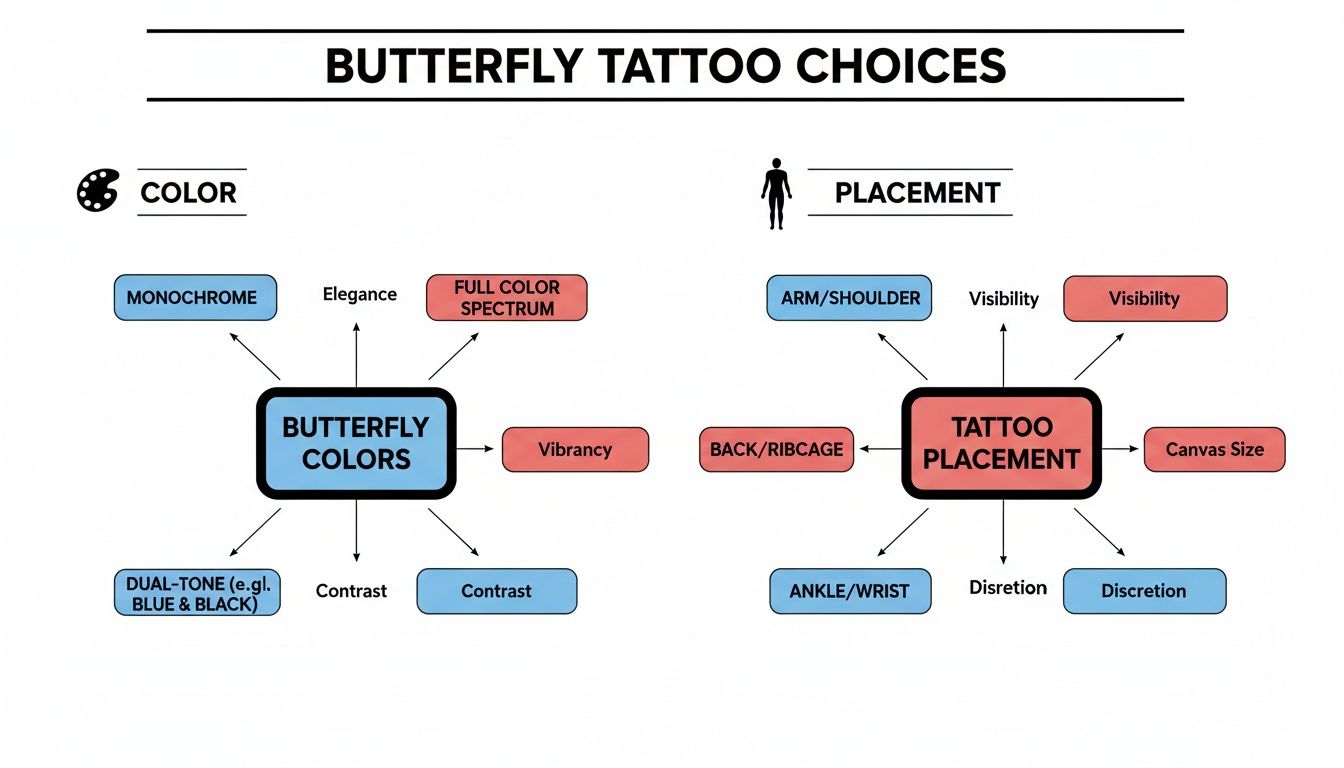
This map shows how foundational choices like color palettes and body placement can completely shape your design’s personal significance. For an even deeper dive, exploring a comprehensive tattoo style guide can bring total clarity, helping you find the perfect artistic match for your vision right here at Fountainhead NY.
Designing Your Custom Butterfly Tattoo
This is where the magic really happens. You’ve explored the symbolism, considered the colors, and have a feel for the artistic styles you love. Now it’s time to take all those ideas and work with a professional artist to create a piece of permanent art that’s completely yours.
Creating a custom butterfly tattoo isn’t just about picking a picture; it's a deep collaboration. You bring the story, the meaning, and the inspiration. The artist brings the technical skill and artistic vision to translate that into a design that will not only look incredible but will also stand the test of time.
Preparing for Your Consultation
The best tattoos start long before you hear the buzz of a machine. They start with a great consultation. This meeting is your chance to connect with an artist, share what you’re thinking, and make sure they’re the right person to bring your idea to life.
To get the most out of it, you need to do a little homework first.
- Gather Your Inspiration: Don't just think it, show it. Collect images—tattoos you like, photos, paintings, anything that captures the mood and look you're going for. This gives your artist a visual language to understand your taste.
- Know Your Story: Be ready to talk about what this butterfly means to you. Is it a symbol of overcoming a struggle? A tribute to someone you've lost? The more of your "why" you can share, the more personal and powerful the final design will be.
- Think About Placement and Size: Have a solid idea of where on your body you want the tattoo and a rough estimate of its size. A design for a forearm is very different from one that wraps around a thigh, and this info is crucial for the artist from the get-go.
Your consultation is a creative dialogue. You bring the "why"—the story and the meaning—and the artist brings the "how," using their technical skill and artistic eye to translate your vision into a beautiful, lasting design.
Finding the Right Artist and Taking the Next Step
This is probably the single most important decision you'll make in the whole process. You need to find an artist whose work truly speaks to you. Spend time looking through portfolios. If you want the bold, clean look of American Traditional, find an artist who excels at it. If you’re dreaming of something delicate and subtle, you need a fine-line specialist.
When you see a style that clicks, you've found your starting point.
Ready to begin your own transformation story? Here’s how to move forward with us at Fountainhead New York.
- Explore Portfolios: Take a look at the work from our talented crew right here on our site. See whose style resonates with your vision.
- Book a Consultation: Once you have an artist in mind, reach out to the studio to set up a time to talk. This is where your ideas start becoming a reality.
- Trust the Process: Getting a custom tattoo is a partnership. You've chosen your artist for their expertise, so trust their guidance. From the first sketch to the final session, they are there to create a piece that is 100% uniquely yours.
Common Questions About Butterfly Tattoos
Alright, let's talk logistics. Figuring out the practical side of getting a tattoo is just as crucial as landing on a design you love. To help you feel completely ready for your butterfly tattoo, we’ve put together answers to the questions that always come up during the planning stage.
Getting these details sorted out ahead of time makes the whole experience feel less intimidating. It lets you relax and just enjoy the excitement of watching your idea come to life on skin.
How Much Will My Butterfly Tattoo Cost?
The price of a custom butterfly tattoo can really vary. Things like the final size, how complex the design is, whether it’s in color or black and grey, and the artist's specific hourly rate all factor into the final cost.
A small, simple fine-line butterfly on your wrist, for example, is going to be a different price than a large, highly detailed piece on your back that takes multiple sessions to finish. The absolute best way to get a solid estimate is to book a consultation. That's where you can sit down with your artist and hash out all the details.
What Is the Best Placement for a First Tattoo?
If this is your first time getting tattooed, you might want to pick a spot that's known for being a little less sensitive and is pretty easy to take care of while it heals. A lot of people find the forearm, outer thigh, or shoulder blade to be great starting points.
The cool thing about a butterfly is that its shape works almost anywhere on the body. An experienced artist can also give you great advice on placements that will flow with your natural anatomy and match how visible you want the tattoo to be.
Can I Combine a Butterfly With Other Symbols?
Absolutely. In fact, combining a butterfly with other elements is an amazing way to build even deeper, more personal layers of meaning into your tattoo. It’s something we do all the time, and it allows for a truly one-of-a-kind design.
Some popular pairings we often see are:
- Flowers: Roses can bring in a feeling of love or passion, while a lotus often represents spiritual growth and enlightenment.
- Skulls: This is a classic combination that speaks to the profound cycle of life and death, linking the idea of transformation directly with mortality.
- Names or Dates: Weaving in text is a powerful way to dedicate the tattoo to someone important or to mark a significant moment in your life.
A professional artist is an expert at creating a balanced, beautiful design that makes all the different elements look like they were always meant to be together.
How Should I Care for My New Tattoo?
Good aftercare is non-negotiable. It’s what ensures your new butterfly tattoo heals perfectly and stays looking sharp and vibrant for years. Your artist will give you a detailed rundown, but the basics are pretty universal. You can learn more by reading our detailed guide on tattoo aftercare and frequently asked questions.
At Fountainhead New York, our artists are dedicated to creating custom work that tells your unique story with exceptional craftsmanship. Visit our studio to book your consultation today.


https://benzouk.com/
Roxicodone 30 mg
Buy Ritalin
Valium (Diazepam)
Tramadol 100 mg Tabletten
Subutex 8 mg
Subutex 2mg Sublingualtabletten
Suboxone
Stilnox Zolpidem 10 mg
Soma Carisoprodol 350 mg
Xanax Alprazolam
Xanax XR
buy diazepam uk
Demerol Meperidin
Codeinphosphat 30 mg Tabletten
Codeine 30 mg tablets
Cialis 10 mg tablet
Oxycodon 30 mg
<a href=“https://benzouk.com/product/buy-mifepristone-online-uk/” rethadone/" rel="dofollow">Methadone 10 mg
Percocet 10mg
Saxenda liraglutide
Oxycontin 80 mg tablet
Pregabalin capsules
Arimidex anastrozole 1 mg
Adderall 5 mg
Xanax 2mg
Adderall XR 10 mg
Ibuprofen 200 mg
Dilaudid Hydromorphon 8 mg
Dihydrocodein
Farmapram 1mg
Dormicum
Diazepam Valium
Clonazolam Pellets
Blue Xanax 2mg
Klonopin
Halcion Triazolam Tablets
Flurazepam Dalmane
Fenbendazole Panacur
Yellow Xanax 2mg
White Xanax 2mg
Valium 10mg
Tranxene Clorazepate
Prazepam centrax
oxazepam Serax
Trenbolone Acetate
Winstrol Stanozolol
Testosterone Cypionate Injection 200mg
Trenbolon Enanthate
Propionat
Nolvadex
Omnadren 250 mg
Methyltestosteron 25 mg
Lasix 40 mg
Insulin
Sustanon
Primobolan
Heroin
Dexedrine Spansule
Reine A-PvP-Kristalle
ketamine
Benzedrinsulfat
Carfentanil
Ritaline
Xanax 2mg
Lorazepam
Hydroxybutyrat gamma
Amoxicillin 500 mg
Midazolam
Methamphetamin
Cocaine hydrochloride
Nembutal
Amphetamin
Rohypnol 2mg
Oxynorm 20mg Kapseln
Temazepam 20mg
Ambien 10mg Zolpidem
Testogel without prescription
Concerta 36mg
Wegovy
Thiopental
Alprazolam 0,5 mg
Clonazepam Tablet
Rybelsus
Fenbendazole
White Xanax 2mg
Yellow Xanax 2mg
Valium 10mg
Tranxene Clorazepate
Prazepam Centrax
oxazepam Serax
https://buyaustraliapsychedeliconline.com/
Dried MushroomsAlbino A+ Magic MushroomAlbino P Envy MushroomsBrazilian Magic MushroomsBurmese Dream Magic MushroomsGolden Teacher Magic MushroomsLiberty Cap MushroomsMalabar Coast Magic MushroomsMartinique Magic MushroomsNepal Chitwan Magic MushroomsP Envy Magic MushroomsPink Buffalo MushroomShroom SporesAlacabenzi SporesB+ Spores (B Plus Spores)Burma SporesGolden Teacher SporesKETAMINEBuy ketamine Crystals OnlineBuy Ketamine PowderBuy liquid ketamineKETAMINE NASAL SPRAYKetamine RocksKetamine TrochesMDMA ECSTASYBlue Domino MDMABuy MDMA CrystalsMDMA PowderMethyloneLSD1A LSD1P LSD1P-LSDBuy LSD BlottersLiquid LSDLSD ACID 200 UgLSD SHEETSDMT4-ACO-DMT5-MeO-DMTChanga DMTDMTCartridge and Battery5mLDMT VAPE PENN-Dimethyltryptamine DMT crystalsButtermilkCherry RipeConfetti Cookies Dough CreamShirley TempleTwisted CaribbeanHot Honey Butter BlondiesGumdropz Honeydrew DelightSprinklez Fruitty PeblesMarshmallow Sparkling ChampagneSprinklez MIllionaire ShortbreadTorchiez Fire Plum CrumbleSprinklez Bubblegum CottonCandyFrosty Snowman MarshmallowGumdropz Persian PeachChoko Whip Swirl MarshmallowGumdropz Cantaloupe DreamSpiced Gingerbread Choco ChunkMarshmallow CloudberryGumdropz Tropical SnowMarshmallow Coconut Royale