

Choosing a tattoo artist is a big deal, especially on a creative island like ours. This isn't just a transaction; it's the start of a partnership. Think of this guide as your roadmap to navigating Long Island's incredible tattoo scene, turning what can feel like an overwhelming search into an exciting part of your journey.
Your Journey to Finding the Perfect Long Island Tattoo Artist
Finding the right tattoo artist on Long Island goes way beyond picking someone who can draw well. You're looking for a partner, an expert who can take your vision and translate it into permanent art that you'll love for a lifetime. It’s a process that requires a little soul-searching on your end and a sharp eye for quality and professionalism.
There's a reason the search can feel intense here: Long Island is one of the most heavily tattooed places on the planet. We’re part of a massive North American tattoo market that hit USD 861.68 million in 2024. That market is growing at a staggering 8.8% each year and now makes up over 40% of the entire global industry. The talent pool is deep, but so is the need to choose wisely.
To help you get started on the right foot, this table breaks down the entire process into clear, manageable phases.
Key Steps to Choosing Your Long Island Tattoo Artist
| Phase | Your Goal | Why It's Crucial |
|---|---|---|
| 1. Define Your Vision | Get crystal clear on the style, subject, and placement you want. | This is your creative brief. Without a clear idea, it's impossible for an artist to bring your vision to life accurately. |
| 2. Evaluate Portfolios | Learn to spot technical skill, artistic consistency, and the right style match. | A portfolio is an artist's resume. It shows you what they're capable of and if their style aligns with your dream tattoo. |
| 3. Verify Safety & Hygiene | Confirm the studio meets non-negotiable standards for cleanliness and safety. | Your health is paramount. A clean, professional studio is the only option for a safe and successful tattoo experience. |
| 4. Consult with Confidence | Ask the right questions to ensure the artist is the perfect creative partner for you. | This is where you build trust. A good consultation confirms you're on the same page and that you've found your match. |
Think of this framework as your guide for the detailed steps we’ll cover next.
Setting a Clear Path Forward
Before you even glance at an Instagram profile, the first step is always inward: clarifying what you want. This guide will walk you through every stage, from decoding artistic styles to spotting a top-tier professional studio.
An artist’s online presence is often the first clue to their level of professionalism. As you start your search, remember that a well-maintained website or social media profile matters. In fact, understanding the importance of good website design for a business can give you early insights into an artist's commitment to their craft.
A great tattoo is a collaboration. It begins with your idea and is brought to life through the skill, experience, and artistic integrity of a professional you trust. Finding that connection is the most crucial part of the process.
We’ll use premier studios like Fountainhead New York as a benchmark, showing you what excellence looks like in the real world. By the time you finish this guide, you’ll have the confidence to find an artist who won’t just execute your idea, but elevate it. For a closer look at some of the best talent around, check out our curated list of top Long Island tattoo artists.
2. Translating Your Vision into a Tattoo Style
Before you even think about finding the right artist, you need to learn how to speak their language. Getting a tattoo is a lot like commissioning a painting; you wouldn't walk up to a watercolorist and ask them for a heavy oil canvas. It just doesn't work that way. The tattoo world is the same, broken down into distinct styles, each with its own history, its own rules, and its own unique feel.
Figuring out which style fits your idea is the most critical first step. It’s your compass. This single decision will point you toward the handful of tattoo artists on Long Island who specialize in the exact look you’re after. Get this part right, and you'll find an expert who doesn't just trace a design but truly lives and breathes the art form you want on your skin.
This infographic breaks down the core stages of your search, from nailing down the style to checking out portfolios and making sure the studio is legit.
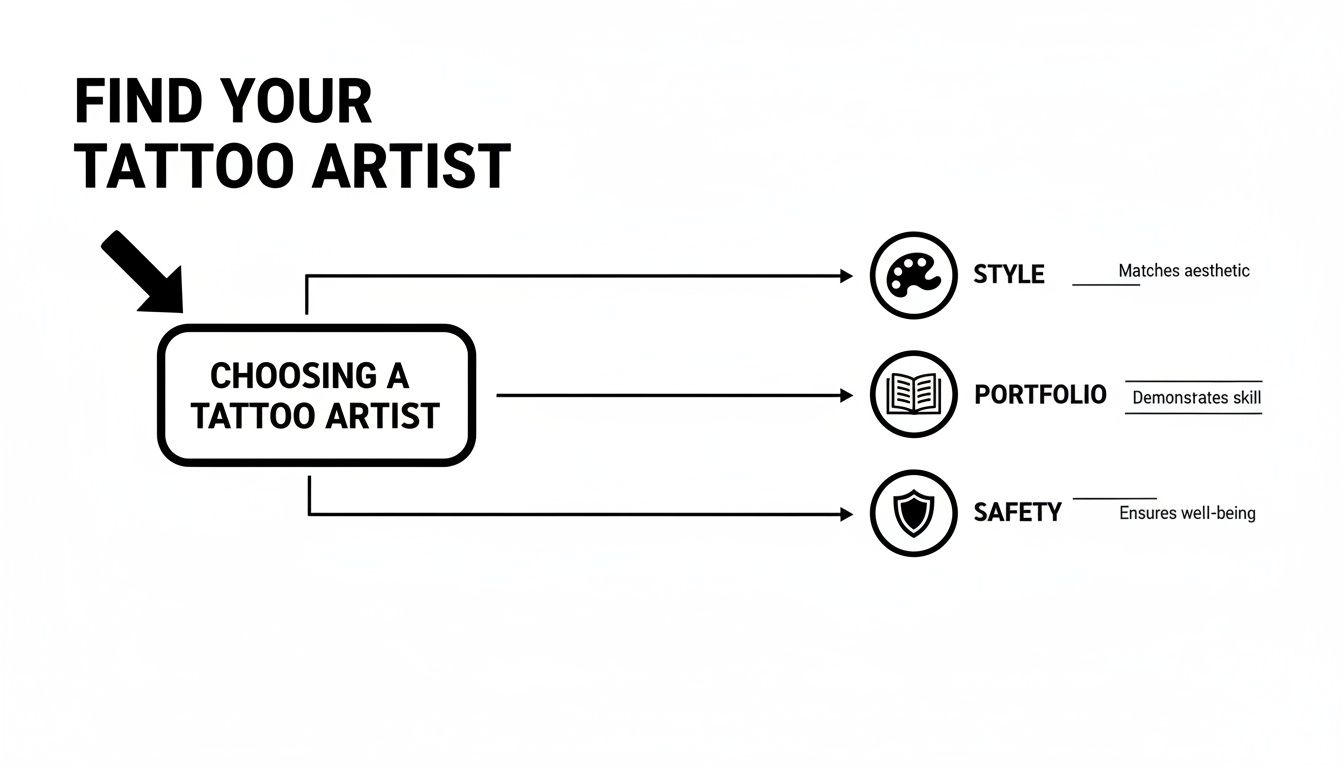
Think of it as a roadmap. Your journey starts with art, gets confirmed by skill, and is locked in by professional standards. Let's break down those artistic styles so you can start looking with a bit more confidence.
American Traditional: Bold and Timeless
American Traditional is the bedrock of Western tattooing. If you're picturing classic sailor tattoos—eagles, anchors, roses, skulls—you're right on the money. This style is all about a powerful, clean look that's built to last.
The key ingredients are impossible to miss:
- Heavy black outlines: This is what gives the tattoo its structure and ensures it won't turn into a blurry mess decades from now.
- A limited, bold color palette: We're talking bright reds, greens, yellows, and blues, packed in solid without a lot of fancy blending.
- Simple, iconic imagery: The designs are meant to be instantly recognizable, even from across a room.
This style is for anyone who wants a tattoo that is unapologetically a tattoo—classic, tough, and vibrant. It's a piece of history.
Japanese Style (Irezumi): Flow and Mythology
Japanese tattooing, or Irezumi, is an ancient art form dripping with symbolism and storytelling. Unlike the standalone pieces common in American Traditional, Japanese tattoos are often designed as large-scale works—like full sleeves or back pieces—that flow with the natural curves of the body.
The style is famous for its intricate details and epic themes. You'll see mythological creatures like dragons and koi fish battling fierce waves, often framed by natural elements like cherry blossoms or maple leaves. It all comes together to create a dynamic, powerful composition that tells a story right on the skin.
Irezumi is more than just a picture; it's a commitment to a larger piece of art. The artist has to understand how to make the design move with the body, creating a masterpiece that's truly custom-fit.
Fine-Line and Micro-Realism: Delicate and Detailed
On the complete opposite end of the spectrum is the delicate world of fine-line tattooing. Using tiny needles, artists create incredibly intricate designs that look more like a precise pen-and-ink drawing than a classic tattoo.
Fine-line is perfect for things like florals, elegant script, or any small, subtle piece of art. It demands an artist with a rock-steady hand and an obsession with tiny details. This style is what opened the door for micro-realism, where artists tattoo tiny, photorealistic portraits or scenes with mind-blowing accuracy. If you’re looking for something elegant and understated, this is your world.
Realism and Black & Grey: Depth and Drama
Realism does exactly what it says: it aims to replicate an image—a photograph, a portrait, a statue—as accurately as possible on skin. This requires a massive amount of technical skill in shading, blending, and perspective to create a believable three-dimensional effect.
Black & grey is a form of realism that uses only black ink, diluted with water to create a full spectrum of tones. Think of it as a charcoal drawing on skin. This technique is perfect for creating mood, depth, and dramatic contrast without a single drop of color. A master of this style can make a tattoo look like it's literally popping off your skin.
Getting a handle on these foundational styles is the key to finding the right person for the job. To see more examples of how these aesthetics come to life, our detailed tattoo style guide will help you find your perfect match. With this knowledge, you’re ready to start looking at portfolios with a critical eye, prepared to find the Long Island artist who was meant to bring your idea to life.
How to Read a Portfolio Like a Professional
An artist's portfolio is their resume, but it's written in ink, not words. Learning how to read it is probably the single most important skill you can develop in your search for the right artist. It’s way too easy to get distracted by a cool subject—like a dragon or a wolf—but your job is to look past what was tattooed and zero in on how it was tattooed.
Think of it like being a judge at a figure skating competition. Sure, the skater's routine might be exciting, but the judges are scoring the technical execution—the clean landings, the smooth edges, the perfect form. You need to bring that same critical eye to a portfolio to really understand an artist's skill.
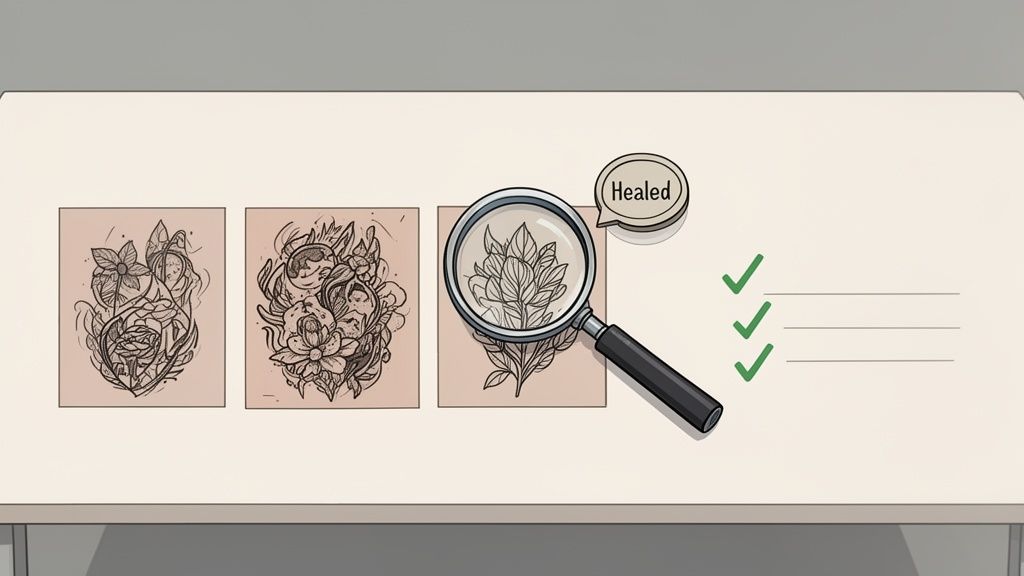
This guide will give you a practical checklist for sizing up the work of any tattoo artist on Long Island, helping you spot the true professionals.
Deconstructing the Linework
Linework is the skeleton of almost every tattoo. If the lines are weak, the whole piece just falls apart. When you're looking at a portfolio, zoom in. Get right up on those lines and give them a hard look.
So, what are you looking for? Consistency. The lines need to be solid, crisp, and confident from start to finish. Ask yourself these questions:
- Is the thickness consistent? A line that's supposed to be uniform shouldn't get wobbly, thinner, or thicker along its path.
- Do the lines connect cleanly? Where two lines meet, they should form a perfect, sharp intersection, not a blurry or overshot mess.
- Are the curves smooth? Circles should look like actual circles, not lumpy ovals. A shaky hand becomes incredibly obvious in curved or circular designs.
A great artist lays down a line in one fluid pass. It looks effortless, but that’s the sign of some serious control and experience.
Judging Color and Shading
Color and shading are what breathe life into a tattoo, giving it depth, dimension, and pop. When it's done poorly, color can look patchy and faded, and bad shading can make a tattoo look flat or just plain muddy.
For color tattoos, the saturation should be totally solid and even. You shouldn't see any "holidays," which are little missed spots of skin peeking through a field of color. The colors should be bright and jump off the skin without looking overworked or scarred.
When it comes to black and grey work, the transitions are everything.
The gradients between black, grey, and skin tone should be buttery smooth. Patchy or abrupt shading is a major red flag that indicates an artist struggles with controlling needle depth and technique.
Smooth shading is what creates that realistic sense of depth, making the tattoo look three-dimensional. When you find an artist who has this down, their work has a powerful, almost photographic quality.
The Ultimate Test: Healed Tattoos
Here’s the pro tip that most people miss: a great tattoo looks good healed, not just fresh. Anyone can snap a slick, well-lit photo of a tattoo moments after it’s finished. The skin is still swollen, the ink is at its absolute darkest, and a little glare can hide a multitude of sins.
The real proof of quality comes weeks, months, or even years later. A skilled artist's work will settle into the skin and look just as crisp and vibrant as it did on day one. With a less-skilled artist, things can go wrong. Lines can "blow out" (get blurry under the skin), colors can fade, and shading can heal patchy.
When you're browsing portfolios of tattoo artists on Long Island, make it a priority to find the ones who show off their healed work. It's a massive sign of confidence and transparency. It proves their technique is solid and that they build tattoos to last a lifetime, not just for a quick, impressive Instagram post. This one step is your best insurance for getting a tattoo you'll still love decades from now.
Navigating the Consultation and Asking the Right Questions
Once you’ve found an artist whose portfolio gets you excited, it’s time for the consultation. This isn't just a quick chat about price; think of it as the first real step in your collaboration. It’s where you and the artist get on the same page about the design, the process, and the vibe to make sure you’re a great fit for each other.
Walking into that conversation prepared makes all the difference. The goal is to leave with zero unanswered questions, feeling confident that the artist not only gets your idea but is absolutely the right person to bring it to life. This is about more than just booking a time slot—it’s about covering every single detail before the needle ever touches your skin.
The demand for high-quality tattoos has never been greater. The U.S. tattoo industry is on track to hit $1.3 billion in revenue by 2025, with over 23,774 tattoo businesses operating nationwide. This boom means the scene for tattoo artists on Long Island is more professional than ever, and top-tier studios like Fountainhead New York pride themselves on clear, professional communication from the very beginning.
Questions About the Creative Process
This is where you make sure your artistic vision and the artist's style are in sync. You need to understand their creative flow and how they handle a client's concept.
- How do you typically develop a custom design from a client's idea? This tells you a lot about their collaborative process. Do they prefer having total creative freedom, or are they excited to build the design with your input every step of the way?
- Looking at my idea and references, do you think it's a good match for your style? A truly professional artist will be honest. If your idea is outside their wheelhouse, they’ll tell you and might even point you toward someone better suited for the project.
- What are your thoughts on my placement choice? A seasoned artist can offer incredible insight here. They’ll advise you on how the design will flow with the anatomy of that specific area, any potential challenges with healing, and how it’s likely to age over the next decade.
This conversation is all about building trust. It confirms you’ve found not just a technician, but a creative partner who respects your vision.
Discussing Logistics and Studio Policies
Okay, the creative part is locked in. Now it’s time for the practical stuff. Getting clarity on pricing, scheduling, and studio rules upfront prevents any awkward misunderstandings later.
A clear understanding of studio policies protects both you and the artist. It establishes a professional framework for your project, ensuring there are no surprises along the way.
As you get ready for your consultation, keep in mind that many modern shops have streamlined their booking. Getting familiar with how studios manage their schedules, especially with tools like mobile-first appointment booking, can make the whole process smoother for you.
Here are the essential logistical questions you need to ask:
- What is your pricing structure? Do they charge by the hour, or will they give you a flat rate for the entire piece? Knowing this from the start is crucial for budgeting.
- What is your deposit policy? Almost every custom artist requires a non-refundable deposit. This secures your spot and covers the time they spend drawing your design. Make sure you know the amount and what it covers.
- What is your current availability, and what’s the estimated timeline for my tattoo? This sets realistic expectations for when you can get started and whether your piece will require multiple sessions.
Nailing down these details ensures a smooth, professional experience from start to finish, letting you focus on the excitement of getting your new art.
What to Look for in Studio Safety and Aftercare
The artwork is what gets all the attention, but nothing—absolutely nothing—is more important than your health. A jaw-dropping design means very little if it's done in an unsafe environment. Knowing the non-negotiable standards for studio hygiene is the single best way to protect yourself and ensure a great experience with any of the top-tier tattoo artists on Long Island.
Think of a professional tattoo studio like you would a doctor's office or a dental clinic. It should feel clean, smell sterile, and look organized. Your health is literally on the line, so you have every right to be picky and observant. A truly great artist takes immense pride in their clean workspace and will be completely transparent about their safety procedures.
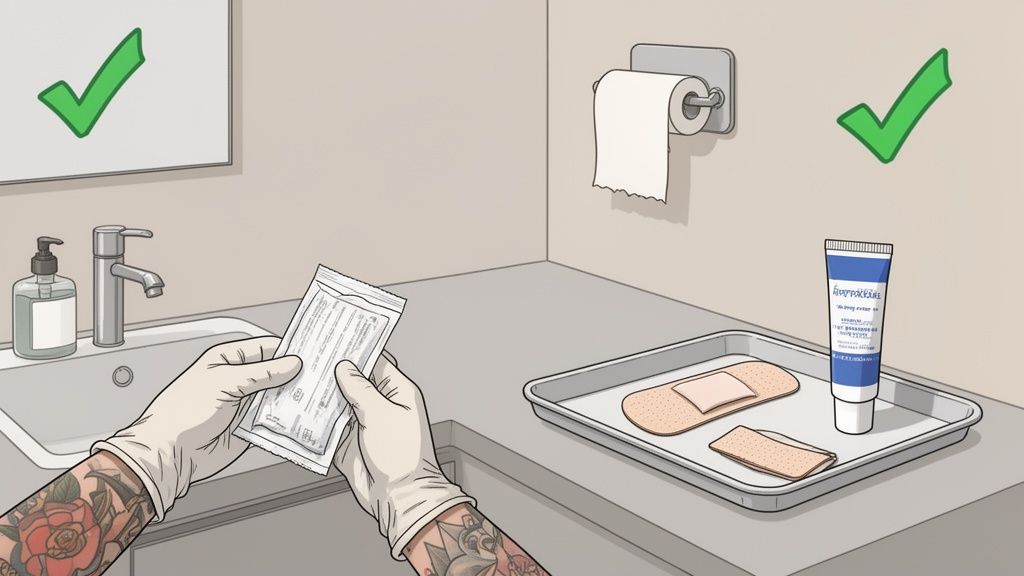
Studio Hygiene Green Flags
When you walk into a studio for a consultation or your actual appointment, keep your eyes peeled for these absolute must-haves. These are the "green flags" that tell you you're in a safe, professional shop.
- Single-Use Equipment: This is non-negotiable. The artist must use brand-new, sterile, single-use needles for every single client. They should open the sterile packaging right in front of you just before the session starts.
- Barrier Protection: Look around the station. Everything the artist might touch while tattooing—the machine, the power supply, spray bottles, even the chair—should be wrapped in disposable plastic barrier film.
- Impeccable Artist Hygiene: Your artist must wash their hands thoroughly and put on a fresh pair of disposable gloves before they start. If they touch anything non-sterile, like their phone or a drawer handle, they need to change those gloves.
- Sharps Disposal: You should see a clearly marked, puncture-proof sharps container for used needles. This is a fundamental requirement for handling biohazardous waste safely.
Your tattoo is a partnership. The artist is responsible for creating a beautiful, clean piece of art, but you are responsible for healing it correctly. Your diligence in the weeks after your appointment is the final, crucial step.
If you don't see these standards being met, that's a massive red flag. If a studio feels dirty, cluttered, or the artist brushes off questions about safety, just walk away. Your health is worth infinitely more than any tattoo.
The Vital Role of Aftercare
The moment you stand up from that chair, the responsibility for your new tattoo shifts squarely to you. Proper aftercare is what makes the difference between artwork that heals crisply and stays vibrant versus a piece that gets infected or fades poorly. Think of it as protecting your investment—both the money you spent and the part of your body it now lives on.
Your artist will give you specific instructions, and you need to follow them to the letter. Generally, the healing process involves a few key stages.
- Initial Bandaging: Your artist will cover the fresh tattoo. Depending on the type of bandage they use, you'll be told to leave it on for anywhere from a few hours to several days. Don't second-guess them.
- Gentle Cleaning: Once the bandage comes off, you'll need to gently wash the tattoo with lukewarm water and a mild, fragrance-free soap. Pat it dry with a clean paper towel—never rub it or use a bath towel, which can harbor bacteria.
- Light Moisturization: Apply a very thin layer of the aftercare ointment they recommended. Overdoing it can suffocate the tattoo and hinder healing, so less is always more.
- Protection and Patience: For the next few weeks, keep your new tattoo out of direct sunlight and do not submerge it in water. That means no pools, hot tubs, lakes, or long baths. Let it breathe and resist the urge to pick at any scabs that form.
Getting these steps right is critical for a perfectly healed tattoo. For a deeper dive, checking out some common tattoo aftercare frequently asked questions can clear up any confusion and give you some extra peace of mind.
Fountainhead New York: A Case Study in Tattoo Excellence
Theory is one thing, but seeing it all click in the real world is something else entirely. We've talked about styles, portfolios, and safety, but let's tie it all together by looking at a Long Island studio that gets everything right. Fountainhead New York in Huntington Village is a perfect example of what you should be looking for.
This studio wasn't just opened; it was deliberately created by acclaimed artists Matt Beckerich and Phil Szlosek. Their vision was to build a space that honors tattooing's deep history while pushing the craft into the future. It’s more than a shop—it's an environment designed from the ground up to make you feel comfortable, respected, and part of the creative process.
Masters of Their Craft
A studio is only as good as its artists, and Fountainhead is a masterclass in specialization. Instead of trying to be a jack-of-all-trades, the resident artists have dedicated their entire careers to perfecting specific styles.
- Matt Beckerich is an absolute powerhouse in American Traditional. His portfolio is a perfect illustration of what we discussed earlier: clean, confident lines, colors that are packed in to stay, and timeless designs built to look good for a lifetime.
- Phil Szlosek is a master of the flowing, intricate world of Japanese tattooing. His work shows a profound understanding of how to make large-scale designs move with the body—the true sign of an expert in Irezumi.
This kind of focus is what you're paying for. When you go to an artist like Matt for a traditional piece, you're not just getting someone who can draw an eagle. You're getting an artist who lives and breathes the history and technique of that style. This is what separates adequate tattoo artists on Long Island from the truly exceptional ones.
The Complete Client Experience
Beyond the world-class artwork, Fountainhead nails the professional standards that guarantee a safe and positive experience. The studio itself feels more like a curated art gallery than a typical tattoo shop, creating a calm, welcoming atmosphere that immediately puts you at ease.
A great studio doesn't just produce great tattoos; it cultivates an environment of trust, professionalism, and mutual respect. The client experience should feel as considered and well-crafted as the art itself.
From the moment you walk in for a consultation, the process is dialed in. The artists actually listen to your ideas, offer their expert guidance on design and placement, and make sure you feel 100% confident before a single needle is set up. Their commitment to hygiene is obvious and non-negotiable; every safety protocol we've covered is just a standard part of their daily routine.
By looking at a studio like Fountainhead, you get a real-world benchmark for excellence. It’s that blend of top-tier artistry, a relentless focus on safety, and genuine respect for both the client and the craft. This is the standard you should be holding every artist to in your search.
Your Long Island Tattoo Questions Answered
Even after scrolling through hundreds of portfolios and finding an artist you love, it’s completely normal to have some lingering questions before you commit. It's a big decision, after all.
Think of this as the final check-in before your appointment. We'll walk through the practical stuff—cost, timing, and prep—so you can walk into the studio feeling confident, relaxed, and ready for a great experience with one of Long Island's best tattoo artists.
How Much Does a Quality Tattoo Cost on Long Island?
This is usually the first question people ask, and the honest answer is: it varies. The final price tag depends on the artist's experience, the studio's reputation, and the tattoo's size, complexity, and placement on your body.
Generally speaking, you can expect top-tier studios on Long Island to charge hourly rates anywhere from $150 to over $300. For big projects like a full sleeve or back piece, some artists will offer a flat rate for a full-day session, which can be more economical. The key is to have this conversation during your consultation so there are no surprises.
Remember, a tattoo is a permanent investment in your body. Chasing the lowest price is almost always a bad idea. Prioritizing an artist's skill, safety, and experience is the only way to get a result you'll be proud of for the rest of your life.
What Is the Best Time of Year to Get a Tattoo?
Most artists and seasoned collectors will tell you to get tattooed in the fall or winter. The reason is simple and has everything to do with proper healing. A new tattoo is essentially a beautiful, open wound, and it needs to be protected.
Two things are absolute enemies of a healing tattoo:
- Direct Sunlight: Fresh ink is incredibly sensitive. UV rays can cause the color to fade and damage the healing skin.
- Soaking in Water: Pools, oceans, hot tubs, and even long baths are breeding grounds for bacteria. You have to avoid them completely for a few weeks.
Cooler weather just makes life easier. You're naturally wearing more clothing, which keeps your new piece shielded from the sun and helps you avoid the temptation of a summer beach day.
How Should I Prepare for My Tattoo Appointment?
How you prepare can make a world of difference in your comfort level and even the final result. A few simple steps will set you and your artist up for a smooth session.
For at least 24 hours before your appointment, stay away from alcohol or blood thinners like aspirin, as they can make you bleed more. Just as important, get a great night's sleep. A well-rested body handles the stress of being tattooed much better.
On the day of, make sure you eat a solid meal an hour or two before you come in—this keeps your blood sugar stable and prevents you from feeling lightheaded. Drink plenty of water to stay hydrated. And finally, wear comfortable clothes that give your artist easy access to the spot being tattooed. Now, all that's left is to relax and trust the professional you've chosen.
Ready to start your journey with artists who live and breathe quality, safety, and true artistry? The team at Fountainhead New York is here to bring your vision to life. Check out our work and book your consultation today.


9k5909