

Choosing a tattoo style is the first, and maybe the most important, step you'll take on your ink journey. This is about so much more than just finding a cool picture online; it's about picking a visual language. Styles like American Traditional, Japanese, and Fine-Line each have their own rich history, unique techniques, and aesthetic rules that define them. This single decision shapes everything that follows, from the tattoo's final look to how it will settle and age on your skin over the years.
Your Journey Into the World of Tattoo Art
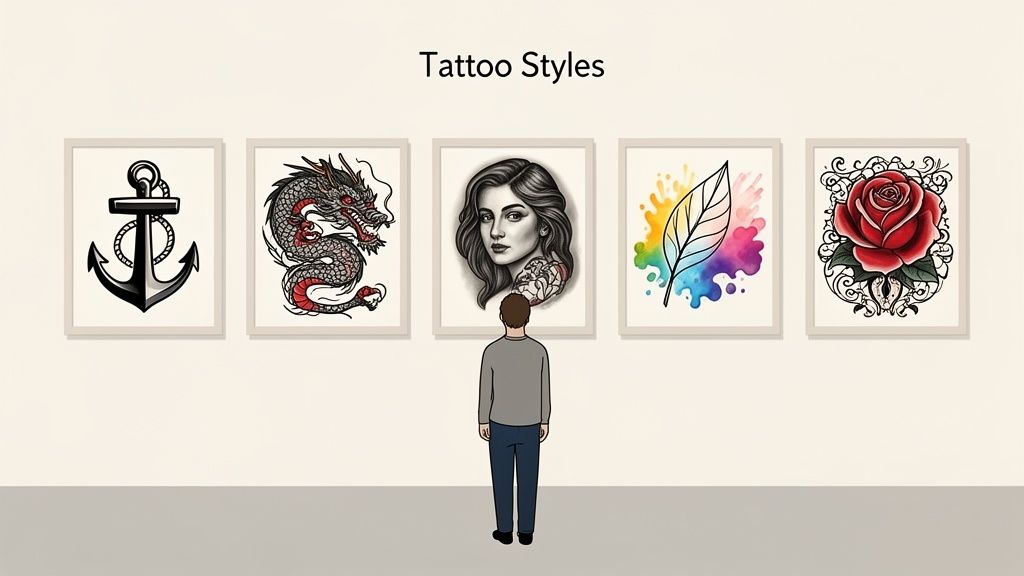
Think of a tattoo style as the fundamental blueprint for your body art. It’s the difference between a classic, ornate building and one with a sleek, modern design. Each uses different materials and construction methods to get a specific result. In the same way, every tattoo style is its own distinct artistic tradition.
A style isn't just a simple category; it's a whole set of guidelines a skilled artist uses to bring an idea to life. These rules dictate everything—the thickness of the lines, the way colors are packed or blended, and how shading is used to create depth. Grasping these differences helps you graduate from simply picking a picture to thinking like a true art collector.
Why Style Matters More Than Subject
So many people start their tattoo journey by choosing a subject—a wolf, a rose, a skull—without giving any thought to the style. But the very same subject can look radically different depending on the artistic language used to create it.
For instance, let’s take a simple rose:
- An American Traditional rose will have those classic bold black outlines and a limited palette of solid red and green. It's built to last.
- A Realism rose is all about soft, photorealistic shading and subtle color gradients to make it look as lifelike as possible.
- A Watercolor rose might not have any outlines at all, using fluid splashes of color to create a painterly, organic feel.
This is exactly why choosing your style first is so critical. It makes sure the final piece matches your personal vision and sets the foundation for a tattoo that not only looks incredible today but continues to tell your story for decades to come.
By understanding the language of different tattoo styles, you're not just getting a tattoo; you're commissioning a piece of art that speaks in a specific dialect. This knowledge is the key to a successful collaboration with your artist.
The growing appreciation for tattoo art is mirrored in the industry's massive growth. The global tattoo market is projected to skyrocket from $2.31 billion in 2025 to an incredible $9.25 billion by 2034. This boom reflects a huge cultural shift where tattoos are now seen as a legitimate and respected form of personal expression. You can read the full analysis on the tattoo market for a deeper dive, but this guide is your first real step to navigating this exciting world with confidence.
Timeless Foundations: American Traditional and Japanese Tattoos
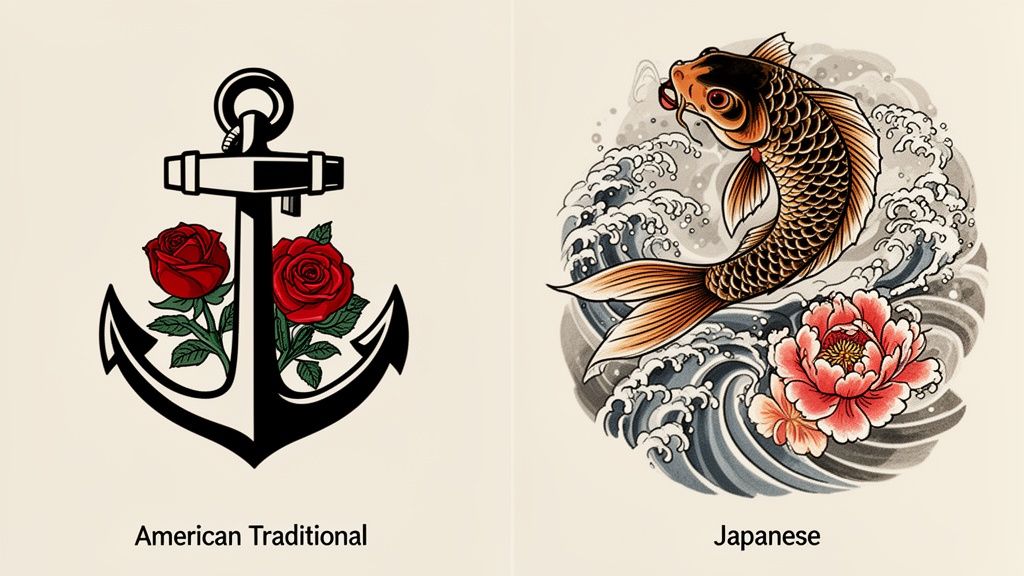
To really get a handle on tattoo styles, you have to start at the bedrock—the two traditions that have shaped almost everything we see in modern ink. American Traditional and Japanese tattooing are more than just popular aesthetics; they're the foundational pillars of the craft. Both come with rich histories, strict artistic rules, and a visual power that has stood the test of time.
These styles are built for the long haul. Both were designed with longevity in mind, ensuring the art looks just as good decades from now as it does fresh. While they grew from opposite sides of the world, they share a deep respect for powerful symbolism, bold application, and designs that flow with the human body. Understanding these two giants is the first step to appreciating the entire world of tattoo art.
American Traditional: The Bold Will Hold
You know American Traditional when you see it. It’s the absolute classic of Western tattooing, defined by its heavy black outlines, a deliberately simple color palette—mostly primary colors like red, green, and yellow—and straightforward shading. The whole philosophy can be summed up in three words: "Bold will hold."
This wasn't just an artistic choice; it was a practical one born from necessity. Pioneered by legends like Norman "Sailor Jerry" Collins in the early 20th century, these tattoos were made for the rugged lives of sailors and soldiers. The thick lines and fully packed color ensured the designs would stay crisp and clear, standing up to years of sun, sea, and the natural aging of skin.
The subject matter is iconic and packed with meaning:
- Anchors: A classic symbol of stability and a safe return home after a long journey at sea.
- Swallows: Traditionally tattooed after a sailor traveled 5,000 nautical miles, they represent experience and the promise of coming home.
- Eagles: A powerful emblem of American patriotism, strength, and honor.
- Roses and Daggers: These often represent the duality of life—beauty and pain, love and sacrifice.
Choosing an American Traditional piece is an investment in a tattoo that's guaranteed to age like fine wine. For a deeper dive into its history, check out our guide to the Traditional American Tattoo style.
The magic of American Traditional is in its powerful simplicity. Each design is boiled down to its essential elements, creating an image that’s instantly readable and built to be a permanent part of you for life.
Japanese Tattoos: Stories in Ink
Meanwhile, across the ocean, Japanese tattooing—known as Irezumi or horimono—was developing from a completely different cultural heritage, drawing on centuries of art and folklore. With deep roots in the imagery of traditional ukiyo-e woodblock prints, this style is famous for its large-scale, story-driven compositions that often cover entire limbs, backs, or even the full body.
Unlike the standalone flash designs of American Traditional, Japanese tattoos are meant to be a single, flowing masterpiece. They are defined by their incredible dynamism, using backgrounds of wind bars, water, and clouds to tie the main subjects together and fit the unique contours of the body. The artwork tells a complete story.
The symbolism in Irezumi is incredibly deep, with every element carrying specific meanings:
- Dragons (Ryu): Represent wisdom, strength, and their power to do good for mankind.
- Koi Fish: A symbol of perseverance and courage, famously depicted swimming upstream to become a dragon.
- Tigers (Tora): Embody strength and courage, serving as protectors against evil spirits and bad luck.
- Peonies (Botan): Known as the "King of Flowers," they symbolize wealth, elegance, and good fortune.
A true Japanese tattoo is a serious commitment, often demanding dozens or even hundreds of hours to finish. It’s a testament to the wearer’s patience and the artist’s mastery of a tradition passed down for generations.
The timeless appeal of these foundational styles has helped fuel the tattoo industry's massive growth. In the U.S. alone, professional tattoo artists generated around $1.3 billion in revenue through 2025, with an estimated 23,774 tattoo businesses in operation. This boom reflects a broader cultural embrace, with more people than ever seeking out meaningful, well-crafted body art that lasts a lifetime.
Modern Precision: Black and Grey Realism and Fine Line Styles
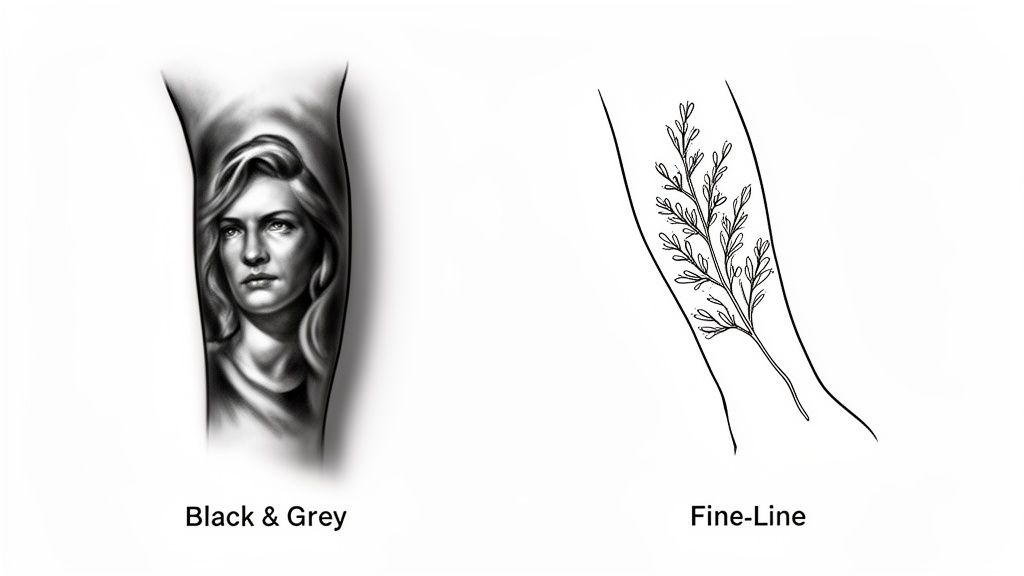
Leaving behind the bold, saturated rules of traditional styles, we step into a world built on subtlety, precision, and breathtaking technical skill. Modern tattooing has empowered artists to create work with a level of detail that was once unimaginable. Styles like Black and Grey, Realism, and Fine-Line represent the absolute peak of an artist’s control over their tools and their craft.
These aren't just about artistic vision; they demand a profound understanding of how ink settles into living skin. The effects are achieved through meticulous shading, layering, and linework. Here, the artist's ability to manipulate contrast and texture is everything, proving you don’t always need a riot of color to make a powerful, lasting statement.
Black and Grey: The Art of Shade and Contrast
Black and Grey tattooing is a masterclass in creating depth using only black ink and its various diluted tones. It originally grew from the ingenuity of prison tattoo culture in the mid-20th century, where artists had to make do with what they had. That resourcefulness has since evolved into one of the most sophisticated and beloved forms of modern body art.
Artists use a technique called "wash shading," mixing black ink with distilled water to create a full spectrum of grey tones. This allows them to build up buttery-smooth gradients and soft textures that give the tattoo an almost three-dimensional feel. Instead of relying on hard outlines, the forms are defined by the delicate transitions between light and shadow, making it an incredibly versatile style for everything from powerful portraits to intricate floral work.
There's a timeless, almost cinematic quality to Black and Grey. It has a classic feel that forces the viewer's focus onto the subject’s form, emotion, and texture, completely unburdened by color.
Realism and Hyperrealism: Capturing Life in Ink
Realism takes the principles of Black and Grey a giant leap forward, aiming to replicate an image on skin with the clarity of a photograph. This style demands an elite tier of technical skill. The artist must flawlessly recreate every minute detail, from the glint of light in an eye to the paper-thin texture of a flower petal.
Hyperrealism pushes this idea to its absolute limit, often resulting in tattoos that appear even sharper or more vivid than their source photo. An artist specializing in this style must have a complete command of:
- Light and Shadow: Knowing precisely how light falls across an object is what creates believable depth and volume.
- Texture: The ability to render different surfaces—skin, fur, metal, or water—is what sells the illusion and makes the tattoo truly believable.
- Color Theory: For color realism, artists must expertly blend dozens of shades to achieve the seamless, natural-looking gradients that mimic life.
This obsession with detail means realism tattoos often require longer sessions and careful planning. For anyone looking for the highest standard of detail, our guide to finding the best black and grey realism tattoo artists offers key insights into what defines a true specialist.
The real challenge of Realism isn't just to copy an image, but to translate it onto a living, breathing canvas. A truly great realism tattoo captures the spirit and emotion of the subject, making it feel alive on the skin.
The rise of these hyper-detailed styles has been fueled by huge leaps in tattooing technology. The tattoo ink market alone, valued between $107-258.75 million in 2024, is projected to grow to as much as $392.9 million by 2032. This growth is driven by manufacturers creating specialized ink formulas that make the vibrant colors and subtle grey washes essential for realistic work possible.
Fine Line: Delicate and Intricate Designs
On the other end of the modern precision spectrum lies the Fine-Line style. Defined by its use of single needles or very small needle groupings, this approach produces thin, delicate, and often incredibly intricate linework. It has become a go-to for those seeking a more subtle and understated form of body art.
Fine-Line tattoos are perfect for detailed illustrations, script, tiny symbols, and minimalist designs. The entire focus is on clean, crisp lines rather than heavy shading or bold color. Many people choose this style for its elegant and refined aesthetic, which works beautifully in discreet spots like the wrist, ankle, or behind the ear.
But be warned: the delicate nature of fine lines means that your choice of artist is absolutely critical. An unsteady or inexperienced hand can result in shaky lines, ink "blowouts" under the skin, or a design that fades unevenly. When done perfectly, however, a fine-line tattoo is a stunning piece of minimalist art that proves less can truly be more.
Expressive Ink: Neo-Traditional and Watercolor Tattoos
While some tattoo styles are built on centuries of rigid rules, others find their magic by blending the old with the new—or by throwing the rulebook out entirely. Neo-Traditional and Watercolor tattoos live on this exciting frontier, where artists mix timeless fundamentals with modern freedom to create something truly expressive.
These styles show just how far tattooing can evolve. One builds on a classic framework by adding incredible detail and color, while the other completely mimics a different art form. Both push the boundaries of what ink on skin can achieve, making them a perfect fit for anyone who wants their art to feel both contemporary and deeply personal.
Neo-Traditional: The Evolution of a Classic
Think of Neo-Traditional as the vibrant, worldly grandchild of American Traditional. It takes the core elements that make its ancestor so bulletproof—bold, clean outlines and a clear silhouette—and pumps them full of detail, color, and depth that feel completely modern. It’s a style that respects its roots while confidently forging its own path.
Where American Traditional stuck to a limited color palette, Neo-Traditional explodes with a full spectrum of hues, complete with rich blending and sophisticated shading. This unlocks a much more dimensional and illustrative feel. You'll often see nods to other art movements, like the flowing, organic lines of Art Nouveau or the decorative flair of Art Deco, which add a layer of elegance and complexity to the work.
This style is perfect for subjects that need both clarity and detail to really shine:
- Animals: Especially expressive portraits of creatures like foxes, owls, and cats.
- Ornate Objects: Things like jeweled daggers, lanterns, and intricate keys come to life with rich detail.
- Figurative Work: Portraits of women and mythological figures are common, often wrapped in floral or decorative elements.
Essentially, Neo-Traditional keeps the solid bones of an old-school tattoo but dresses it up with a more refined and illustrative aesthetic.
Watercolor Tattoos: Painting on Skin
Breaking away from traditional linework almost completely, the Watercolor style aims to capture the fluid, translucent, and often unpredictable nature of watercolor painting. These tattoos are all about soft edges, vibrant color splashes, and delicate gradients that seem to bleed into one another, creating a beautiful, organic effect.
This style intentionally dodges the heavy black outlines that anchor most other tattoos. While some artists use minimal or fine-line contours to give the piece a little structure, many let the colors themselves form the shape. The result is a tattoo that feels light, airy, and painterly, almost as if an artist took a brush directly to your skin.
The beauty of a Watercolor tattoo is in its free-flowing, spontaneous look. It’s less about rigid definition and more about capturing a feeling or an impression through color and movement, which makes every piece feel one-of-a-kind.
But the lack of strong outlines has sparked plenty of debate about how these tattoos age. This is why it’s absolutely critical to find an artist who is a true specialist in this style. A skilled watercolor artist knows exactly how to place darker tones and subtle lines to make sure the design holds its shape and vibrancy for years to come. It’s an incredible choice for abstract designs, floral pieces, or any subject where you want a dreamy, ethereal quality.
How to Choose the Right Tattoo Style for You
Alright, you’ve seen the incredible range of tattoo styles out there. Moving from a head full of inspiration to actually picking a direction can feel like the toughest step. This is where the rubber meets the road—where you take all those cool ideas and turn them into a real plan.
Choosing a style isn’t just about what looks good on Instagram. It’s about finding a visual language that fits your personality, your body, and the story you’re trying to tell. Think of it like picking the material for a sculpture. A marble statue sends a completely different message than one forged from steel, even if they show the same thing. Your body is the gallery, and the style you choose sets the entire mood.
Consider Your Personal Aesthetic and The Story
First things first, take a minute to look inward. What kind of art do you already love? Are you drawn to the bold, classic confidence of old-school designs, or do you lean toward something more subtle and modern? Your tattoo should feel like a genuine part of you, not something you’re just trying on.
Take a look at your clothes, the prints on your wall, even the movies you watch. This quick personal audit can give you some serious clues. The goal isn't to chase a trend, but to find a style that truly clicks with who you are.
This is how new, expressive styles are born—by combining different influences. The visual below shows how foundational art, like Traditional, can evolve and blend with other concepts. Your personal taste works the same way, mixing and matching until you land on the perfect fit.
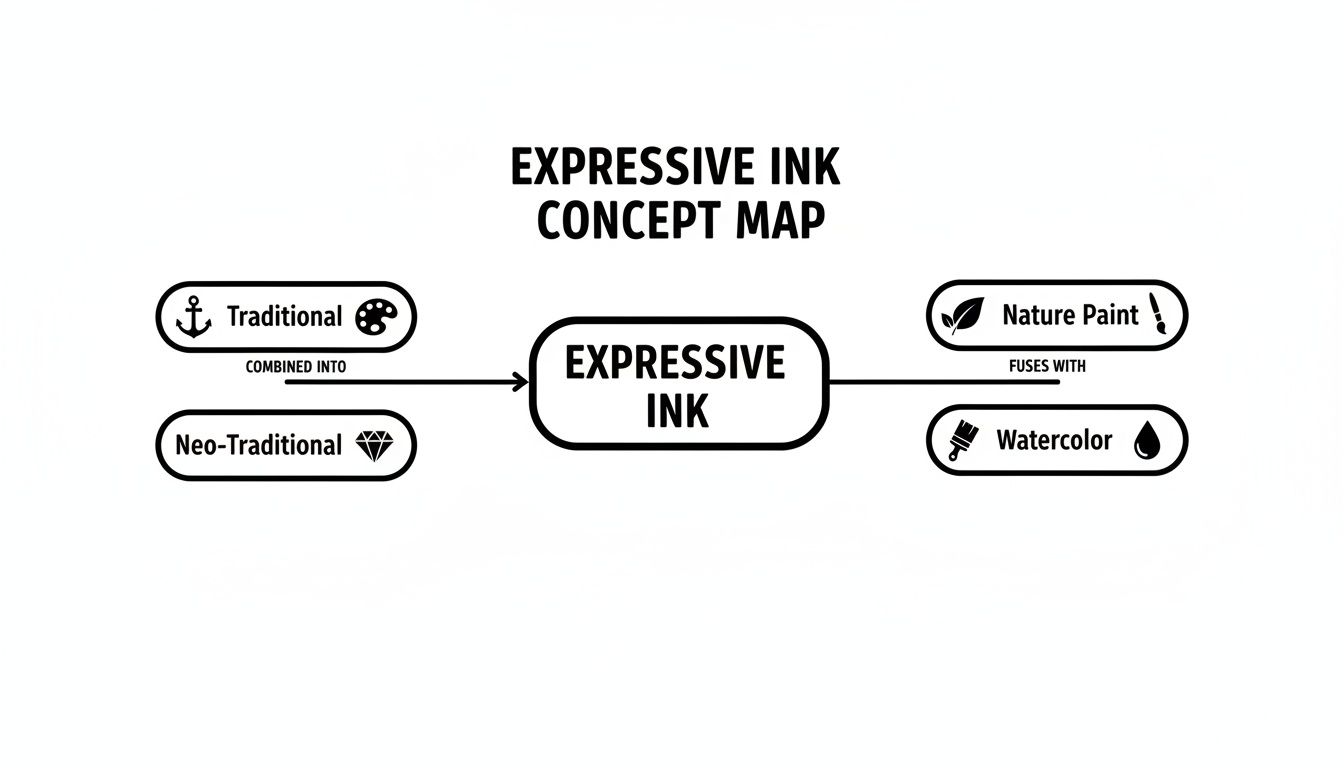
This map illustrates how a classic style like Traditional evolves into Neo-Traditional by adding new artistic flavors, much like how nature can inspire painterly Watercolor tattoos. It’s all about a creative fusion.
Evaluate Placement and Body Flow
Where you put the tattoo is just as crucial as the design itself. Certain styles are simply made for specific parts of the body. A massive Japanese backpiece, for instance, needs that huge, open canvas to create its signature flow and dramatic impact. On the flip side, a tiny Fine-Line script is perfect for a more intimate spot like the inner wrist or behind the ear.
You have to think about how the design will move with the natural curves and lines of your body.
- For Curvy Areas: Styles that have a natural sense of movement, like Japanese or illustrative Neo-Traditional, are fantastic for wrapping around an arm or leg. They also work beautifully with the muscles of the back and torso.
- For Flat Areas: Super-detailed work like Realism or intricate Black & Grey often looks best on flatter planes like a forearm or thigh, where the image won’t get distorted by too much movement.
Your body is not a flat sheet of paper. A great tattoo works in harmony with your anatomy, enhancing its natural lines rather than fighting against them. Discussing placement with your artist is a critical step in the design process.
Longevity and Lifestyle Factors
Finally, let’s talk about the long game. How a tattoo ages is directly tied to its style. There's a reason artists say, "Bold will hold." American Traditional tattoos, with their heavy black outlines and solid color, are famous for looking sharp for decades.
On the other hand, styles without strong outlines—like Watercolor or some hyper-delicate Micro-Realism—might need more diligent aftercare and eventual touch-ups to keep them looking crisp.
Your lifestyle matters, too. If you're constantly out in the sun, a tattoo with bold lines and saturated color will stand up to UV exposure much better than one with soft, subtle shading. Be real with yourself about the level of maintenance you’re willing to put in. Matching your tattoo style to both your aesthetic and your real life is the secret to loving your ink for a lifetime.
To help you sort through these options, we've put together a quick-reference table. It breaks down the most popular styles by their core features so you can see how they stack up side-by-side.
Tattoo Style Comparison Guide
| Style | Key Characteristics | Best For | Longevity & Aging | Typical Pain Level |
|---|---|---|---|---|
| American Traditional | Bold black outlines, limited color palette, iconic imagery | Timeless designs, high-contrast pieces, any placement | Excellent; lines stay crisp for decades | Moderate |
| Japanese (Irezumi) | Large-scale, flowing designs with cultural symbolism | Back pieces, sleeves, body suits that tell a story | Very good; designed to age gracefully with the body | Moderate to High |
| Black & Grey | Uses shades of black ink to create depth and dimension | Realism, portraits, soft and detailed imagery | Good; contrast can soften over time | Moderate |
| Fine-Line | Delicate, thin lines; often single-needle work | Minimalist designs, script, small and intricate pieces | Fair; lines can spread or fade without proper care | Low to Moderate |
| Realism | Photorealistic detail, complex shading, and color | Portraits, nature scenes, replicating photos on skin | Good, but details may soften; requires skilled artist | High |
| Neo-Traditional | Traditional rules with expanded colors and subjects | Illustrative, detailed pieces with the boldness of traditional | Very good; combines bold lines with modern detail | Moderate |
| Watercolor | Mimics paintbrush strokes, splatters, and soft blends | Abstract, vibrant, and artistic pieces; less focus on outlines | Fair to Poor; fades faster without black outlines | Low to Moderate |
| Tribal | Bold, black, interlocking patterns with cultural roots | Symmetrical designs that flow with the body's musculature | Excellent; solid black holds up extremely well | High |
This guide is a great starting point, but the best conversations happen in the studio. Use it to narrow down your preferences, and then bring your ideas to an artist who can help you make the final call.
Finding an Artist Who Masters Your Chosen Style
You’ve got a style in mind, a subject you love, and the perfect spot picked out. Now comes the single most important decision in your entire tattoo journey: choosing the right artist. A great tattoo is a collaboration, and finding an artist who is a true specialist in your chosen style is absolutely non-negotiable.
Think of it this way: you wouldn’t ask a master sculptor to paint a delicate watercolor. While both are incredible artists, their tools, techniques, and entire training are worlds apart. The exact same principle applies to tattooers. A jack-of-all-trades might give you a decent tattoo, but only a dedicated specialist can deliver an exceptional one.
Researching an Artist and Their Portfolio
Your first move should be a deep dive into an artist's portfolio, which you'll usually find on their Instagram or a shop website. Don't just glance and look for one or two tattoos you like; you're looking for consistency across their entire body of work. A true expert’s portfolio will be packed with dozens of examples in the same style, all executed at an incredibly high level.
When you're reviewing their work, here’s what to zero in on:
- Clean Application: Are the lines crisp, confident, and solid? Is the color fully saturated without looking chewed up or overworked?
- Smooth Shading: Do the gradients transition seamlessly? In black and grey work, the shading should look buttery and smooth, never patchy.
- Design Cohesion: Do their designs just flow well? Do they feel balanced and thoughtfully composed? This shows a real understanding of artistry, not just tracing.
The goal is to find an artist whose worst tattoo is still better than what you’d be happy settling for. Consistency is the hallmark of a true professional who has truly mastered their craft.
The Importance of a Consultation
Once you’ve found an artist whose work gets you excited, the next step is booking a consultation. This is your chance to talk through your ideas, see how they interpret your vision, and make sure you connect on a personal level. A good vibe is crucial.
This is also where an expert artist provides priceless feedback. They might suggest tweaks that will make the tattoo look better on your body and age more gracefully over the decades. They know the rules of the style you're looking for, inside and out.
Ultimately, choosing an artist is an investment in permanent art on your body. By prioritizing a specialist whose work truly speaks to you, you ensure the final piece will be something you are proud of forever. For more guidance on this crucial step, you can learn more about how to choose a tattoo artist in our detailed guide.
Your Top Questions About Tattoo Styles
Stepping into the world of tattoos always brings up a few important questions. It's totally normal. Getting the right answers is the key to feeling confident and making sure the piece you end up with is one you'll love forever.
Can I Mix and Match Different Tattoo Styles?
Yes, but this is where the skill of your artist becomes absolutely critical. Some styles are practically cousins—Neo-Traditional, for example, is literally a blend of old and new school techniques. That kind of fusion feels natural.
But trying to smash two completely different aesthetics together, like the rigid structure of Japanese Irezumi and the soft blending of Photorealism, is a massive artistic challenge. To pull it off, the artist has to be fluent in both visual languages to create something that feels intentional and whole, not like a messy collage. This is a huge point to bring up during your consultation.
Which Tattoo Style Will Last the Longest?
Styles that are built to last have one thing in common: a strong, solid foundation of black ink. Both American Traditional and Japanese tattoos are legendary for how well they age precisely because their bold outlines act as a powerful container, holding everything in place for decades.
On the flip side, styles that skip outlines or rely on super delicate lines, like many Watercolor pieces, are just more vulnerable to the effects of time and sun. They might need a touch-up every few years to keep them looking sharp and vibrant.
There's an old saying in this business that's as true today as it was 50 years ago: “Bold will hold.” A tattoo designed with a solid structure is a tattoo that’s built for life.
How Does My Skin Tone Affect How a Style Looks?
Your skin tone is the canvas, and it plays a huge role in the final outcome. It’s not a limitation, just a factor a good artist always works with.
Bold, high-contrast styles like Tribal, American Traditional, and classic Black and Grey have a powerful, timeless look that works beautifully on literally every skin tone.
For styles that use more subtle color palettes or fine lines, a true professional will know exactly how to adjust the design, the color saturation, and the ink selection to make sure your tattoo has maximum clarity and impact. An experienced artist doesn't fight your skin; they create art that works in harmony with it.
Ready to turn your vision into a timeless piece of art? The artists at Fountainhead New York specialize in a range of styles and are dedicated to world-class custom work. Book your consultation today.


em8bx2