

When you see a mind-blowing black and grey tattoo, you're looking at an artist who has mastered the art of turning skin into a living photograph using only black ink and its diluted shades. This isn't just about technical skill; it's about sculpting with light and shadow to create something with breathtaking depth and real emotion. It's no wonder this style is the go-to for deeply meaningful portraits and memorials.
What Defines Black and Grey Realism Tattoo Art
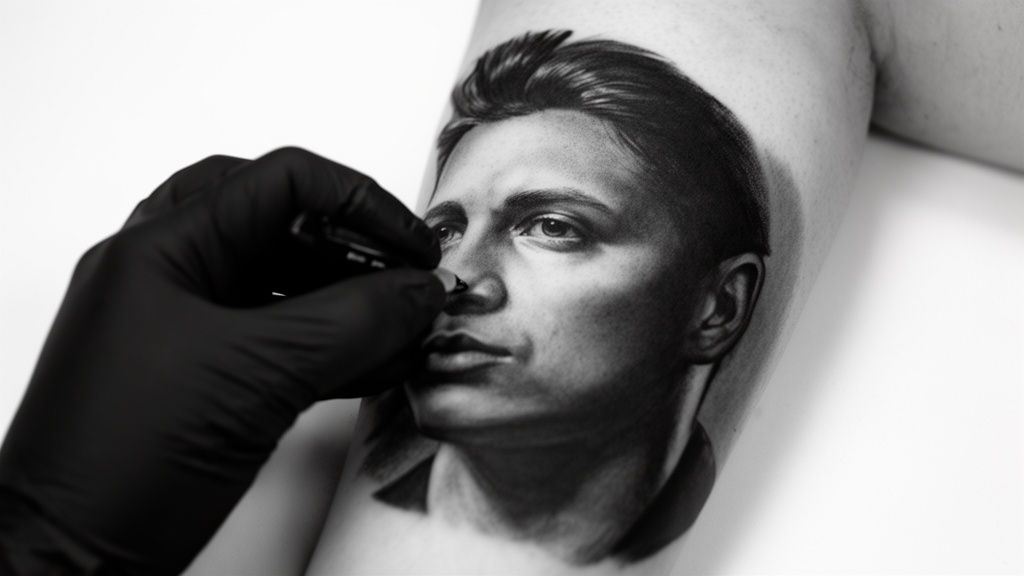
Before you can pick the right artist, you need to know what you’re actually looking for. Black and grey realism is so much more than just tracing a photo. It’s about taking a three-dimensional world and translating it onto the living, breathing canvas of skin with an incredibly limited palette.
The entire art form hinges on how well an artist handles contrast and gradients. By mixing pure black ink with distilled water (and sometimes a touch of white ink), the artist creates a full spectrum of grey tones. This technique, known as a grey wash, is the secret sauce. It’s what lets them render soft, smooth skin, create the illusion of light bouncing off metal, and capture the subtle details that make a piece feel alive.
The Core Pillars of the Style
An elite black and grey realism artist has to be a master of a few key techniques. These are the non-negotiables that separate a decent tattoo from a true piece of fine art that will stop people in their tracks.
- Smooth Gradients: This is everything. The transition from the deepest black to the softest grey—and right into the natural skin tone—has to be absolutely seamless. When done right, it looks almost airbrushed. This is how you get realistic textures that make you want to reach out and touch them.
- Saturated Blacks: The darkest parts of the tattoo need to be packed in solid. These bold, saturated black areas anchor the entire piece, creating the powerful contrast that makes all the lighter shades pop. Without it, the tattoo will look washed out and won't hold up over the years.
- Precise Linework: Realism might look like it has no outlines, but don’t be fooled. Sharp, precise linework is still crucial for defining key edges and locking in the tiniest details. Think about the glint in an eye or the individual hairs in a beard—that’s all thanks to killer linework providing a solid foundation for the shading.
The goal isn't just to copy a photo; it's to capture its soul. A great realism artist knows how to interpret light and texture to pull out the emotion and tell a story, making the final tattoo feel even more real than the reference picture.
This absolute dedication to technical perfection is why people choose this style for subjects that matter most. When someone wants a portrait of a family member or a tribute to a powerful memory, they’re searching for an emotional truth that only this level of artistry can deliver. The artist isn't just a technician; they're a storyteller with a tattoo machine.
The Gritty History of Black and Grey Realism
To really get why today’s best black and grey artists are so skilled, you have to look at where the style came from. Its story doesn't start in a fancy art school or a high-end gallery. It begins in the most unlikely of places: the American prison system.
The style’s roots are planted firmly in the Chicano culture of 1970s East Los Angeles. Behind bars, artists had almost nothing to work with. They didn’t have colored inks, and they had to build their own single-needle machines from whatever they could find—often cassette motors and guitar strings. Out of sheer necessity, they created a whole new look using only contraband black India ink, thinned with water to create different shades of grey. This was the raw beginning of a global movement. You can dive deeper into these origins and the style's evolution over at TimmyGrounds.com.
From Prison Yards to Mainstream Studios
The techniques these artists developed under pressure were surprisingly sophisticated. With the most basic tools, they figured out how to create soft, smooth gradients and achieve incredible depth. This raw, emotional style—often called "joint style" or "single needle"—was perfect for the religious icons and family portraits they were tattooing.
When these artists got out, they brought their skills with them. Pioneers like Freddy Negrete, who learned his craft while incarcerated, were key in moving the style from the underground into professional tattoo shops. They traded their makeshift gear for modern machines but held onto the core principles of meticulous shading and fine detail, showing the rest of the world what was possible with just black and grey.
This history is what gives the style its soul. It’s a testament to resilience, proving that incredible art can come from the toughest situations. The authenticity you feel in a powerful black and grey portrait today is a direct descendant of that ingenuity.
The Digital Age and Global Recognition
As tattooing blew up in the 1980s and 90s, black and grey realism kept evolving. Artists pushed the limits, refining their techniques to get smoother gradients and sharper details, making the work look more and more like a photograph. But the real game-changer was social media.
Platforms like Instagram turned into a worldwide art gallery, letting artists show their work to millions. Suddenly, a client in New York could find their dream artist in Los Angeles or even Europe. This created a massive shift in the industry:
- Standards Skyrocketed: Artists could now see the best work from all over the globe, which lit a fire under everyone to get better and push their craft.
- Demand Exploded: Clients saw what was possible and started seeking out artists who could deliver that stunning, photographic quality.
- Superstars Were Born: The absolute best black and grey realism tattoo artists became famous, attracting clients willing to travel across continents and wait years for an appointment.
What started as an art form born from hardship has become one of the most respected and sought-after styles in the world. It’s a powerful reminder that creativity can’t be locked down, turning limitations into a legacy that’s as timeless as it is tough.
How to Critically Evaluate an Artist's Portfolio
Scrolling through an artist’s Instagram is one thing, but knowing what you’re really looking at is another. It’s easy to get mesmerized by cool designs, but to find a truly elite black and grey realism tattoo artist, you need to look past the subject matter and start seeing the work with a trained eye. You have to learn how to judge the technical skill behind the image.
Think of it like buying a classic car. You don't just fall for the slick paint job. You pop the hood, listen to the engine, and inspect the body for any imperfections. Every single part has to be flawless. A tattoo portfolio demands that same level of scrutiny.
Look for Buttery Smooth Gradients
The number one sign of an expert realism artist is the quality of their shading. The transitions from the deepest blacks through the mid-tones and into the lightest greys should be absolutely seamless. You're looking for blends so soft and gradual that you can't tell where one shade ends and the next begins.
There should be zero patchiness, no "peppery" spots where the ink looks speckled, and no hard lines between different shades. It should look like an airbrush painting, creating that perfect illusion of depth and texture, whether it's the softness of skin or the curve of a bone. If the shading looks blotchy, it’s a massive red flag that the artist lacks fundamental machine control.
Assess the Saturation and Contrast
Great black and grey realism has a dynamic punch that makes it leap off the skin. That power comes from strong contrast, and strong contrast is built on one thing: fully saturated blacks. The darkest parts of the design must be a deep, solid, rich black.
- Saturated Blacks: Scan the darkest areas. Are they completely filled in? Or do you see "holidays" (tiny missed spots) or areas that look weak and greyish? These blacks are the anchor for the whole tattoo.
- High Contrast: The magic happens in the play between those solid blacks, the full range of greys, and the smart use of negative space—the client’s own skin tone. This is what gives the tattoo dimension and makes it readable from across the room.
A tattoo that lacks solid black will look flat and washed out, almost like a pencil sketch left in the sun. Even worse, weakly applied blacks heal poorly, turning into a muddy grey that kills all the definition over time.
Scrutinize the Linework and Details
Realism is known for soft shading, but don't let that fool you into thinking lines don't matter. They absolutely do. While it might not be the bold outlining of a traditional piece, crisp, precise linework is crucial for defining features and locking in the tiny details that make a tattoo come alive.
Zoom in on things like eyelashes, individual strands of hair, the glint of light in an eye, or the hard edge of a piece of armor. Are the lines clean and confident? Or do they look shaky, fuzzy, or blown out? This is where good artists are separated from great ones.
The infographic below shows just how far this style has come, evolving from raw prison art to a globally respected, highly technical discipline.
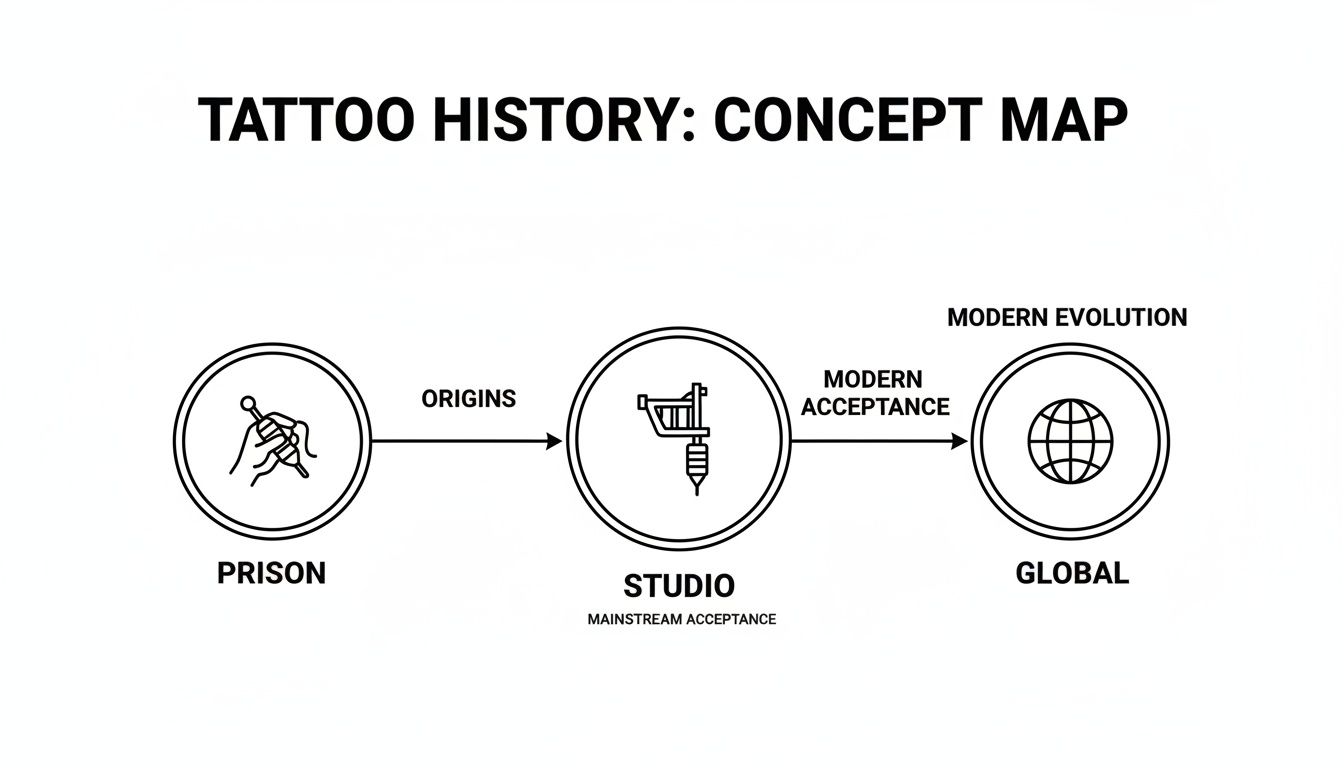
This journey from gritty origins to world-class studios is why the technical standards are so high today, making a critical portfolio review more important than ever.
To help you put all this into practice, here's a simple checklist you can use when you're looking through portfolios. It breaks down exactly what to focus on and what to avoid.
Portfolio Review Checklist for Realism Tattoos
| Technical Hallmark | What to Look For (Excellent) | Red Flag to Watch For |
|---|---|---|
| Smooth Gradients | Seamless, "airbrushed" transitions. No visible lines between shades. Consistent tone. | Blotchy, patchy, or "peppery" shading. Abrupt shifts in tone. |
| Black Saturation | Deep, solid, rich blacks with no gaps or weak spots. | Blacks that look grey, faded, or inconsistent. "Holidays" (missed spots). |
| Contrast & Depth | Strong visual pop. A full range from black to light grey, plus skin tone. | The tattoo looks flat, "muddy," or washed out. Lacks a true black. |
| Fine Linework | Crisp, clean, and confident lines for details like hair, eyelashes, or textures. | Shaky, blown-out, or inconsistent lines. Details look blurry. |
| Healed Photos | Artist proudly shows healed work. Blacks are still black, details are sharp, blends are smooth. | Portfolio only has fresh, glossy photos. No evidence of how the work holds up. |
Use this as your guide, and you'll start to see portfolios in a whole new light, recognizing true skill beyond just a cool picture.
The Ultimate Test: Healed Photos
If you only remember one thing, make it this: look for healed photos. This is the single most important part of evaluating an artist. Anybody can make a fresh tattoo look decent. The skin is red and irritated, which temporarily amps up the contrast, and fresh ink always appears darker and crisper than it will settle.
The true test of skill is how that tattoo looks months or even years down the road.
A skilled, confident artist will be proud to show off their healed work. In those photos, you should still see everything we've talked about:
- Lasting Contrast: The blacks have stayed black, not faded into a dull grey.
- Smooth Blends: The gradients have settled in and remain perfectly soft.
- Crisp Details: The fine lines and textures haven't blurred out; they're still clear and easy to read.
If an artist’s portfolio is nothing but fresh, slick, and shiny photos, be wary. It could be a sign that their work doesn't stand the test of time. Healed work is the ultimate proof of technical skill—it shows the artist knows how to put the ink in properly to make it last a lifetime. For a deeper dive into vetting artists, you can learn more about how to choose a tattoo artist in our comprehensive guide.
Essential Questions to Ask During Your Consultation
Alright, you've spent hours scrolling through Instagram, you’ve compared portfolios, and you've finally found a black and grey realism tattoo artist whose work speaks to you. The next step—the consultation—is where the real magic happens. This isn't just about getting a price quote; it's the final gut check. Think of it as a two-way interview where you make sure the artist’s vision, process, and personality are the right fit for a piece of art you'll wear for life.
The questions you ask will tell you everything you need to know. Moving beyond "how much?" shows the artist you’re serious and have done your homework. A true professional will welcome detailed questions and have confident, clear answers ready. This is your moment to build the trust that great tattoos are made of.
Questions About Their Creative Process
You need to understand how an artist thinks just as much as how they tattoo. The way they approach a design reveals their entire artistic philosophy. It's the difference between an artist who just traces a photo and one who creates a masterpiece that actually fits your body.
Here are a few questions to get that conversation rolling:
- "How do you approach designing a piece to flow with the body?" The answer you're looking for has nothing to do with a flat sticker. A great artist will talk about mapping the design to your muscle structure, thinking about how it will look when you move, and making sure the composition is balanced from every angle.
- "Can you walk me through how you’d turn my idea into a final design?" A skilled artist isn’t a human photocopier. They should explain their method for combining different reference photos, creating a unique composition, and using light and shadow to bring the story to life.
- "What kind of creative freedom do you prefer with a project like this?" This is all about setting expectations. Some artists are at their best when given total creative control, while others excel at bringing a client's specific vision to life with their own signature style.
The goal is always to create the best possible version of your idea, built specifically for your body. Their answers should feel collaborative, with your vision as the foundation and their expertise as the blueprint.
Questions About Technical Skill and Longevity
Now we get into the nitty-gritty. These questions are about the technical details that ensure your tattoo looks phenomenal for decades, not just for the first photo. This is where you separate the good artists from the true masters by asking about how their work ages.
Focus on the long game with questions like these:
- "Can you show me healed photos of tattoos with textures similar to what I want?" We've said it before, but it bears repeating: healed work is the only proof that matters. If you want a portrait with soft skin or an animal with realistic fur, seeing healed examples of those specific textures is the best way to verify their skill will hold up.
- "How do you make sure your deep blacks stay black and don’t turn muddy over time?" A knowledgeable artist won’t hesitate. They’ll talk about their ink choices, their preferred needle groupings, and their packing technique. They should be able to confidently explain how they saturate the skin just right to guarantee that black stays bold and rich.
- "What are your thoughts on using white ink for highlights?" This is a hot-button issue in the black and grey community, and there's no single right answer. Their response will reveal a lot about their technical philosophy and their understanding of how white ink heals and ages—which can be unpredictable. An honest artist will lay out both the pros and the cons.
By asking these kinds of strategic questions, you shift the consultation from a simple transaction to a genuine collaboration. It’s how you build the confidence and mutual respect needed for an amazing experience and an even better tattoo.
Understanding Pricing and Session Expectations
Getting a high-end black and grey realism tattoo isn't like buying something off a shelf; it's more like commissioning a piece of fine art. The price reflects more than just the hours you spend in the chair—it's an investment in the years of dedication, sacrifice, and mastery the artist has poured into their craft. Knowing what to expect with costs and sessions is key to a smooth, confident experience from start to finish.
There’s no simple price tag for this kind of work. The final cost is a blend of a few key factors. An artist's experience and demand play a huge role; renowned black and grey realism tattoo artists with long waitlists will naturally command higher rates than an emerging talent. Of course, the size and complexity of your design are also major considerations. A palm-sized portrait is a world away from a full back piece loaded with intricate textures and hyper-realistic details.
Hourly Rates Versus Day Rates
When you get a quote, your artist will likely frame it in one of two ways: an hourly rate or a day rate. Most artists have a preferred method depending on the project’s scale, and it’s good to understand the logic behind each.
- Hourly Rates: This is the go-to for smaller or medium-sized pieces that can be knocked out in a single sitting. Depending on the artist, you can expect rates anywhere from $200 to $500+ per hour.
- Day Rates: Reserved for the big stuff—sleeves, back pieces, or chest panels that require multiple full-day commitments. This approach is more economical for extensive work and lets the artist get into a solid workflow without constantly watching the clock. A day rate can range from $1,500 to $3,500+ for a 6-8 hour session.
Remember, these rates aren't just for the time the needle is running. They cover the hours of research and design, stencil prep, premium supplies, and the overhead of maintaining a professional, sterile studio. It’s a complete investment in quality, safety, and artistry.
Preparing for a Long Session
Realism tattoos are a marathon, not a sprint. A full-day session is physically and mentally demanding for both you and your artist. Showing up prepared isn't just a good idea—it's a sign of respect for the artist's time and an act of kindness to your own body.
When you come prepared, you ensure the artist can work efficiently and that you can sit as comfortably as possible. This teamwork ultimately leads to a better tattoo.
Here’s how to set yourself up for success:
- Get a Good Night's Sleep: Walk in well-rested. Being exhausted magnifies pain and makes it a struggle to stay still.
- Eat a Substantial Meal: About an hour before your appointment, eat a solid, carb-heavy meal. This keeps your blood sugar stable and helps your body handle the stress of being tattooed.
- Hydrate Well: Drink plenty of water the day before and the day of your session. Healthy, hydrated skin accepts ink much more readily.
- Bring Essentials: Pack snacks, a sugary drink (like juice or soda), headphones, and a phone charger. And don’t ever be afraid to ask for a break when you need one.
By getting these expectations straight from the beginning, you turn what could be a stressful process into an exciting collaboration. You’re not just getting a tattoo; you’re paving the way for a masterpiece you’ll cherish for the rest of your life.
Protecting Your Investment with Proper Aftercare
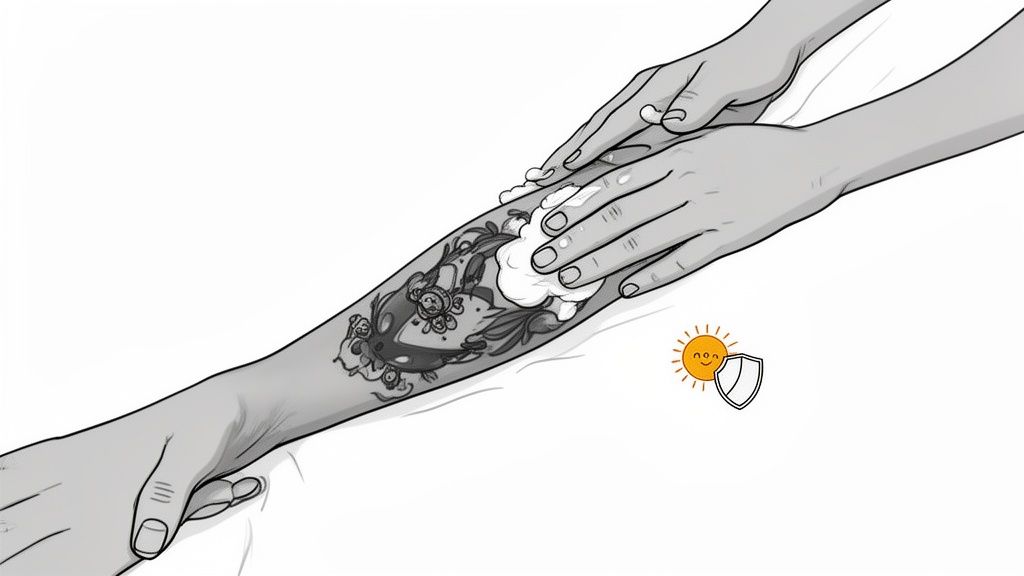
Once your session ends, the artist’s job is done—but yours is just getting started. A black and grey realism tattoo is a serious investment of time, money, and skin. Honestly, how you treat it for the next few weeks is the single most important factor in making sure it heals perfectly and stays sharp for years.
Think of it this way: the healing process is the final, critical step in the tattoo’s creation. Neglecting aftercare is like commissioning a beautiful painting and then leaving it out in the rain. It undermines all the incredible work that just happened.
The First 48 Hours
This initial period sets the tone for everything that follows. Your artist will cover your new tattoo with a protective bandage, either a classic wrap or a clear, breathable film like Saniderm. Listen to their specific instructions—they know what works best for their technique.
- Traditional Wrap: Take this off after about 2-4 hours. Wash the tattoo gently with lukewarm water and a mild, unscented soap. When you're done, pat it dry with a clean paper towel. Never, ever rub it or use a bath towel, which can hold bacteria.
- Adhesive Film: This kind of bandage can usually stay on for 3-5 days. You'll likely see some fluid—a mix of plasma, ink, and blood—building up underneath. Don't worry, that's totally normal and part of the healing magic.
After that first wash, let the tattoo air-dry for 10-15 minutes before putting on a super thin layer of your artist's recommended ointment. Less is more here. Your skin absolutely needs to breathe.
The goal for these first two days is simple: keep it spotlessly clean to prevent infection and give your body the perfect environment to start healing.
Weeks One and Two: The Peeling Phase
As your tattoo moves into the next stage, it's going to start peeling and flaking, kind of like a sunburn. This is a good sign. It's just your body getting rid of the outermost layer of damaged skin.
This is critical: do not pick, scratch, or peel the flakes off. I can't stress this enough. Pulling them off can literally pull ink out of the new skin underneath, leaving you with patchy spots and ruining those perfect, smooth details. Just keep washing the area gently 2-3 times a day and apply a thin layer of unscented moisturizer to help with the itching and keep it hydrated.
For a more detailed daily guide through this crucial period, Fountainhead has put together a complete set of tattoo aftercare instructions that will walk you through everything.
Long-Term Protection
Your tattoo might look healed on the surface in about 2-4 weeks, but the deeper layers of skin can take a few months to fully settle. Long-term care is simple, but it's completely non-negotiable if you want to preserve your art.
The number one enemy of any tattoo—especially the delicate shades in black and grey realism—is the sun. UV rays are brutal; they break down the ink pigments, turning deep blacks into hazy, washed-out greys and blurring fine details into mush.
Make this a habit: Always apply a high-SPF sunscreen (30 or higher) to your healed tattoo whenever it's going to be in the sun. It's the best insurance policy you can have for keeping your masterpiece looking crisp and vibrant for a lifetime.
Ready for Your Masterpiece? Let's Talk.
You’ve seen what separates the good from the truly great. Now, you’re ready to see that level of craftsmanship in person. The artists at Fountainhead New York—from our residents like Matt Beckerich and Justin Morcillo to the incredible guest artists who join us—live and breathe the standards we've been talking about. Their work is proof of what this demanding art form can achieve.
Every artist here has their own approach, their own philosophy. But what they all share is an obsession with technical perfection and a genuine desire to collaborate on the design with you. We invite you to spend some time in their portfolios. You'll see for yourself the buttery-smooth gradients, the fully saturated blacks, and the obsessive detail that are the hallmarks of master-level black and grey realism.
How to Get Started
We keep the process of getting tattooed here simple and direct. The journey from your initial idea to the finished tattoo should feel as smooth and effortless as the shading in the final piece. A world-class tattoo should always start with a world-class experience.
The entire legacy of black and grey realism was built by legends who constantly raised the bar. Artists from Freddy Negrete to Robert Pho pushed the style to unbelievable heights, with Pho's work, in particular, being so lifelike it's often mistaken for photography. You can dive deeper into the masters who shaped black and grey realism on certifiedtattoo.com.
At Fountainhead, we feel a deep responsibility to honor that history. We do it by creating powerful, lasting tattoos that respect the tradition of the craft while telling your personal story. We're here to collaborate and turn your vision into a permanent work of art.
Taking that first step is easy. When you submit your idea, you're starting a conversation. That conversation leads to a consultation where we’ll match your vision with the perfect artist to bring it to life. For a full breakdown of what to expect, check out our guide on how to book a tattoo appointment.
Ready to begin? Visit Fountainhead New York online, submit your idea, and get connected with one of our resident or guest black and grey realism specialists. https://fountainheadny.com


