

To become a tattoo artist, your journey starts with a strong artistic foundation and a professional apprenticeship. This path demands you master the fundamentals of drawing, build resilience to harsh critique, and respect the craft’s deep-rooted traditions long before you ever pick up a tattoo machine.
The Reality of a Career in Tattooing
So, you want to be a tattoo artist? Before you start daydreaming about slinging ink, you need to understand that this career is built on a foundation much deeper than just being good at drawing. It's a demanding path that mashes together fine art, intense personal discipline, and the mindset of a small business owner. The artists you see thriving in high-end studios didn't just stumble into it; they spent years obsessing over every single detail of their craft.
This isn't about instant creative gratification. It's about relentless practice and a genuine respect for the tradition—spending thousands of hours with a pencil in your hand to earn the right to hold a needle.
Building Your Non-Negotiable Artistic Foundation
Your journey doesn’t begin in a tattoo studio. It starts with a sketchbook, a pencil, and an unwavering commitment to the basics. An exceptional portfolio is your only ticket through the door, and it has to prove you’ve mastered the fundamentals of art. Shops aren't looking for someone who can trace a cool design; they're searching for a true artist who gets what makes a design work.
This means you need to be rock-solid in several key areas:
- Composition and Flow: You have to understand how to create designs that actually fit the human body, moving with its natural curves and muscle structure. A dragon that looks fierce on paper can look weak and awkward on a forearm if the flow is wrong.
- Color Theory: Knowing which colors clash, which ones blend, and—most importantly—how they'll look after years in the skin is absolutely critical. A vibrant red next to a bright green might pop when it's fresh, but it can easily turn into a muddy mess over time if you don't know what you're doing.
- Linework and Shading: Clean, confident lines and smooth, consistent shading are the bedrock of any decent tattoo. You don’t learn this by jumping straight to a machine; you develop it through thousands of hours of drawing exercises.
Let’s be blunt: if your drawing skills are just "pretty good," you're not ready. The mentors worth learning from are looking for portfolios that scream raw artistic talent, originality, and a deep understanding of design principles.
This process chart breaks down the essential progression from building foundational skills to running a professional practice.
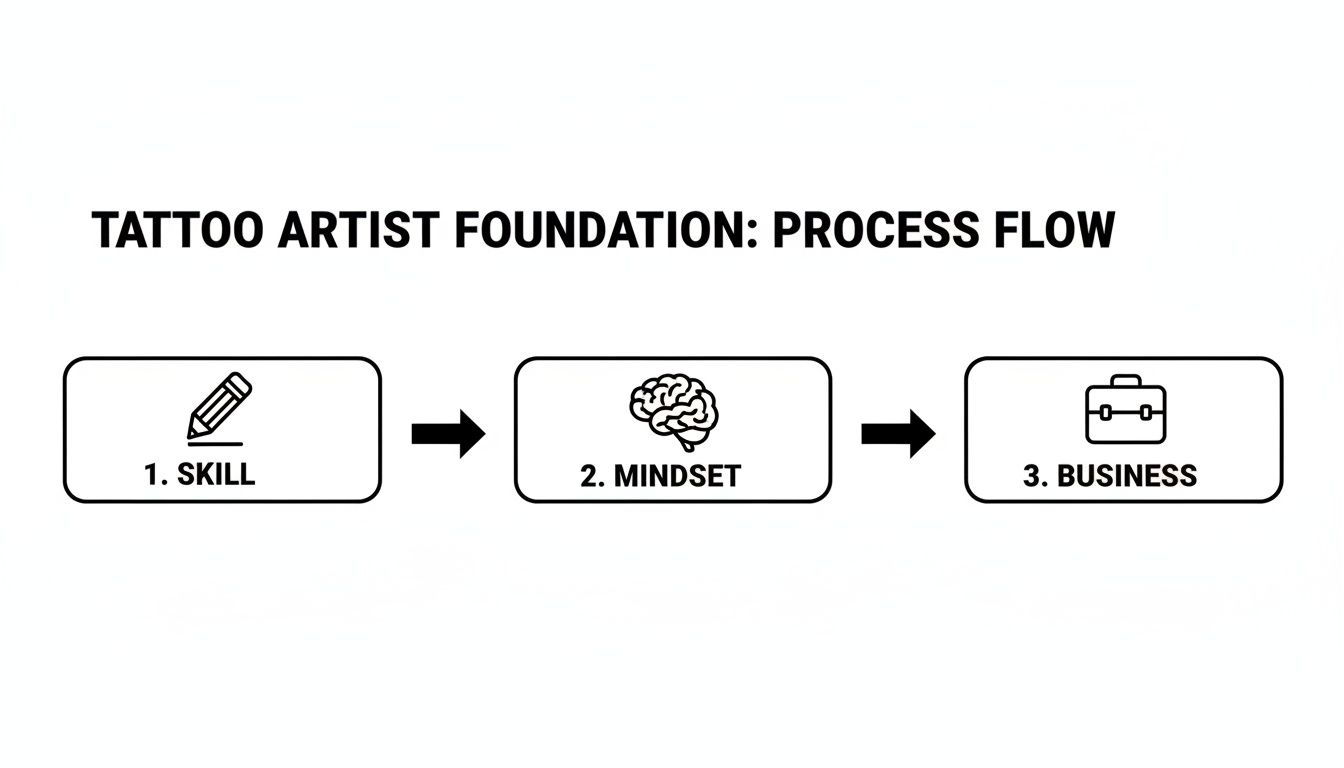
As you can see, becoming a successful tattoo artist requires a deliberate fusion of artistic skill, a tough-as-nails mindset, and sharp business sense.
Developing the Mindset of a Professional
Talent isn't enough. A career in tattooing demands a very specific mentality. You’re going to face constant criticism, work brutal hours, and carry the immense pressure of permanently changing someone's body. An apprenticeship is specifically designed to test whether you can handle it.
Get ready to be the first person to arrive and the last to leave. You’ll spend far more time scrubbing tubes, mopping floors, and breaking down stations than you will drawing. This isn't hazing; it’s a filter. It's a test of your commitment and respect for the craft, teaching you the unglamorous but vital disciplines of hygiene and shop operations.
You also have to learn to take feedback without letting your ego get in the way. A good mentor will tear your drawings apart, not to crush your spirit, but to forge you into a better artist. The key to growth is seeing that criticism as a gift. The pressure is intense, and only those with genuine passion, humility, and a relentless work ethic will make it through to a real career.
Securing and Excelling in Your Apprenticeship
The apprenticeship is where your career is forged. Forget what you’ve seen on TV—this isn’t about instant fame or glamour. It’s a grueling, all-consuming education in art, safety, and the unspoken culture of a professional tattoo studio. Your success here, or failure, sets the course for your entire future in this industry.
This is where you'll spend countless hours drawing, observing, cleaning, and mastering sterilization protocols long before you ever touch a client's skin. It’s not about learning to tattoo; it's about earning the right to tattoo.
Crafting a Portfolio That Gets Noticed
Your portfolio is your first, and most important, test. It’s the key that might just unlock the door to a real apprenticeship. A mentor isn’t looking for a few decent sketches or copies of other artists' work. They're looking for an obsessive commitment to the fundamentals and a spark of originality.
Your portfolio has one job: prove you have artistic potential. Forget digital for this part; a physical binder or portfolio case holding 15-20 fully finished pieces shows a level of seriousness that a tablet just can't match.
So, what should you actually put in it?
- Clean Linework: Show you can pull a confident, clean line with ink pens. Vary your line weights and textures to demonstrate control.
- Smooth Shading: Use graphite or charcoal to create smooth, buttery gradients. This proves you understand value, light, and dimension.
- Color Theory in Action: Include a few full-color pieces using watercolors or colored pencils. This isn't about being flashy; it's about showing you understand how colors work together to create mood and harmony.
- Original Designs: Fill that book with your own ideas. It’s fine to tackle classic tattoo motifs like skulls, roses, or daggers, but give them your own unique spin. Show you can think for yourself.
"A great portfolio proves you're a serious artist first and an aspiring tattooer second. It should scream 'I am obsessed with drawing' and show a clear understanding of composition, flow, and clean execution. That’s what makes a mentor stop and pay attention."
Navigating Shop Etiquette and Culture
Once you’re in the door, the real work begins. An apprenticeship is as much about learning the unwritten rules of a shop as it is about the art itself. Humility is your single most valuable asset. You are there to learn, listen, and do whatever it takes to support the studio's daily operations.
Get ready to be the shop’s backbone. That means:
- Cleaning is Your Priority: You will mop floors, take out the trash, scrub tubes, and break down artist stations. A tattoo studio's reputation is built on being sterile, and you are the first line of defense.
- Observe Silently, Absorb Everything: Pay close attention to how senior artists talk to clients, set up their machines, and handle consultations. You’ll learn more by watching and listening than by constantly asking questions.
- Anticipate Needs: Figure out your mentor’s routine. Have their station ready before they arrive. Know what supplies are running low before they do. Making yourself indispensable is the fastest way to earn real respect.
Finding the right shop and mentor is absolutely critical for your growth. For those in the New York area, you can learn more about how to find the best tattoo shop on Long Island in our detailed guide. A great mentor will push you, critique your work honestly, and be genuinely invested in your success.
The Hard Truths of Apprentice Life
An apprenticeship is a marathon, not a sprint. It demands a massive time commitment, often forcing you to put the rest of your life on hold. Most apprenticeships are unpaid, so having savings or a flexible part-time job is a practical necessity.
You will spend the majority of your first year—sometimes longer—just drawing. Your mentor will ask you to draw the same flash design hundreds of times until your lines are perfect and your shading is flawless. This isn't punishment; it's how you build the muscle memory and precision required to work on living skin.
The tattoo industry is booming, with the global market projected to hit USD 9.25 billion by 2034. Amid this growth, regulations are getting stricter. Apprentices must log anywhere from 1,000 to 2,000 hours of training, mastering everything from sterilization to artistic precision. To stand out in an increasingly crowded market, your training has to be impeccable. Excelling in your apprenticeship means focusing on quality and structure—exactly what high-end studios look for.
Finding Your Voice in Core Tattoo Styles
Technical skill might get your foot in the door for an apprenticeship, but developing a distinct artistic voice is what turns a competent technician into a sought-after artist. That whole journey starts with a deep, genuine respect for the foundational styles that are the backbone of modern tattooing. You have to master the classics before you can break the rules with any real intention.
This isn't about just copying old flash. It's about internalizing the "why" behind each style—the history, the techniques, the philosophy. When you do that, you're building a massive visual library in your head that will feed every unique piece you create down the road.
The Bedrock of Tattooing: American Traditional and Japanese
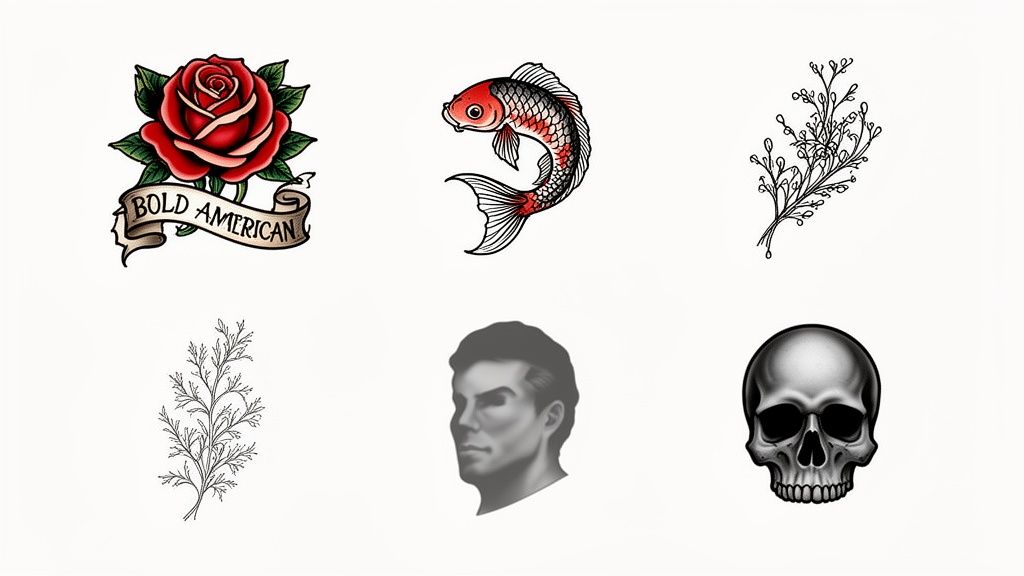
American Traditional (or Old School) and Japanese (Irezumi) are the two pillars of the craft. Seriously, if you want to learn how to be a tattoo artist, you start here. Both are defined by strict rules of composition, color, and subject matter, which makes them incredible disciplines for any apprentice. They force you to learn structure.
American Traditional is all about:
- Bold, black outlines that give the tattoo a powerful, lasting structure.
- A limited color palette, usually just red, green, yellow, and black.
- Simple, iconic imagery like eagles, panthers, roses, and daggers.
Japanese Irezumi, on the other hand, is built around large-scale compositions that flow with the body. These pieces tell stories using mythological creatures, historical heroes, and natural symbols like cherry blossoms or koi fish. Learning these styles teaches you how to build a tattoo that isn't just beautiful on day one, but is designed to look great for a lifetime.
The tattoo world is blowing up, thanks to a huge cultural shift that sees tattoos as a legitimate form of self-expression. The market hit USD 2.20 billion in 2024 and is expected to rocket to USD 5.65 billion by 2034. For anyone starting out, this just highlights how crucial it is to master timeless styles like American Traditional and Japanese, which are always in demand at top-tier studios. You can get a closer look at these market trends and projections on SlideShare.
Mastering Gradients in Black and Grey
Once you move past the hard lines of traditional work, you get into the subtlety and nuance of black and grey. This style is a masterclass in value. It relies on soft shading and buttery-smooth gradients to create depth and realism without a drop of color. It requires the same understanding of light and shadow as a professional graphite artist.
Your ability to pull off a seamless blend is everything. Artists working in black and grey use different needle groups and hand motions to get the job done:
- Whip Shading: A quick, flicking motion creates a stippled, almost peppered texture that's great for building up tones.
- Smooth Blending: Using bigger magnum needles and a slower, more deliberate hand speed to pack in grey wash inks for a soft, airbrushed finish.
This style is less about rigid rules and more about artistic feel, which makes it incredibly challenging but also deeply satisfying to get right.
The Delicate Art of Fine-Line and Realism
On the more modern end of the spectrum, you have fine-line and realism—two styles that demand an almost superhuman level of precision and patience. Fine-line tattooing often uses single needles or tiny liner groupings to create incredibly delicate and intricate designs. Think of it as the pen-and-ink illustration of the tattoo world; every single line has to be placed with confidence and perfection.
Realism pushes that precision to its absolute limit. The goal here is to create a photorealistic image on skin, which is one of the most difficult things to do in this craft. It forces you to see the world in terms of textures, light sources, and microscopic details.
Here's a quick rundown of what it takes to get good at the five core styles you'll need to know.
Comparison of Core Tattooing Styles
| Style | Key Characteristics | Common Motifs | Primary Techniques |
|---|---|---|---|
| American Traditional | Bold black outlines, limited color palette, simple designs | Eagles, skulls, roses, ships, daggers | Solid line work, heavy black shading, solid color packing |
| Japanese (Irezumi) | Large-scale, body-fitting compositions, rich symbolism | Dragons, koi, tigers, mythological figures, waves | Bokashi (gradient shading), strong outlines, detailed backgrounds |
| Black & Grey | Use of only black ink and its dilutions (grey wash) | Portraits, religious imagery, chicano style, realism | Whip shading, smooth blending, stippling, layering values |
| Fine-Line | Delicate, thin lines, often minimalist or illustrative | Botanicals, script, micro-portraits, geometric patterns | Single needle or small liner groups, precise line work |
| Realism | Photorealistic depiction of subjects, focus on detail | Portraits, animals, landscapes, objects | Layering, smooth blending, color matching, texture work |
Each of these styles offers a unique set of challenges and rewards, but mastering them gives you the versatile toolkit you need to succeed.
While you're learning, you'll quickly discover that skills from one style bleed into another. The bold structure of Traditional can give a fine-line piece the backbone it needs to last. The smooth shading you perfected in black and grey is the same skill you'll need for realism. If you want to go deeper into the nuances of these and other designs, our comprehensive guide on tattoo styles explained is a great place to start.
Ultimately, your unique artistic voice will show up when you start fusing these foundational skills into something that is truly your own.
Your Professional Toolkit: Equipment, Hygiene, and Licensing
Artistic talent might get you in the door, but it’s your technical professionalism that keeps you in business. A tattoo artist isn't just a creator; you're a technician responsible for a client's health and safety. There is absolutely no room for error when it comes to your tools, your gear, and your hygiene protocols. This part of the craft is non-negotiable.
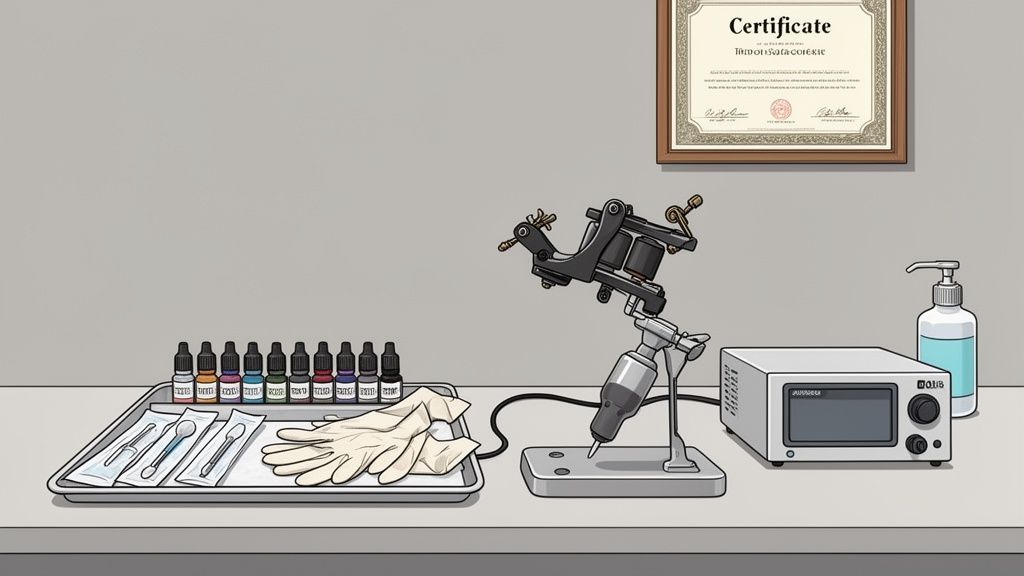
Think of your gear as an extension of your own hand. Choosing the right tools is critical, and the classic debate between coil and rotary machines is one every artist navigates. The truth is, most seasoned pros use both, just for different applications.
Assembling Your Essential Gear
That initial investment in quality equipment will pay you back for years. Cheap, unreliable gear doesn't just produce garbage tattoos—it's a legitimate safety hazard. Your mentor will steer you in the right direction, but you need to get familiar with the core components of a pro setup yourself.
- Tattoo Machines: Coil machines are the old-school workhorses. You know them by their signature buzz. They hit hard, making them fantastic for pulling clean, crisp lines. Rotary machines are much quieter and lighter, and their smooth, steady motion is perfect for shading and packing color.
- Power Supply: You need a reliable digital power supply. It keeps your voltage consistent, ensuring your machine runs without the kind of hiccups that can mess up your work.
- Needles and Cartridges: You'll build a massive collection of needle configurations—round liners (RL), round shaders (RS), magnums (Mags), you name it. Modern cartridge systems make swapping needles mid-tattoo quick and sterile, but learning how to work with traditional needles on the bar is a foundational skill you can't skip.
- Inks: Always stick to reputable, industry-standard ink brands. High-quality pigments are sterile, heal vibrantly, and are specially formulated to look good in the skin for decades.
Beyond the hardware, a deep understanding of chemical safety in the workplace is critical for keeping everyone safe. That means knowing exactly what’s in your inks, green soaps, and sterilizing agents.
The Unbreakable Rules of Hygiene and Safety
Hygiene is the absolute bedrock of this profession. A single mistake can lead to a nasty infection or, worse, the transmission of bloodborne pathogens. There are no shortcuts. Every single step has to be deliberate and perfect, every single time.
Your apprenticeship will drill these procedures into you until they become muscle memory. This includes setting up your station with single-use barriers covering everything—your machine, power supply, clip cord, wash bottle, and work surface. It also means mastering how to work cleanly to prevent any chance of cross-contamination.
A sterile field is sacred. Anything that touches the client's broken skin or is contaminated with ink and plasma must be single-use and disposed of immediately in a designated sharps container or biohazard bag. Your reputation and your clients' health depend on this discipline.
The breakdown process is just as crucial as the setup. Once the tattoo is done and bandaged, you must carefully dispose of all single-use items before disinfecting every single surface with a hospital-grade virucide. Providing proper aftercare instructions is the final step in your responsibility; check out our guide on tattoo aftercare frequently asked questions for a detailed rundown.
Navigating Licensing and Legal Requirements
Working cleanly is one thing; working legally is another. Every state, and often every county, has its own set of rules for tattoo artists and studios. Ignoring them can lead to massive fines or even getting your business shut down.
To go pro, you'll generally need a few key documents:
- State or County Artist License: This is your official permit to practice in your area.
- Bloodborne Pathogen (BBP) Certification: This mandatory course teaches you how to prevent the spread of diseases like HIV and hepatitis. You'll have to renew it regularly.
- First Aid/CPR Certification: Many health departments also require artists to be certified in basic first aid.
- Studio Permit: The shop itself has to pass regular health inspections to keep its license to operate.
While tattooing has roots going back 5,000 years to Ötzi the Iceman, the modern industry is built on a foundation of rigorous standards. After WWII, sailors helped popularize American Traditional, and the industry exploded. By 2012, global ink consumption was 376.44 metric tons, and that number surged 5.46% each year to hit 465.6 MT by 2022. To honor this history and meet modern demands, the training is intense. State licenses often require one to two years of shadowing an experienced artist on top of all the required safety certifications.
Building Your Client Base and Personal Brand
Alright, you've got your license. Congratulations—you've officially made it to the starting line. All those hours of practice and apprenticeship got you in the door, but what happens next? This is where the real work begins. It’s the pivot from being a technician who can pull a clean line to becoming an artist with a booked-up schedule and a loyal clientele.
It all starts with learning how to properly value what you do. Pricing tattoos is a tough hurdle for almost every new artist. You aren't just selling some ink and an hour of your time; you're charging for your expertise, the unseen hours of drawing, and the non-negotiable cost of keeping everything sterile and safe.
The Art of the Client Consultation
Your first conversation with a client is everything. It sets the tone for the entire experience. A solid consultation isn't about making a sale—it's about a creative partnership. This is where you build trust and turn a half-formed idea in their head into a piece of art they'll love for life.
The most important rule? Listen more than you talk. Let them tell you their vision, why the piece matters, and where they want it. Your job is to be the expert translator, figuring out how to make their idea work as a tattoo that will actually last. This means being honest. If someone wants a micro-realistic portrait of their dog on their pinky finger, you have to be the one to gently explain why that's a terrible idea and how it will look like a blurry smudge in a few years.
A successful consultation is a masterclass in communication. You're not just an artist; you're a guide. Managing expectations with clear, honest advice builds the kind of trust that leads to repeat business and word-of-mouth referrals, which are the lifeblood of any artist's career.
Pricing Your Work Fairly and Confidently
Pricing feels like a dark art when you're starting out, but having a system makes it manageable. Most artists stick to one of two models: an hourly rate or a flat price per piece. Hourly usually works best for big, multi-session projects like sleeves or back pieces. For smaller, single-sitting tattoos, a flat price is the way to go.
When you're crunching the numbers, think about these things:
- Size and Detail: A simple, palm-sized line-work tattoo is a world away from a piece of the same size that’s packed with color and intricate detail. Price it accordingly.
- Placement: The ribs, neck, or hands are just plain harder to tattoo. They require more skill, patience, and time—that needs to be reflected in your price.
- Design Time: Never, ever forget to account for the hours you pour into drawing before the client even walks through the door. Your drawing time is work.
Look, your rates won't be the same as the artist who's been in the game for 20 years. That's fine. But don't sell yourself short. Stating your price with confidence shows that you respect your own skill, and clients will respect you for it.
Building Your Brand on Social Media
In this industry, your Instagram profile is your portfolio, your business card, and your front desk, all rolled into one. It’s the first place a potential client will go to check out your work, see if your style clicks with them, and decide if you're the artist they want to trust with their skin. Having a strong online presence isn't optional anymore.
Your feed should be a curated gallery of your absolute best tattoos. Post high-quality photos with good lighting. Show the work both fresh and, more importantly, healed. Healed shots are proof. They show clients what they’re really paying for—a tattoo that looks great for the long haul. Use your captions to share the story behind a piece or post your available flash designs.
Once you've got a decent gallery going, you need to learn how to get more engagement on Instagram. This is key to connecting with people who are actively looking for a new tattoo. Interacting with your followers, using specific hashtags (like #NYCTattooArtist or #FineLineChicago), and posting consistently will draw in the right kind of clients—the ones who want your specific style. This is how you stop being just another tattooer and start building a brand that people seek out.
Common Questions About Becoming a Tattoo Artist
The road to becoming a professional tattoo artist is a serious commitment, and it’s smart to have questions before you dive in. It's a demanding career, and the reality is often different from what people see on TV. We’ve heard all the common questions from aspiring artists over the years, so we’ve put together some straight answers to give you the real picture.
How Much Can a Tattoo Artist Realistically Earn?
Let's be blunt: your income is a direct reflection of your skill, your reputation, and how hard you work to build a client base.
During your apprenticeship, you should expect to earn nothing. That's the industry standard. You're trading your time, effort, and often menial shop tasks for a priceless education in a skilled trade. Think of it as your tuition.
Once you’re licensed and working as a junior artist, you might see an income in the $30,000 to $50,000 range. But the real money comes with time and a dedicated following. Established artists with a signature style and a consistently booked schedule can easily earn well over $100,000 a year. The goal isn't just to tattoo; it's to build a brand that people seek out and are willing to wait for.
How Long Does It Take to Get Good?
This is a marathon, not a sprint. A proper apprenticeship will typically last anywhere from one to three years, but that’s just learning the absolute basics—how to set up, tear down, and run the machine without ruining someone's skin.
The real learning begins after your apprenticeship. Those first few years are where you truly start to hone your craft and develop your own artistic voice.
Most seasoned artists will tell you it takes at least five years of constant tattooing to become truly proficient. Reaching a level of mastery? That can take a decade or more. This isn't just about drawing well; it's about understanding skin, composition, and creating designs that will look great for a lifetime, not just the day they're done.
Why Can't I Just Teach Myself?
In an age of YouTube tutorials, the idea of a self-taught tattooer is more common—and more dangerous—than ever. Skipping a formal apprenticeship is a massive mistake and, frankly, disrespectful to the craft and the clients you'd be putting at risk.
Tattooing is a trade handed down from mentor to apprentice for a critical reason: safety. An apprenticeship is the only way to learn the non-negotiable standards of hygiene, blood-borne pathogen prevention, and cross-contamination. This isn't something you can absorb from a video; it has to be drilled into you in a professional environment.
A good mentor gives you something else you can't get online: immediate, honest feedback. They’ll teach you how to work with different skin types, manage client nerves, handle difficult design requests, and navigate the culture of a professional tattoo shop. Trying to go it alone almost always results in bad tattoos and, worse, puts people's health in jeopardy.
The best artists never stop being students of the craft. They're constantly attending seminars, taking drawing classes, and tattooing alongside other artists to push their skills forward. This career demands a lifelong obsession with getting better.
Ready to start your journey with artists who honor the craft? At Fountainhead New York, we believe in the power of mentorship and the pursuit of excellence. Book a consultation today to experience world-class artistry firsthand. Learn more at https://fountainheadny.com.


uaurl5