

Choosing your first tattoo is a massive decision, and it’s a process that deserves real thought. It’s a collaboration, a true partnership between your vision and an artist’s expertise. When those two things come together correctly, you end up with a piece of art you’ll be proud to wear for the rest of your life.
Your First Tattoo Journey Starts Here

Getting that first piece of ink is a milestone. It’s a cocktail of pure excitement mixed with some totally understandable nerves. It’s a permanent mark of who you are, and the path to getting it right begins long before you ever sit down in the artist’s chair. This guide is here to cut through all the noise and get you focused on what actually matters: deliberate, careful planning.
That impulsive, walk-in tattoo might seem like a thrill in the moment, but the tattoos that mean the most are born from a partnership. Your personal vision gives the piece its soul, while a professional artist brings the technical skill and artistic eye needed to make it a lasting work of art.
Why Thoughtful Planning Is Non-Negotiable
Rushing the process is probably the most common mistake we see, and tattoo regret is more real than people think. A 2023 survey showed that about 25% of Americans regret at least one of their tattoos. That number actually jumps to 28% for people who got their first tattoo at 18, which tells you everything you need to know about how impulse can lead to second thoughts. You can dig into more of the tattoo regret statistics from Advanced Dermatology if you’re curious.
Your first tattoo isn't just about the final image on your skin. It's about the entire experience—from that first spark of an idea all the way to the final, healed piece. A well-planned journey ensures the outcome is a source of pride, not a constant reminder of a hasty choice.
Building a Foundation for a Timeless Tattoo
To make sure you don’t become part of that statistic, we need to shift your focus toward creating something with real staying power. This means understanding what makes a tattoo look great not just today, but decades from now.
We’re going to walk through the key elements that contribute to a successful first tattoo, including:
- Clarifying Your Intent: Getting past just "what looks cool" to find a design that holds genuine personal significance.
- Choosing a Style Wisely: Focusing on timeless styles like American Traditional or Japanese—styles that are literally built to last and age gracefully.
- Collaborating with an Artist: Learning how to actually talk to your artist, communicate your vision, and trust their professional guidance when they give it.
By treating this like a thoughtful project instead of a whim, you're setting yourself up for a killer experience and a piece of art you'll love for a lifetime.
Finding a Design That Genuinely Means Something
Before you even think about needles, artists, or pain, the journey to your first tattoo starts with one simple question: why are you getting this? A great tattoo is so much more than a cool picture; it’s a story you wear. The biggest mistake I see first-timers make is jumping on a trend instead of digging deep for something that genuinely means something to them.
Sure, that design you saw on Pinterest looks sharp today, but how will you feel about it in ten or twenty years? The real goal is to find a concept that feels like it’s always been a part of you, not just a passing interest. That takes a bit of honest self-reflection.
Translate Your Ideas into Visuals
Most of the best tattoo ideas don't start as fully-formed images. They usually begin as feelings, abstract concepts, or memories of significant life moments. The real trick is to turn that abstract idea into something a tattoo artist can actually draw on your skin. This is where a mood board becomes your secret weapon.
Don’t just save pictures of other people's tattoos. Broaden your search. A good mood board captures a vibe, a specific feeling, or even just a color palette. Use a platform like Pinterest or a private Instagram account to gather a whole range of references that connect to your core idea.
Let's say the concept you want to capture is "resilience." Your mood board could be way more interesting than just a bunch of strong-looking tattoos. You could include:
- Images of kintsugi, the Japanese art of mending broken pottery with gold.
- Photos of tough plants that thrive in harsh places, like a lone desert wildflower or a windswept tree on a cliffside.
- Symbolic imagery that speaks to you, like a phoenix or a lotus flower.
- Even abstract textures, patterns, or colors that you feel evoke strength and perseverance.
This kind of collection gives your artist a much richer, more nuanced understanding of what you’re trying to say. It’s the difference between asking for "a lion tattoo" and showing an artist images of stoic Roman sculptures, weathered oak trees, and a specific family crest to create a truly unique lion that represents your personal definition of strength.
Gather References, Not Replicas
Once you've built that mood board, you can start hunting for specific reference images. These aren't designs you want the artist to copy. Think of them as ingredients for your artist to cook with. Any artist worth their salt will refuse to plagiarize another's work, but they can absolutely draw inspiration from the components you bring to the table to create something original for you.
A tattoo should be a collaboration, not a transaction. Your references provide the vocabulary; your artist uses their expertise to write the story on your skin. Trust them to interpret your vision into a design that is both meaningful and artistically sound.
Imagine your tattoo is meant to honor your "family." Instead of pointing to a generic infinity symbol with names woven through it, your references could be far more personal and powerful.
- A scanned snippet of your grandmother’s handwriting from an old birthday card.
- A photo of the specific type of flower that grew in your childhood backyard.
- A simplified star chart of a constellation that was visible on a meaningful family date.
These elements are deeply personal and give your artist unique building blocks to craft a design that is 100% yours. This approach guarantees your piece has layers of meaning that might only be fully understood by you, which is what makes a tattoo truly timeless.
Finally, remember to treat your artist like the creative partner they are. Bring your mood board and references to the consultation, but present them as a starting point for a conversation. Be open to their professional feedback on composition, flow, and what will actually look good and age well on skin. Their expertise is what will ultimately turn your meaningful idea into a beautiful piece of art that lasts a lifetime.
2. Choosing the Right Tattoo Style and Size
Okay, you’ve got a concept that means something to you. Now for the fun part: deciding what it will actually look like on your skin. The style is everything—it’s the visual language that turns an idea into art, defining the boldness of the lines, the richness of the color, and the overall feel of the piece.
For a first tattoo, I always steer people toward styles with a proven track record. You want something that not only looks great today but will still look sharp decades from now. This is where timeless approaches really shine.
Three styles, in particular, are fantastic starting points because they are built to last: American Traditional, Japanese (Irezumi), and Fine-Line. Each has a totally distinct vibe, and getting a handle on their core characteristics is the key to matching your idea to the right aesthetic. If you want to go deeper, exploring a comprehensive tattoo style guide can open up even more possibilities.
This quick visual breaks down the essential differences between these three powerhouse styles.
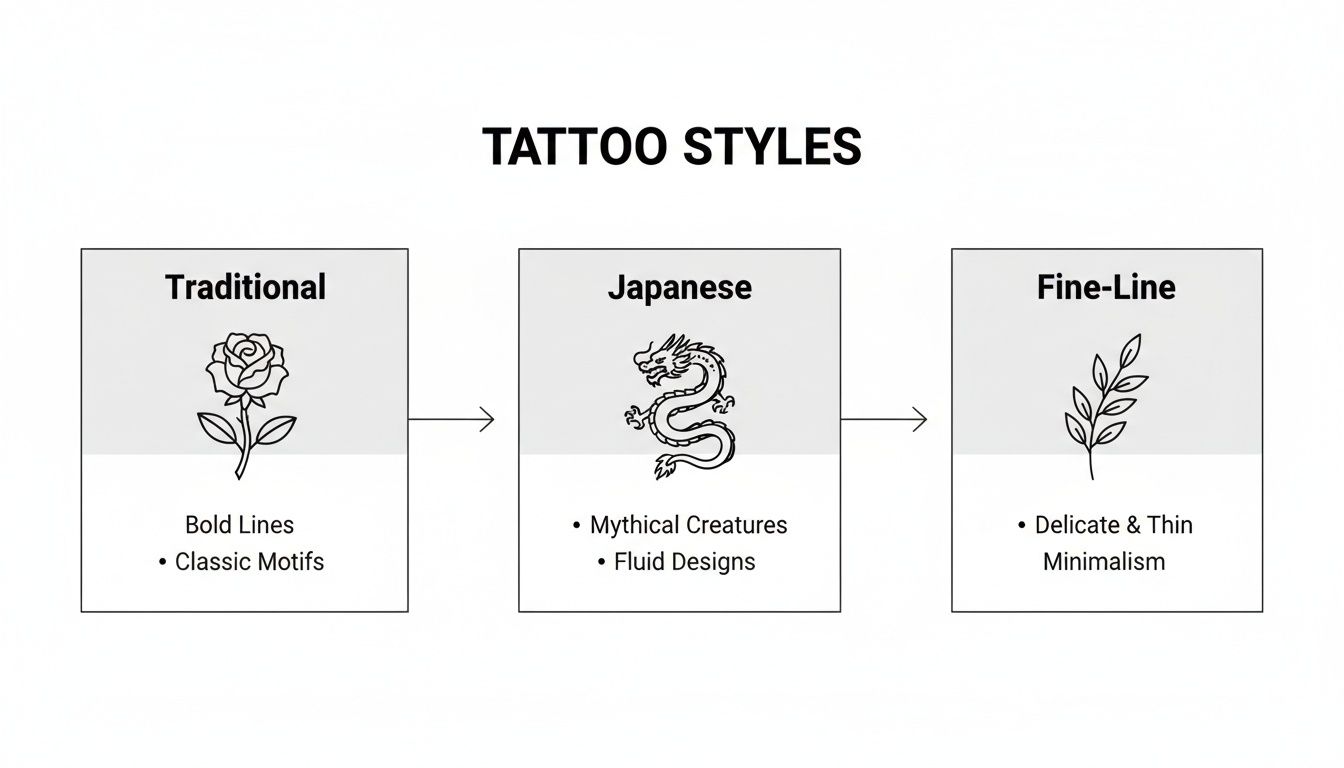
As you can see, Traditional and Japanese styles rely on a bold, solid structure to make a statement, while Fine-Line achieves its elegance through delicate detail. Each is suited for a different kind of artistic expression.
A Closer Look at Timeless Styles
So what makes these styles so enduring? Let’s break it down.
American Traditional tattoos are the bedrock of modern tattooing. They’re famous for their bold, black outlines, a punchy but limited color palette (think reds, yellows, greens), and iconic imagery like roses, skulls, and eagles. That clean, straightforward design is precisely why they hold up so well and stay readable for a lifetime.
Japanese tattoos, known as Irezumi, are all about narrative and flow. These are often large-scale, dynamic designs that are custom-fit to the body's natural curves. Steeped in symbolism, they tell epic stories with dragons, koi fish, and chrysanthemums, all set against powerful backgrounds of wind and water.
Fine-Line tattoos have become incredibly popular for their subtle, detailed look. Using thin needles, artists create intricate designs that almost feel like a delicate illustration on the skin. It’s the perfect style for small script, botanical drawings, or minimalist symbols. One thing to keep in mind, though: those delicate lines can soften and spread more over time compared to their bolder cousins, so a skilled artist is non-negotiable.
To help you visualize which path feels right, I've put together a quick comparison of these popular first tattoo styles. It's a simple way to see how the characteristics of each style impact both the look and its staying power over the years.
Comparing Popular First Tattoo Styles
| Style | Key Characteristics | Best For | Longevity & Aging |
|---|---|---|---|
| American Traditional | Bold black outlines, limited primary color palette, simple and iconic imagery. | Clear, classic designs that make a strong statement and are easy to read from a distance. | Excellent. The bold lines hold their integrity extremely well over time. |
| Japanese (Irezumi) | Large-scale flowing designs, rich symbolism, detailed backgrounds (wind, water). | Storytelling pieces that cover larger areas and conform to the body's shape. | Very Good. The strong structure and background elements help the design age cohesively. |
| Fine-Line | Thin, delicate lines, intricate details, often black and grey. | Small, detailed, and subtle designs like script, florals, or minimalist symbols. | Good. Lines may soften and spread slightly over many years, requiring a skilled artist for best results. |
This table should give you a solid foundation for thinking about which style aligns best with your vision. Remember, the best style is the one that you'll love looking at for the rest of your life.
How Design Complexity Dictates Size
Just as crucial as the style is the size, and these two things are completely intertwined. One of the most common rookie mistakes is trying to shrink a complex design into a space that’s way too small. Any good artist will tell you that every design has a minimum size it needs to be to look good—and more importantly, to age well.
Here’s why: ink naturally settles and spreads a tiny bit in the skin over the years. If lines in a design are too close together, they’ll eventually blur into an unrecognizable blob. A bold Traditional eagle needs to be big enough for its feathers to stay distinct. A delicate fine-line floral piece will turn into a smudge if you try to make it the size of a postage stamp.
"A good rule of thumb is to trust your artist's recommendation on sizing. They understand how ink behaves in the skin over decades, not just on day one. Forcing a complex design to be too small is a recipe for a blurry, unreadable tattoo down the road."
Here’s a practical tip I give all my clients: print out your design idea in a few different sizes. Seriously. Cut them out, tape them to the spot you're considering, and wear them around for a day. See how the size feels, how it moves with you, and whether it has the impact you want. This simple test can give you so much clarity and confidence before you ever set foot in the studio.
Where to Place Your Tattoo: Pain and Longevity
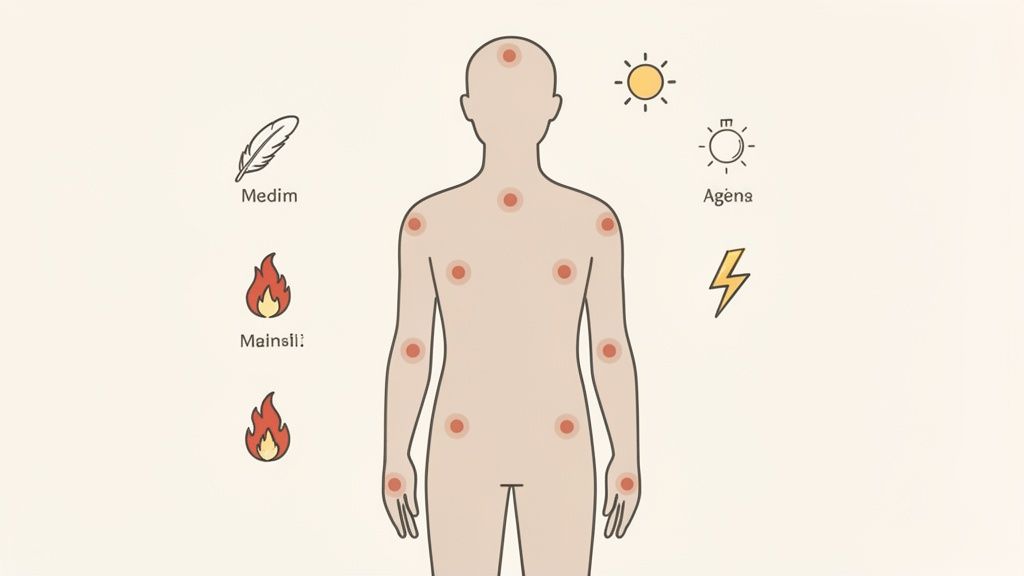
You’ve landed on a meaningful design and a style that feels right. The next big question is a strategic one: where on your body will this piece of art live? Deciding on placement is just as crucial as the design itself. It's a delicate balance between visibility, personal comfort, and how the tattoo will age with you over the decades.
This one decision impacts everything from the pain level during the session to its long-term appearance. A design on a stable, fleshy area like the thigh will be a completely different experience from one on the bony, high-motion skin of the ribs. Thinking through these factors now is the key to choosing a spot you'll love for life.
Navigating the Tattoo Pain Chart
Let's address the elephant in the room—pain. Yes, getting a tattoo involves some discomfort, but it’s manageable, and knowing what to expect can make all the difference. You’ve probably seen those "pain charts" online showing hotspots in bright red. It's best to view them as general guides, not absolute truths.
Pain is highly subjective. Your tolerance is unique to you, but there are some reliable patterns we see in the studio all the time.
-
Less Painful Areas: These are typically spots with more fat, muscle, and thicker skin, which act as a cushion against the needle. Think outer thighs, forearms, calves, and shoulders. These are often excellent choices for a first tattoo because the experience tends to be much more tolerable.
-
More Painful Areas: Bony areas with thin skin and tons of nerve endings are naturally more sensitive. This includes the ribs, spine, ankles, feet, sternum, and inner biceps. You can absolutely get your first tattoo here, but it's good to be mentally prepared for a more intense session.
Think of it less as "pain" and more as a unique sensation. Some clients describe it as a persistent, hot scratching, while others feel a vibrating or buzzing. For your first time, the best approach is to choose a less sensitive area to get acquainted with the feeling.
Thinking About Visibility and Your Lifestyle
Beyond the physical sensation, you have to consider the social and professional side of things. Tattoos are more mainstream than ever, but visibility still matters in certain contexts. It's all about choosing a spot that aligns with both your personal expression and your practical, day-to-day life.
Recent data shows a fascinating duality in public perception. While 98% of people agree that tattoos are more normalized now, a significant 47% still hold some form of judgment. For a first tattoo, this suggests choosing a placement that’s versatile. A surprising 75% of people think visible ink can hamper career opportunities, so it's a factor worth considering. You can dig into the numbers yourself in the full report on tattoo perceptions from Pew Research Center.
Choosing a spot like the upper thigh, shoulder blade, or bicep gives you complete control over who sees your art and when. This allows you to ease into having a tattoo without immediately navigating potential workplace or social dynamics.
How Placement Affects Tattoo Longevity
Finally, think about how your tattoo will look in 10, 20, or even 50 years. The location you choose plays a massive role in how well the ink holds up over time. Your skin is a living canvas that stretches, tans, and changes, and your tattoo will change with it.
Certain areas are simply more prone to aging factors that can impact a tattoo’s clarity.
-
High-Friction Zones: Tattoos on hands, fingers, feet, and inner thighs can fade faster due to constant rubbing from clothing, shoes, or skin-on-skin contact. These spots often require more frequent touch-ups to stay crisp.
-
Sun Exposure: Areas frequently exposed to UV rays—like the forearms, hands, and neck—will see ink fade much more quickly than protected areas. Diligent sunscreen use is a non-negotiable for all tattoos, but choosing a spot that's usually covered can significantly prolong its vibrancy.
-
Skin Stretching: The skin on areas like the stomach, hips, and lower back can change significantly with weight fluctuations or pregnancy. While tattoos will stretch with your skin, drastic changes can distort the design. Stable placements like the calf, forearm, or back of the shoulder are less susceptible to these effects, making them solid choices for a first piece.
How to Find an Artist You Can Trust
You’ve got your design direction, style, and placement figured out. Now comes the most critical part of the entire journey: choosing the person who will bring it all to life.
This isn't just about finding a technician. Your artist is a creative partner who will permanently translate your vision onto your skin. Finding the right one is about so much more than a quick "tattoo shops near me" search. It takes real research, a sharp eye, and listening to your gut.
The mission is to find someone whose art you truly admire and whose professional vibe makes you feel completely at ease. Don't forget, you'll be spending a few hours (or more) with this person, so building a good rapport is key to a great experience.
Mastering the Art of Online Research
Let's be real, your search is going to start online, and Instagram is the undisputed king of tattoo portfolios. This is where you get a genuine feel for an artist’s skill, how consistent their style is, and their overall professionalism.
As you scroll through their feed, you need to look past the cool factor of the designs themselves and really inspect the technical quality of their work.
- Clean Linework: Are the lines solid, crisp, and confident? You don't want to see anything that looks shaky, blurry (known as a "blowout"), or faded in spots.
- Smooth Shading: Whether it's black and grey or full color, the shading should be buttery smooth and evenly saturated. If it looks patchy or blotchy, that's a major red flag.
- Strong Composition: Does the tattoo actually fit the body part it’s on? A great artist doesn't just slap a design on; they consider the natural curves and flow of the body to make it look like it belongs there.
A portfolio that only shows fresh, glossy, high-contrast photos can be a little deceptive. The real gold is an artist who proudly posts pictures and videos of healed tattoos. This is the ultimate proof of their skill—it shows you exactly how their work settles into the skin and holds up over time.
Decoding Client Reviews and Studio Vibe
Once you've shortlisted a few artists whose work you love, it’s time to dig a little deeper. Checking out what past clients have to say is a crucial step, like reading client testimonials or reviews on Google and Yelp.
Look for comments that get specific. You want to see people talking about the artist's communication, the cleanliness of the studio, and the overall experience. Consistent praise for making clients feel comfortable and respected is a fantastic sign. On the flip side, if you see multiple complaints about bad communication or crazy, unexplained wait times, you should probably hesitate.
For a more detailed look at what separates a good artist from a great one, our guide on how to choose a tattoo artist breaks it all down.
Preparing for Your Consultation
The consultation is your chance to meet the artist, hash out your idea, and see if you click. Think of it less like a business transaction and more like a creative strategy session. The more prepared you are, the better the meeting will be, and it shows the artist you’re serious.
Bring all your reference photos and your mood board, but come with an open mind. A true professional will offer suggestions to improve the design’s composition, make it last longer, or place it better. Be wary of any artist who just says "yes" to everything without any feedback, especially if you're asking to shrink a highly detailed design into a tiny space.
To make sure you cover all your bases, show up with a list of questions. It proves you're an engaged client and helps you get all the info you need to move forward with confidence.
Essential Consultation Questions Checklist:
- How do you usually handle a custom design process for a piece like this?
- What are your thoughts on sizing, based on my idea and the placement I want?
- Do you have any photos of healed work in a similar style you could show me?
- What's your policy on touch-ups if they're needed down the road?
- Can you walk me through the studio's hygiene and sterilization process?
That last question about hygiene is non-negotiable. Any professional artist will be more than happy—proud, even—to explain their safety protocols, like using single-use needles and sterilized equipment. Your comfort and safety are everything, and a trustworthy artist will make that crystal clear from the start.
Getting Ready for Your Appointment and Aftercare
All your careful planning comes down to this: the appointment itself and the crucial healing period that follows. These final stages are just as important as the first. Nailing this part is what ensures your new art not only looks incredible walking out the door but stays that way for years to come.
Your Pre-Appointment Checklist
Preparing for tattoo day is straightforward, but it makes a massive difference in how you'll feel in the chair. In the 24 hours leading up to your session, your goal is to set yourself up for success.
This isn't the night for a big party. Prioritize a full, restful night's sleep so your body and mind are ready. On the day, make sure you eat a substantial, balanced meal about an hour or two before you head to the shop. Going in on an empty stomach is a recipe for feeling lightheaded and can actually increase your pain sensitivity. Hydration is just as important, so drink plenty of water.
Before you leave the house, run through a quick mental checklist:
- Dress for Success: Wear loose, comfortable clothes that give the artist easy access to the area. Getting a thigh piece? Shorts are perfect. An arm tattoo? A tank top or loose-sleeved shirt is your best bet.
- Pack the Essentials: For any session over an hour, bring a water bottle, a simple snack like a granola bar, and your phone charger. Little comforts can be a lifesaver during a long sit.
- Stay Sober: Do not drink alcohol for at least 24 hours before your appointment. Alcohol thins your blood, which can cause excessive bleeding and mess with how the ink settles into your skin.
Once you’re in the artist’s chair, they’ll handle the prep. They’ll clean and shave the area, then apply a stencil of your design. This is your absolute last chance to check the placement and size. If anything feels even slightly off, speak up now. It’s a simple fix at this stage, but impossible once the needle starts.
Navigating Tattoo Aftercare
The moment your artist finishes, the responsibility for your tattoo’s future shifts to you. Proper aftercare isn't just a suggestion; it’s a non-negotiable part of the process for getting a vibrant, well-healed piece. Your artist will give you their specific instructions, but the core principles are universal.
The first two weeks are the most critical healing period for a new tattoo. What you do during this time directly impacts how the ink settles and how sharp the final result will be. Treat it like a medical wound that just happens to look beautiful.
Your artist will wrap your new tattoo. Depending on their preferred method, you’ll be told to remove it after a few hours. When you do, gently wash the area with lukewarm water and a mild, fragrance-free soap. Pat it dry with a clean paper towel—never rub it or use a bath towel, which can harbor bacteria.
Apply a very thin layer of the aftercare ointment your artist recommended. You'll repeat this wash-and-moisturize process 2-3 times daily for the next couple of weeks. Your tattoo will start to peel and flake a bit, like a sunburn. This is completely normal. The number one rule? Do not pick or scratch it.
During the healing phase, you must avoid submerging the tattoo in water. That means no baths, swimming pools, hot tubs, or ocean dips. You also need to keep it out of direct sunlight, as UV rays are notorious for fading fresh ink.
The whole process, from finding an artist to healing your new piece, can feel like a lot. Breaking it down and knowing what to expect makes all the difference. Following a clear guide on how to book a tattoo appointment can help streamline the journey and get you closer to the art you've been dreaming of.
Got Questions About Your First Tattoo?
Getting your first tattoo is a huge step, and it's totally normal for your head to be buzzing with questions. Everyone feels that mix of excitement and nerves. Let's tackle some of the most common things people ask, so you can walk into your appointment feeling confident and prepared.
One of the biggest worries we hear about involves skin reactions. A lot of people have concerns about sensitive skin and wonder how it’ll hold up. The best thing you can do is be upfront with your artist. Tell them about any allergies or skin conditions you have. A true professional can often do a quick "patch test" with the ink to make sure you won't have a bad reaction, keeping the whole process safe and worry-free.
Cost and Custom Designs
So, how much is this going to cost? It really depends. The price tag is based on the size, how detailed the design is, and the artist's hourly rate. For a small, straightforward piece, you can generally expect to start somewhere in the $150-$300 range. My advice? Don’t shop for a tattoo based on price. This is an investment that will be on your body forever, so prioritizing an artist whose work you love is always the right move.
And yes, you can absolutely bring in your own design! It's actually a great way to start the conversation. A skilled artist will take your idea and use it as inspiration, redrawing it to fit the natural curves of your body and ensuring the design will hold up over the years. This back-and-forth is where the magic happens.
Trust the process. Your initial idea, combined with an artist’s expertise, will result in a piece that's not only beautiful on day one but for decades to come.
Ready to start your own tattoo journey with an artist you can trust? The team at Fountainhead New York is here to guide you, from initial concept to a perfectly healed tattoo. Book your consultation with us today.


6i4qgk