

When people ask about Traditional vs. Realism tattoos, I tell them it boils down to one key difference: interpretation versus replication.
Traditional tattoos are built to be read from a distance. They use powerful, bold lines and a punchy, limited color palette to create iconic designs that feel timeless. In contrast, realism tattoos aim for something entirely different. They use incredibly fine details, subtle shading, and a full spectrum of color to create lifelike images that look like a photograph on the skin.
Defining the Core Tattoo Styles
Before we get into the nitty-gritty, it's important to understand where these two styles come from and what they're trying to achieve. One style is built on decades of foundational rules designed for maximum longevity and clarity. The other leans on modern technology to push the very limits of what’s possible on skin.
To get a better sense of how visual arts are defined, it’s helpful to look at the principles of other mediums, like traditional photography styles. This core conflict in purpose—bold, symbolic interpretation versus literal, lifelike depiction—is what drives all the other differences between them.
American Traditional tattoos have roots reaching back to the late 19th century, made famous by icons like Sailor Jerry. It’s a style born from necessity, designed to hold up against sun, salt, and time. Realism, on the other hand, really came into its own in the 1990s and 2000s as tattoo technology like needles and machines got more advanced.
Today, Realism makes up a huge slice of the market, accounting for up to 35% of custom work in high-end studios. Traditional tattoos are still a major force, representing about 25% of bookings in major U.S. markets. You can find more insights into the current tattoo market trends on Fortunebusinessinsights.com.
Choosing between these styles isn't about which is "better." It's about which visual language best tells your story. Are you drawn to the power of a timeless symbol or the stunning detail of a lifelike portrait? That’s where you’ll find your answer.
At a Glance Traditional vs Realism Tattoos
For a quick breakdown, this table cuts straight to the chase, comparing the defining features of Traditional and Realism tattoos side-by-side.
| Characteristic | Traditional Tattoo | Realism Tattoo |
|---|---|---|
| Outlines | Bold, heavy black outlines are mandatory. | No outlines; uses shading for edges. |
| Color Palette | Limited and highly saturated (red, green, yellow, black). | Full, complex spectrum to mimic reality. |
| Shading | Simple black shading or solid color packing. | Smooth, layered gradients for depth. |
| Subject Matter | Symbolic icons (eagles, skulls, roses, anchors). | Lifelike portraits, nature scenes, objects. |
| Visual Goal | Readable, two-dimensional symbol. | Three-dimensional, photorealistic image. |
| Aging | Ages exceptionally well, remains legible. | Details can soften and fade over time. |
This gives you a clear snapshot of how fundamentally different these two approaches are, from the initial linework all the way to how they'll look decades from now.
Breaking Down the Visual Language of Each Style
To really get the difference between a Traditional and a Realism tattoo, you have to see them as two completely separate visual languages. Each one follows a specific set of artistic rules to get its point across. One is built for bold, instant recognition, and the other for breathtaking, lifelike detail.
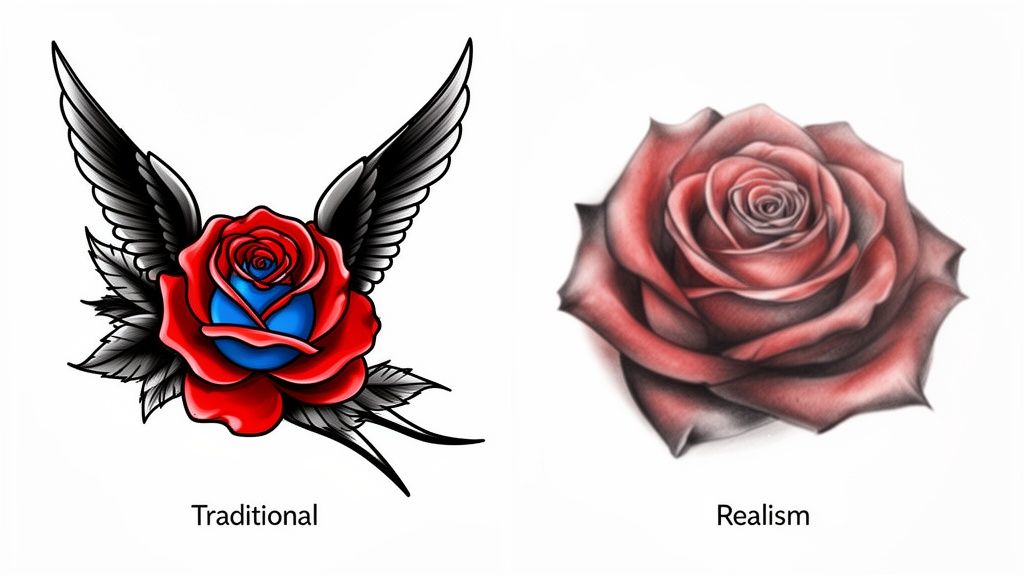
The very foundation of a Traditional tattoo is its powerful outline. These thick, black lines are non-negotiable; they create a solid container for the entire design. This is what makes the image so easy to read, even from across a room, and it's a huge reason why these tattoos age so incredibly well.
Inside those bold lines, you'll find a color palette that's intentionally limited but packed with punch. We're talking primary colors—bold reds, rich yellows, deep greens—all applied with heavy, solid saturation. Shading is minimal and aggressive, often using black to create simple but effective contrast rather than smooth, three-dimensional gradients. The final product is a striking, two-dimensional piece of art that cares more about symbolism and clarity than looking exactly like the real thing.
If you want to go deeper, our guide to the Traditional American tattoo style has a ton more history and examples.
Realism: The Art of Nuance and Depth
Realism operates on the complete opposite principle, ditching the hard outline almost entirely. Instead of using lines to contain the image, realism artists use contrast, light, and shadow to define its edges. This is the key technique that allows them to create a true sense of three-dimensional depth on your skin.
The approach to color and shading here is way more complex. An artist might use dozens of shades of a single color, building up soft, seamless gradients that perfectly mimic how light hits an object in the real world. This painstaking layering is what creates believable textures, whether it’s the delicate softness of a flower petal or the rough grain of a piece of wood.
Realism doesn't just show you a subject; it aims to replicate it with photographic accuracy. This style sacrifices the immediate punch of Traditional for subtle, intricate detail that invites closer inspection and captures a moment in time.
The final visual effect is pure representation. The tattoo isn’t a symbol of a rose; it is the rose, rendered with such precision that it can genuinely trick the eye. This absolute commitment to detail is what defines the visual language of realism.
The Artist's Technique: Linework, Shading, and Color
Seeing the difference between a Traditional and a Realism tattoo is one thing, but truly appreciating the wildly different skill sets needed to pull them off is another. The way an artist actually puts ink to skin changes completely between these two styles, marking a fundamental split in artistic discipline.
Each style demands its own unique touch when it comes to linework, shading, and laying down color.
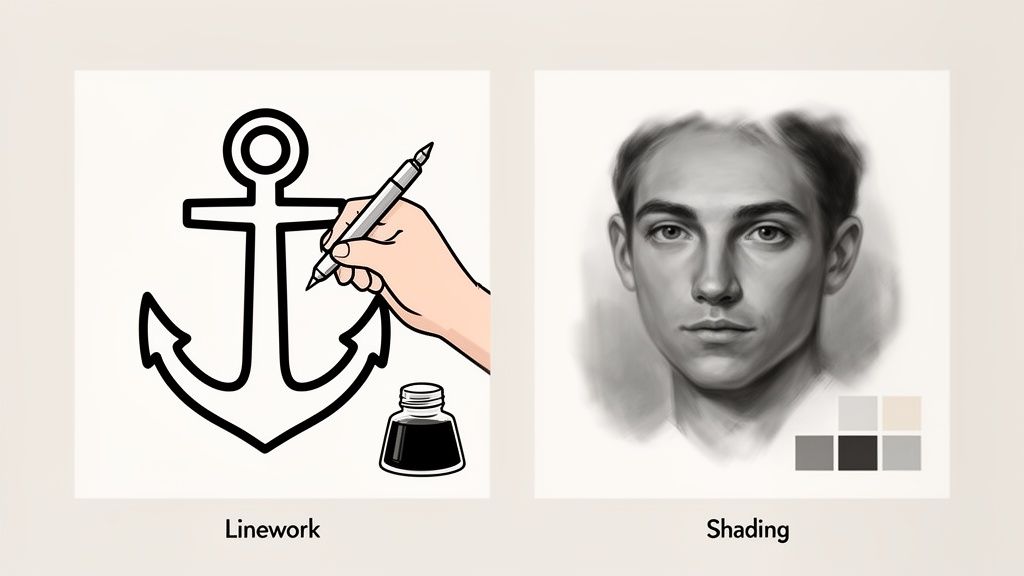
A Traditional tattoo is pure confidence and precision. The artist has to pull those bold, clean lines in a single, unwavering pass. There's just no room for error—every line is meant to be seen, defining the entire tattoo's structure.
Color gets punched in using a method called color packing. This is where the artist systematically floods the skin with dense, bright pigment to create a flat, solid block of color. It's exactly this technique that keeps Traditional tattoos looking so vibrant for decades. The shading is just as direct, typically using solid black to create heavy contrast and a sense of weight without fussing over subtle 3D effects.
The Layered Complexity of Realism
Realism, on the other hand, is a game of patience and layering. Realism artists rarely, if ever, use a hard outline. They build shapes and define edges using subtle shifts in tone, letting light and shadow do all the work. It requires a deep understanding of how light wraps around a form.
Shading is everything in this style. Artists meticulously layer ink with all sorts of needle groupings to create buttery-smooth gradients. It's not uncommon for an artist to pass over the same spot dozens of times to get the blend just right, building up textures that feel like you could touch them.
This incredibly detailed work has a direct impact on both the time it takes and the price tag. For perspective, a large Realism piece can easily take 20-40 hours, while a Traditional tattoo of a similar size might only take 10-15. This time commitment is a major reason why a high-end Realism session can run $500-$1,200 or more.
"With Traditional, your hand has to be perfect on the first try—that line is forever. With Realism, your patience has to be perfect—you're building a photograph one tiny layer at a time. They are two completely different mindsets."
It’s worth noting how modern tools play into this. Many artists now use digital apps to prep their designs, which makes understanding the differences between vector and raster graphics surprisingly relevant. Traditional designs, with their clean lines and solid colors, are a lot like vector art. Meanwhile, the pixel-by-pixel detail needed for Realism is the perfect parallel to complex raster images.
How Traditional and Realism Tattoos Age Over Time
When you’re deciding between a Traditional or a Realism tattoo, one of the most important questions is how it’s going to look in 10, 20, or even 30 years. A tattoo is a serious commitment, and the way these two styles are built means they will interact with your skin—and with time itself—in completely different ways.
A Traditional tattoo is, quite literally, engineered to last a lifetime. Those heavy black outlines aren't just for show; they’re the structural steel of the design. They create a solid container that keeps the ink from spreading or “blowing out” as the years go by, locking colors in place and keeping the entire piece sharp and readable for decades.
The Built-in Durability of Traditional Designs
The simple, high-contrast color palette of an American Traditional tattoo is another key part of its staying power. When an artist solidly packs in saturated reds, greens, and yellows, those colors are far less likely to fade into an undefined blur. They hold their own, allowing the iconic imagery to stay bold and clear.
It’s no secret in the industry why this style has stuck around for so long. The combination of bold lines and solid colors has been proven to slow the fading process. In fact, some studies have shown that these inks can fade up to 15% slower than those used in the early days of Realism. This durability is a huge reason collectors who want a truly timeless piece keep coming back to it. You can see just how much the industry has grown around these reliable techniques in the latest tattoo market analysis from Fortunebusinessinsights.com.
Aging Considerations for Realism Tattoos
Realism tattoos, for all their breathtaking detail, face a different journey over time. The entire style is built on subtle gradients, whisper-soft shading, and a noticeable lack of hard outlines. This means a Realism piece is naturally more vulnerable to the effects of aging and sun exposure.
This absolutely does not mean your Realism tattoo is doomed to look bad. It just means it will evolve. The fine details and smooth transitions that create that photorealistic magic will inevitably soften and blend into each other over the years.
A skilled artist knows this and plans for it from the start. They work to counteract this by packing ink with incredible precision, ensuring even the lightest grey tones are deeply saturated in the skin. From your end, diligent aftercare isn’t just a suggestion—it’s mandatory. Consistent sun protection and moisturizing are what will keep those delicate details looking as crisp as possible for as long as possible. For a deeper dive into this critical period, check out our guide on how long tattoos take to heal.
Here’s a good way to think about it: A Traditional tattoo is like a stone carving—made with bold, permanent marks designed to withstand the elements. A Realism tattoo is more like a detailed pencil drawing, where every delicate line and subtle shade needs careful preservation to maintain its original clarity.
At the end of the day, the longevity of any tattoo comes down to two things: the skill of your artist and how well you take care of it. But there’s no denying that the fundamental principles of Traditional tattooing give it a natural head start when it comes to staying legible over a lifetime.
How to Choose the Right Tattoo Style for You
Picking between a Traditional and a Realism tattoo is about much more than just what looks cool on day one. It’s a decision that needs to align with your lifestyle, where you want the tattoo, and what you expect it to look like decades from now. To make a choice you’ll love for life, you have to get practical.
The first question is simple: are you looking for a bold, symbolic icon that reads from across the room, or a photorealistic memory captured on your skin? Answering that gets you halfway there.
Your long-term expectations are just as crucial. If seeing that tattoo stay crisp and legible in 30 years is your absolute top priority, the tough-as-nails structure of a Traditional tattoo is almost impossible to beat. Those bold lines and solid colors were engineered to hold their shape and stay vibrant for decades, making it a seriously reliable choice for just about any placement.
Matching the Style to the Placement
Where you put your tattoo plays a massive role in which style will hold up better over time. Different parts of your body age, stretch, and get hit with sun differently, and all of that directly impacts how your ink will look years down the road.
Here are a few situational recommendations we give our clients:
- For High-Motion Areas: Think elbows, knees, hands, and feet. These spots are in constant motion and take a lot of friction. A Traditional tattoo is the clear winner here. Its strong outlines act like a container, preventing the design from blurring or losing its shape as you live your life.
- For Large, Stable Canvases: Areas like your back, thigh, or outer bicep are big, relatively stable surfaces. These spots are perfect canvases for Realism tattoos, giving the artist plenty of room to work in those fine details and smooth gradients without fear of distortion.
The core difference really comes down to this: Traditional tattoos are built to be timeless symbols designed to withstand wear and tear. Realism tattoos are detailed snapshots meant to capture a moment, and they need a more protected placement to preserve their intricate beauty.
This decision tree gives you a clear visual for how longevity should influence your choice.
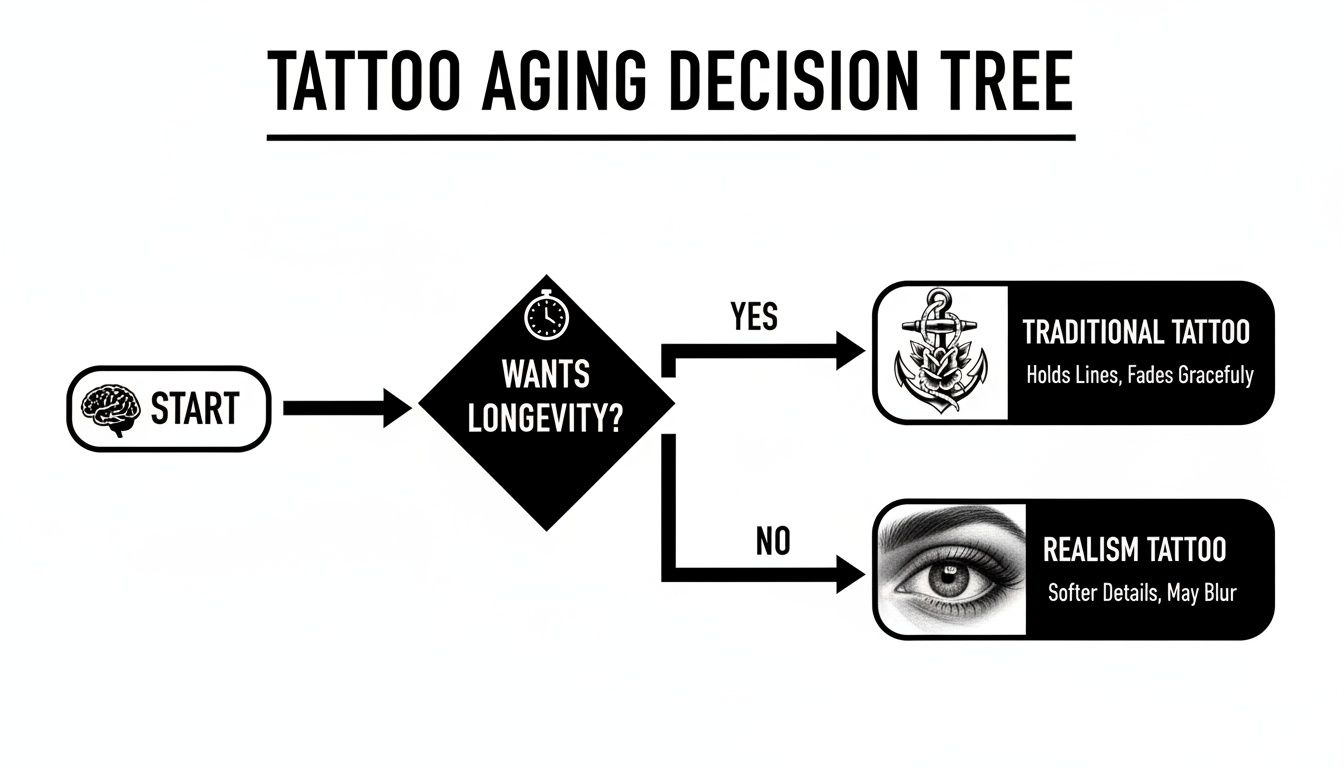
As you can see, if the main goal is a tattoo that stays undeniably clear for a lifetime, all signs point to the Traditional style.
Making Your Final Decision
Ultimately, the best choice is the one that fits your personal story and your practical needs. Think about what you want your tattoo to say and how you picture it aging along with you. Do you love the immediate graphic punch of a classic design, or are you drawn to the subtle, nuanced detail of a lifelike image?
Once you have a good idea of which style you're leaning toward, the next critical step is finding an artist who truly specializes in it. A real expert won't just nail the design; they'll also give you the right advice on making it last. To help you with that vital step, our in-depth guide explains how to choose a tattoo artist who can bring your vision to life perfectly.
Common Questions About Tattoo Styles
Choosing between Traditional and Realism often comes down to a few final, practical questions. Once you’ve sorted through the aesthetics, techniques, and aging potential, you’re left wondering about the real-world experience.
This section tackles the most common concerns we hear from clients every day. We'll give you straight answers to help you lock in your decision with total confidence.
Which Tattoo Style Hurts More: Traditional or Realism?
This is probably the number one question we get, but the answer isn’t a simple one-or-the-other. Pain is always subjective—it really depends on the tattoo’s placement, your personal pain tolerance, and how long you're in the chair.
That said, the type of discomfort you feel can be very different.
Traditional tattoos often deliver a sharp, intense sensation. The artist pulls heavy, clean lines with bold needle groupings and then packs in solid color with a steady, repetitive motion. For many, that initial outlining phase is the most aggressive part of the process.
Realism tattoos, on the other hand, present a different kind of challenge. You won’t get that same initial bite of a thick outline. Instead, the process involves hours of meticulous, layered shading where an artist passes over the same patch of skin again and again with fine-gauge needles to build those buttery-smooth gradients. This can lead to some serious skin fatigue, creating a deep, persistent ache that builds over a long session.
So, which hurts more? It’s a toss-up. A Traditional tattoo can feel more intense in short bursts, while a Realism piece becomes more of an endurance test. Your decision should always come down to the art you want, not a fear of the pain.
Can You Mix Traditional and Realism Tattoo Styles?
Absolutely. When it's done right, blending these two distinct styles can create some seriously stunning and unique artwork. This hybrid approach is the foundation for styles like Neo-Traditional, which takes the core principles of Traditional—bold lines, high contrast—and injects them with the dimensional shading and wider color palettes of Realism.
Here are a few ways an artist can effectively combine them:
- Framing a Realistic Piece: A common technique is to tattoo a photorealistic portrait or animal and then frame it with a classic Traditional border, like a thick rope circle or a spray of bold roses. The contrast makes the realistic element pop right off the skin.
- Adding Realistic Details: Imagine a classic Traditional dagger, but the steel of the blade is rendered with a hyper-realistic metallic gleam. Or a traditional skull enhanced with photorealistic textures and lighting effects.
- Creating an Illustrative Fusion: Some artists specialize in a custom illustrative style that cherry-picks the best of both worlds. They might use strong, clean linework to define the subject but then render the inside with soft, realistic shading and complex color blends.
The key to a successful mixed-style tattoo is finding a versatile artist who has a deep and genuine understanding of both disciplines. They need to know the rules of each style inside and out to know how to break and bend them harmoniously.
How Do I Find the Right Artist for My Chosen Style?
This is it. The single most important step in getting a tattoo you'll love for the rest of your life. Once you’ve landed on either Traditional or Realism, your mission is to find a specialist, not a generalist. An artist who is a master of one style isn't necessarily the right person for the other.
For a Traditional artist, you need to be a hawk when looking at their portfolio. Scrutinize it for these key things:
- Clean, Consistent Lines: Every single outline should be crisp, solid, and unwavering. No wobbles.
- Fully Saturated Color: The colors should be packed in tight with no "holidays" (little missed spots).
- Classic Motifs: A great Traditional artist's portfolio will be rich with eagles, panthers, roses, and other iconic imagery.
For a Realism artist, your focus shifts to pure technical mastery:
- Smooth Gradients: The shading needs to be seamless. You shouldn't see any blocky or choppy transitions.
- Accurate Proportions: Portraits and objects have to be dimensionally correct. A slightly off eye or nose can ruin the whole piece.
- Convincing Textures: Look closely at their ability to replicate textures. Can they make fur look soft, metal look reflective, or skin look like skin?
Instagram and studio websites are your best friends here. Follow artists whose work speaks to you, hunt down their healed photos, and never hesitate to book a consultation to talk through your ideas. This is your body and your art—finding the perfect artist is what brings it to life.
At Fountainhead New York, our artists are masters of their chosen styles, from the timeless power of American Traditional to the breathtaking detail of Realism. Book a consultation today to discuss your vision with an expert who can create a piece you'll cherish for a lifetime.


2ovqfy