

A traditional American tattoo is instantly recognizable. It’s the OG, the blueprint for much of modern tattooing, built on a simple foundation: bold black outlines, a punchy, limited color palette, and imagery that’s easy to read from across the room. These aren't just tattoos; they're wearable art engineered to last a lifetime.
What Defines a Traditional American Tattoo
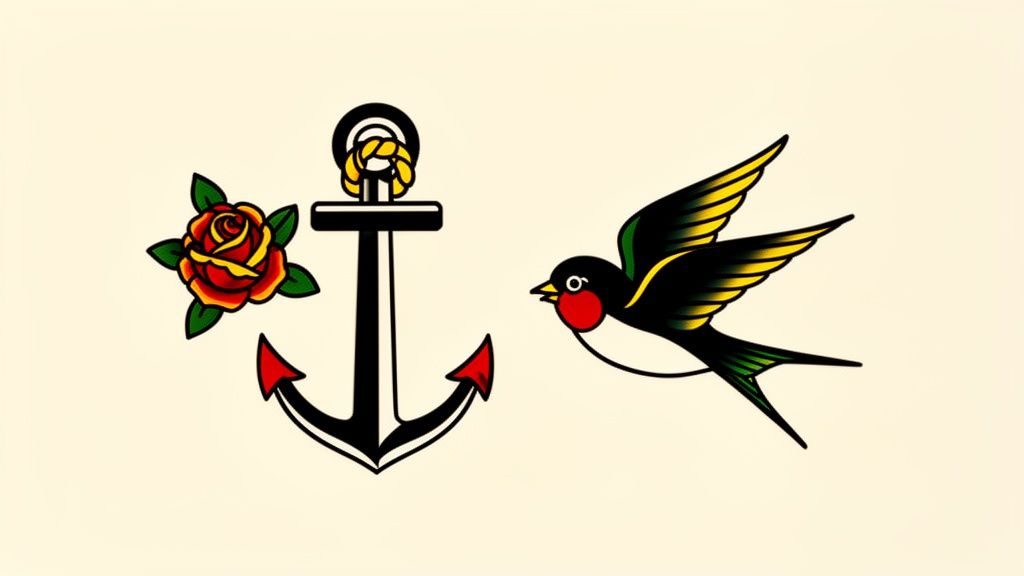
Often called "old school," the American Traditional style is one of the most powerful and enduring visual languages in tattooing. Its rules are strict for a reason—every single element is intentional, designed to look just as good decades from now as it does the day you get it.
The whole style was born from a philosophy that echoes in every legit tattoo shop today: "bold will hold." This isn't just a catchy phrase; it's the guiding principle. It's the reason these designs stand up to sun, time, and whatever else life throws at them. This is art made for a living, changing canvas.
To help you spot a true American Traditional piece, here's a quick rundown of its core components. These visual rules are what give the style its timeless, rugged character.
Key Characteristics of American Traditional Tattoos
| Characteristic | Description |
|---|---|
| Heavy Black Outlines | This is the absolute cornerstone of the style. Thick, solid black lines act as a container, keeping colors from bleeding over time and ensuring the design stays crisp and legible forever. |
| Limited Color Palette | No fuss, no frills. Think bold reds, vibrant yellows, deep greens, and solid black. This high-contrast palette ensures colors stay saturated and punchy for years, no questions asked. |
| Minimalist Shading | Forget smooth, photorealistic gradients. Traditional artists pack in solid color and use simple, heavy black shading to create depth. It’s a technique that adds dimension without muddying the design's clarity. |
These elements work together to create a tattoo that's built like a tank—strong, reliable, and unmistakable.
The goal of a traditional American tattoo isn't to look like a photograph; it's to create an undeniable symbol that tells its story instantly and lasts a lifetime. The simplicity is the whole point—and its greatest strength.
The Godfather of the Style
This iconic aesthetic was practically perfected by one man: Norman 'Sailor Jerry' Collins. From his legendary shop in Honolulu, which he ran from the 1930s to the 1950s, he set the standard.
As a Navy vet, Jerry blended raw American grit with the sophisticated techniques he learned from corresponding with Japanese tattoo masters. He took their masterful shading and applied it to classic American symbols—eagles, daggers, panthers—and in doing so, created the definitive look we still celebrate today. You can learn more about the history of American Traditional tattoos and why they have such enduring appeal.
Exploring the Rich History of Old School Tattoos
To really get American Traditional tattoos, you have to understand where they come from. This style wasn’t dreamed up in some quiet art studio. It was forged in the grit of 19th-century port towns, worn on the skin of sailors, soldiers, and rebels—people living on the edges of society. It’s a visual language that tells a distinctly American story of adventure, conflict, and defiance.
The whole history of this art form is tangled up with life at sea. For sailors heading out on long, dangerous voyages, tattoos were way more than just decoration. They were souvenirs from faraway lands, good luck charms against an unforgiving ocean, and a permanent logbook of their travels and achievements. Every single symbol was a chapter in a story etched right into their skin for everyone to see.
The Dawn of American Tattooing
The style's roots burrow deep into the mid-1800s, when the first real tattoo shops started popping up in America’s bustling port cities. These were rough-and-tumble places, serving a crowd that played by its own rules. The art caught on fast with servicemen, who saw it as a powerful way to build identity and brotherhood in life-or-death professions.
One of the very first documented tattoo shops in the U.S. was opened by Martin Hildebrandt in New York City way back in 1846. Working around the time of the Mexican-American War, he inked sailors and soldiers with designs like anchors, eagles, and family names. These often served a grimly practical purpose: making sure a body could be identified if the worst happened in battle.
That connection to the military cemented the tattoo's place in American culture. From the Civil War on, getting inked became a rite of passage for countless soldiers, a permanent badge of honor marking their service and sacrifice.
From Battlefields to Main Street
As the years went by, the American Traditional style evolved, but its audience stayed firmly working-class. It was the mark of the blue-collar man, the soldier on shore leave, the biker hitting the open road. The imagery started to standardize, reflecting a shared set of values:
- Patriotism: Eagles, flags, and military insignia became potent symbols of national pride, especially during World War I and II.
- Love and Loyalty: Hearts wrapped in banners bearing the name of a mother or sweetheart were everywhere—a constant reminder of home.
- Confronting Mortality: Daggers, skulls, and panthers were all about courage, ferocity, and looking danger right in the eye.
These weren't just random pictures; they were a code. The designs were bold and simple so they could be tattooed quickly and cleanly, often in places that were far from sterile. The heavy black outline and limited color palette were designed to make sure the tattoo would hold up and stay readable for a lifetime.
The legacy of the American Traditional tattoo is all about resilience. It was born out of necessity and adopted by outsiders, yet it has survived for over a century because its core principles—clarity, durability, and powerful symbolism—are simply timeless.
Custodians of a Timeless Craft
Today’s traditional tattoo artists aren’t just applying ink; they’re custodians of a rich historical lineage. When you get an old school tattoo, you're not just picking some flash off the wall. You're taking part in a tradition that stretches back for generations. Every eagle, rose, and anchor carries the weight of all the stories that came before it.
This act of carrying on an artistic legacy is a vital part of human culture. To get a better sense of the broader context of preserving artistic heritage, which is exactly what’s happening with old school tattoos, you can look into the deeper principles of cultural preservation. By choosing this style, both clients and artists make sure this powerful visual language continues to thrive, connecting the past to the present with every bold line and splash of color. It remains a testament to a spirit of independence and adventure that is quintessentially American.
Decoding Iconic Designs and Their Meanings
Every American Traditional tattoo tells a story. These aren’t just pictures; they’re a visual language, a code that sailors, soldiers, and adventurers developed to communicate their experiences, values, and hopes for the future. Each design is loaded with a specific, powerful meaning, turning skin into a living chronicle of a person's journey.
To really get the old school style, you have to understand this symbolism. It’s like learning to read a map of someone’s life, where an anchor isn’t just an anchor and a swallow isn’t just a bird. These images were chosen because they were instantly readable and carried a deep, shared cultural weight.
This visual dictionary traces these classic designs from the rough-and-tumble port towns and battlefields right into the modern tattoo shop, showing just how much their original meanings have endured.
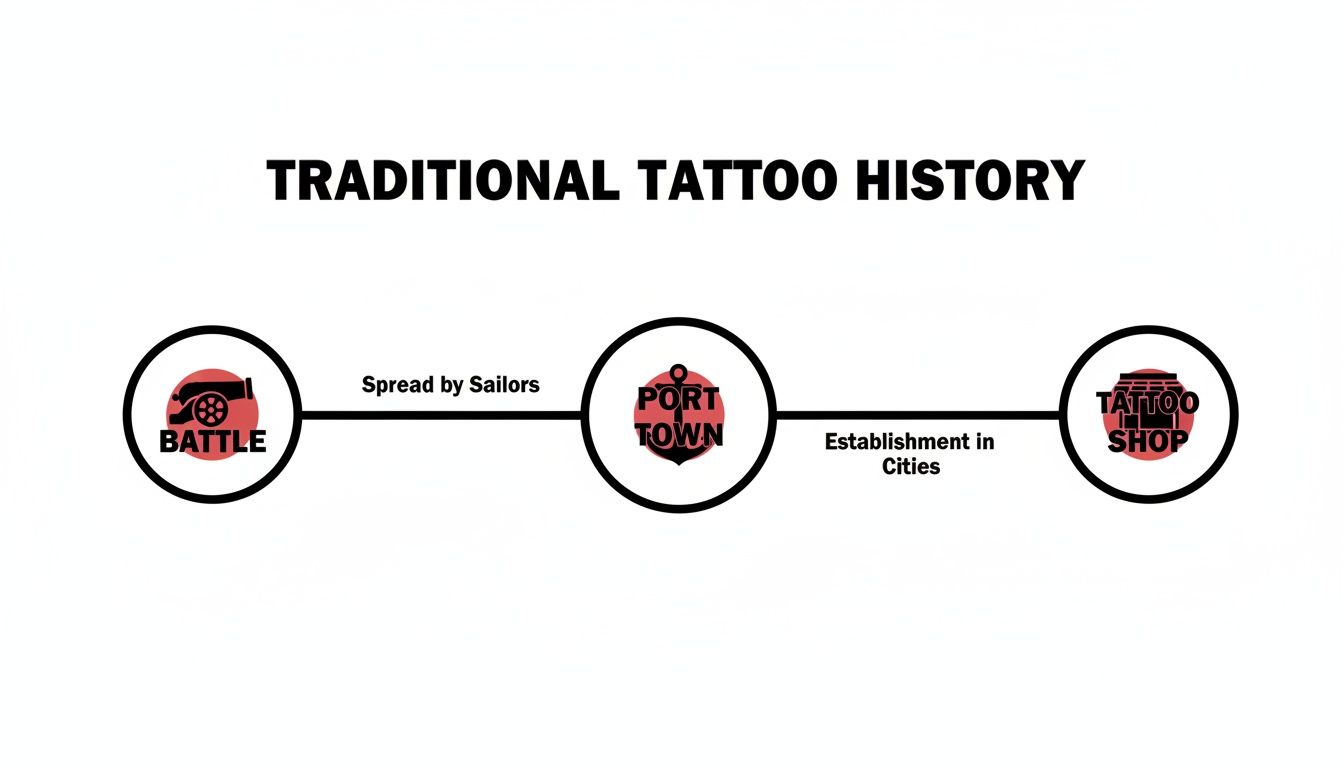
This timeline maps out how traditional tattooing flowed through history, starting with its roots in military and maritime life before becoming the perfected art form we know today. It shows how the symbols born from life at sea became the bedrock imagery for the entire style.
Symbols of the Sea and Sky
Given the style's deep roots in naval culture, it's no shock that many of its most famous designs are tied to the ocean and the sky. For a sailor, these weren't just decorative flair; they were good luck charms and records of achievement.
-
The Anchor: The ultimate symbol of stability and coming home safe. An anchor holds a ship steady through a storm, and for a sailor, it was a constant reminder of their connection to land and the hope of a safe return. Getting an anchor tattoo often marked a sailor's first successful crossing of the Atlantic.
-
The Swallow: This bird is famous for its long migrations, making it a perfect symbol of travel and return. Sailors believed that if they drowned, swallows would carry their souls to heaven. A sailor earned their first swallow tattoo after traveling 5,000 nautical miles and their second after hitting 10,000.
-
The Ship: A full-rigged ship tattoo, shown battling heavy seas, was a real badge of honor. It specifically signified a perilous journey around the infamous Cape Horn. It stood for pure adventure, courage, and overcoming incredible odds.
These maritime symbols laid the foundation for a storytelling tradition that would soon grow to include powerful symbols of life, love, and conflict back on solid ground.
A traditional American tattoo is a statement, not a suggestion. Its meaning is designed to be as bold and clear as its outline, communicating a core human value—like hope, love, or courage—in a single, powerful image.
Emblems of Love and Courage
As the style moved from the docks to the barracks, its vocabulary expanded. The imagery started to touch on universal themes of love, loyalty, and the ever-present reality of life and death.
The Rose is probably one of the most versatile and beloved symbols in all of tattooing. In its classic red form, it stands for love, beauty, and passion. Add some thorns, and it signifies that love isn't without sacrifice or pain. To dive deeper into this classic flower, you can read more about the timeless elegance of rose tattoos and their layers of symbolism.
The Dagger is another design with multiple layers of meaning. While it can represent betrayal or danger, it's more often a symbol of courage, protection, and the willingness to fight for what you believe in. A dagger piercing a heart obviously means heartbreak, while one stabbing a skull represents conquering death or fear itself.
Icons of American Strength
Finally, some of the most commanding images in the American Traditional lexicon are those that represent strength, freedom, and national pride. These designs really took off during wartime, serving as bold emblems of patriotism and resilience.
Here are a few of the heavy hitters:
-
The Eagle: As the national bird of the United States, the eagle is the ultimate symbol of America. It represents honor, freedom, and a fierce, untamable spirit. You'll often see it clutching an American flag, making it a direct and powerful patriotic statement.
-
The Panther: A classic design made famous by legendary artists, the black panther is a symbol of raw power, stealth, and ferocity. It often embodies courage and a rebellious spirit—a perfect design for someone who isn't afraid to stand their ground.
-
The Skull: Far from being just a morbid image, the skull in traditional tattooing is a potent reminder to live life to the absolute fullest. It’s a classic memento mori—a symbol of mortality that encourages the wearer to seize the day.
Choosing an American Traditional tattoo means you're choosing a piece of history. When you understand these deep-rooted meanings, you can pick a design that not only looks timeless but also speaks directly to your own story.
Why These Tattoos Stand the Test of Time
In the world of tattooing, there’s a simple, powerful mantra you’ll hear in every reputable shop: “bold will hold.” This isn’t just an old-school catchphrase; it’s the core principle behind why a traditional American tattoo is an investment in art that genuinely lasts a lifetime.
Sure, delicate, fine-line styles can look incredible when they’re fresh. But they are in a constant battle against time and your own biology.
Think of your skin as a living, breathing canvas. It stretches, it ages, and it’s constantly regenerating. Over the years, the tiny particles of ink that make up any tattoo naturally spread out under the skin. For tattoos with whisper-thin lines and subtle shading, this slow diffusion can cause the design to soften, blur, or in some cases, practically fade away.
The American Traditional style was built with this reality baked right in. It’s designed to work with your body, not against it. Its entire visual language is a masterclass in longevity, engineered to look just as crisp and powerful in thirty years as it does the day you walk out of the studio.
The Science of Lasting Ink
The genius of old-school design boils down to two key ingredients: heavy black outlines and fully saturated color. These aren’t just aesthetic choices—they’re deliberate technical strategies for creating a tattoo with maximum durability.
-
Heavy Black Outlines: Those thick black lines are the tattoo’s skeleton and its fortress. They create a strong, stable container that holds the colors in place, preventing them from bleeding into each other over the decades. This structural integrity is what keeps the image sharp and easy to read.
-
Solid Color Packing: Traditional artists don't mess around with airy, subtle shading. They pack color in solidly, making sure the skin is fully saturated with pigment. This creates a dense, vibrant field of color that’s far more resistant to fading from sun exposure and the natural aging process.
This one-two punch creates a design that stays clear and impactful, even as the skin around it changes. The bold simplicity is its greatest strength.
When you choose a traditional American tattoo, you are choosing a design that was engineered from the ground up to defy time. Its bold lines and solid colors are a time-tested formula for art that endures.
Durability in a Modern World
This commitment to longevity is a huge reason why the style has seen such a massive resurgence. From its beginnings in gritty sailor haunts to becoming a mainstream phenomenon, the traditional American tattoo has exploded in popularity.
Once a well-established but still edgy look by the 1950s, the style has boomed in recent years. Statistics show the prevalence of tattoos in the U.S. jumped from just 21% of Americans in 2012 to 40% by 2019. This surge is largely driven by younger generations—nearly half of all 18-35-year-olds (47%) have at least one tattoo, and many are choosing traditional for its proven durability. You can dive deeper into the rise of tattoo culture on EIU.edu.
The appeal is practical. In a world saturated with fleeting trends, people are drawn to something permanent and reliable. While other tattoo styles might need frequent touch-ups to stay sharp, a well-done traditional piece is built for the long haul. It's a testament to a craft that prioritized function and durability, creating an art form as resilient as the people who first wore it.
How to Choose the Right Artist and Studio
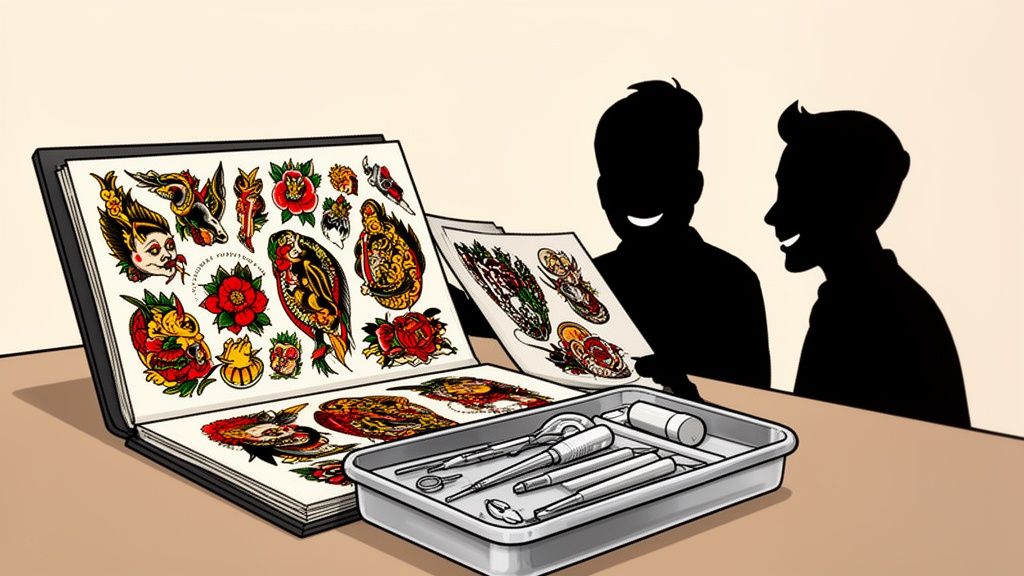
Finding the right artist isn't just one step in the process; it's the single most important decision you'll make. A great artist doesn’t just trace a picture. They get the history, they live by the rules of the style, and they have the technical chops to build a tattoo that will look good for the rest of your life.
This is especially true for the traditional American tattoo, where there’s absolutely no room for error.
Think of it like hiring any other master craftsperson. You wouldn't call an electrician to fix your plumbing, so why would you ask a photorealism artist to pull off a perfect old-school eagle? Your mission is to find a specialist whose work speaks that bold, clean, traditional language.
Scrutinize the Portfolio with a Trained Eye
An artist's portfolio is their entire resume, and it’s where your real homework begins. You’re not just scrolling for pretty pictures you like—you’re hunting for proof of technical skill. As you look through their work, keep an eye out for the non-negotiable pillars of a solid traditional American tattoo.
- Line Consistency: Are the black outlines crisp, solid, and unwavering? You want to see confident lines that are uniform in thickness, with no wobbles or "blowouts" where the ink bleeds under the skin.
- Color Saturation: Is the color fully packed in? Traditional tattoos need to be vibrant and solid, with no patchy spots or "holidays" in the color. It should look rich and even from edge to edge.
- Cleanliness of Design: Does the tattoo read clearly from a distance? A true traditional artist knows how to use negative space and simple shading to make sure the design is instantly legible and won't turn into a muddy mess down the road.
A real specialist’s portfolio will be packed almost exclusively with traditional work. If you only see a handful of old-school designs mixed in with a dozen other styles, you’ve likely found a generalist, not the dedicated expert you need for this.
The mark of an exceptional traditional artist is their ability to make something complex look incredibly simple and clean. Their work should feel timeless, not trendy, with every line and color serving a clear purpose.
The Importance of a Professional Consultation
Once you've zeroed in on a few artists whose work impresses you, the next move is to book a consultation. This is your shot to talk through your ideas, check out the shop in person, and just get a feel for whether you and the artist click. Remember, you’re interviewing them just as much as they’re sizing up your project.
A good consultation is a collaboration. The artist should listen carefully to your vision but also offer their professional guidance on sizing, placement, and flow to make sure the tattoo works with your body, not against it.
Be wary of any artist who seems dismissive or tries to push you into a design you're not 100% sold on. If you want to get a better sense of how different designs fit different people, our tattoo style guide is a great resource.
Vetting the Studio Environment
The artist is critical, but the shop they work in matters just as much. A legit tattoo studio should feel clean, professional, and welcoming—not intimidating. When you show up for your consultation, take a second to look around.
- Hygiene is Paramount: The studio must be spotless. Look for sterilized equipment, single-use needles, and an organized, sanitary workspace. There is no compromising on this; it's the bedrock of a safe tattoo.
- Atmosphere and Communication: Does this feel like a place where you'd be comfortable sitting for a few hours? The staff should be approachable and professional, happy to answer your questions. Clear, respectful communication is the sign of a shop that has its act together.
Ultimately, picking the right artist and studio comes down to a gut feeling backed by solid research. You're looking for that perfect mix of technical skill, artistic vision, and professionalism. Do your homework, trust your instincts, and you’ll find a true craftsperson who can bring your idea to life with the boldness and precision it deserves.
Essential Aftercare for Your New Tattoo
Getting your tattoo is just the first step. The real work begins the moment you walk out of the studio. Proper aftercare isn't just a suggestion—it's the final, crucial part of the process that ensures your investment heals perfectly and stays bold for a lifetime.
Think of your fresh tattoo as a clean, open wound. Your job for the next few weeks is simple: keep it clean, keep it moisturized, and protect it from harm.
The Initial Healing Phase
Your artist will cover your new piece with a bandage before you leave. They'll give you specific instructions on how long to keep it on, which is usually just a few hours. Once the wrap comes off, it’s time for its first wash.
Gently wash the tattoo with lukewarm water and a mild, fragrance-free soap. Use only your clean fingertips—never a washcloth or loofah, which can be too abrasive. Pat it dry with a fresh paper towel, then let it air out for a few minutes before applying a very thin layer of recommended ointment.
You’ll want to repeat this gentle wash-and-moisturize routine 2-3 times a day for about the first week. The key is to keep it clean without smothering it. A little ointment goes a long way; too much can clog your pores and actually slow down healing.
Proper aftercare is not just about healing; it’s about preservation. The steps you take in the first two weeks directly impact the long-term clarity of your lines and the vibrancy of your colors.
What to Expect as It Heals
As your traditional American tattoo starts healing, you’ll notice some changes. It’s completely normal for the tattoo to start peeling and flaking, almost like a sunburn. It’s also probably going to get pretty itchy.
This part is critical: do not pick, scratch, or peel the healing skin. Tugging at those flakes can pull ink right out of your skin, leaving you with patchy spots and faded color. Let everything fall off naturally. If the itching gets intense, a light, open-handed slap on the area can provide some relief without causing damage.
For a more detailed walkthrough, check out our complete guide to tattoo aftercare instructions.
During the entire healing period, which typically takes 2-4 weeks, you need to protect your tattoo from a few things:
- Sun Exposure: Keep your new tattoo completely out of direct sunlight. UV rays are the number one enemy of fresh and healed tattoos, causing them to fade faster than anything else.
- Submerging in Water: Avoid soaking your tattoo. That means no long baths, swimming pools, hot tubs, or trips to the beach until it's fully healed. Showers are fine, of course.
- Tight Clothing: Stick to loose, breathable clothing over the tattooed area. Tight fabrics can rub and irritate the sensitive skin, preventing it from getting the air it needs to heal properly.
Follow these simple but vital steps, and you’ll guarantee your bold new piece heals flawlessly, locking in those crisp lines and saturated colors that make this style so powerful.
Got Questions About Traditional Tattoos?
Even after digging into the style and its history, it's totally normal to have a few last questions before you commit. We get it. Here are some straightforward answers to the things people ask us most, so you can walk into your appointment feeling confident and ready.
What’s the Price Tag on a Traditional Tattoo?
The cost of a traditional tattoo isn't one-size-fits-all. The final price really depends on the size and complexity of the design, where you want it on your body, and the artist's hourly rate.
A smaller piece of pre-drawn "flash" might run you somewhere between $150 and $300. On the other hand, a big custom project like a half-sleeve or a full back piece is a major investment and can easily cost several thousand dollars. Any good studio prices their work based on the skill and time required, so always chat about the cost during your consultation to get a solid estimate for your idea.
Do Traditional Tattoos Hurt More Than Other Styles?
Pain is personal, and it has a lot more to do with the placement of the tattoo than the style itself. That said, the technique for a traditional American tattoo—bold outlines and fully saturated color—can feel a bit more intense for some people.
The process often requires the artist to go over the same spot a few times to make sure those lines are sharp and the color is packed in tight. A seasoned artist knows how to work efficiently to keep you as comfortable as possible. If you're worried about the pain, just talk to your artist. They can suggest spots on the body that are generally less sensitive.
Look, the feeling is temporary, but the art is forever. A little bit of discomfort is a small price to pay for a tattoo that's literally built to look bold and clear for the rest of your life.
Can I Get One With a More Modern Color Palette?
Absolutely. While the classic look is known for that iconic primary palette—bold red, yellow, green, and black—many of today's best artists are expanding those horizons. It's not uncommon to see killer traditional pieces that incorporate blues, purples, oranges, and other vibrant shades.
Some people might call this "Neo-Traditional," but the foundation is the same: strong lines and designs that are easy to read. If you’ve got a specific color scheme in mind, bring it up with your artist. They’ll know exactly which colors will pop on your skin and stay vibrant for years to come.
Should I Get a Flash Design or Go Custom?
There's no "better" option here—it's all about what you want. Flash designs are the time-tested, pre-drawn classics that have decorated skin for generations. Picking a piece of flash connects you directly to tattoo history and is an awesome way to get a timeless tattoo from an artist you respect.
A custom piece, on the other hand, is designed from the ground up just for you. It takes all the core elements of the traditional style and merges them with your unique vision. Both paths lead to an incredible tattoo, and any skilled traditional artist is an expert at bringing both flash and custom ideas to life.
Ready to get a piece of timeless art that’s built to last a lifetime? The artists at Fountainhead New York live and breathe traditional American tattoos, whether you're looking for classic flash or a completely custom design. Book your consultation today and let our team bring your idea to life with the skill it deserves.


