

Traditional tattoo meanings are a visual language, a code passed down through generations. Each classic design—an anchor, a swallow, a rose—carries a deep, symbolic message. These aren't just pictures; they're stories of hope, resilience, and adventure told in bold lines and bright colors, designed to last a lifetime.
The Enduring Language of Traditional Tattoos
Welcome to the world of American Traditional, where every line and symbol tells a story. This isn't about fleeting trends. It's a visual lexicon born from the skin of sailors, soldiers, and rebels—a foundation built on powerful, universally understood meanings that have stood the test of time.
This guide will walk you through the history and symbolism behind these iconic designs. We'll unpack why a simple anchor can represent a lifetime of stability or why a swallow can mean so much more than just a bird. From its maritime roots to its modern revival, you'll see how this rich heritage of storytelling in ink continues to thrive.
Curious about how this style evolved across different regions? You can dive deeper into the nuances of specific traditional tattoo styles to see the subtle variations.
Why Traditional Designs Last
The longevity of American Traditional tattoos comes down to a few key principles that our artists at Fountainhead New York live by. These aren't just style choices; they're technical rules that ensure the art looks just as good decades from now as it does on day one.
- Bold Black Outlines: This is the bedrock. Strong outlines create a solid container for the design, preventing colors from bleeding and ensuring the image holds its shape over the years.
- Limited Color Palette: The classic reds, greens, yellows, and blacks aren't just for show. These pigments are known to age exceptionally well, staying vibrant and true in the skin.
- Readable Symbolism: These designs were meant to be seen and understood from across a ship's deck. Their straightforward nature makes them immediately clear and impactful.
The goal of traditional tattooing has always been readability and permanence. The designs were meant to be easily identified and to withstand the harsh conditions of life at sea, which translates into tattoos that hold their integrity for a lifetime.
At Fountainhead, our artists are experts at translating these classic motifs into personal statements of resilience, hope, and adventure, connecting you to a long lineage of tattoo history. For a broader look at how this fits into the larger art form, check out our guide on various tattoo styles explained.
The Ancient Roots of Body Art and Symbolism
Long before anyone heard the buzz of a modern tattoo machine, people were marking their skin with symbols that held immense power. Tattooing isn't some new trend; it's a practice woven deep into the fabric of human history. To really get a handle on what traditional tattoos mean today, you have to look back at where it all started.
This journey takes us back thousands of years, to a time when body art was a core part of communication and identity. It was a visual language, a way to show your social status, tribal loyalties, spiritual beliefs, or even to heal.
From Ancient Remedies to Sacred Marks
One of the most incredible pieces of evidence we have is Ötzi the Iceman. His mummified body, found preserved in the Alps, is a staggering 5,300 years old and covered in 61 distinct tattoos. But these weren't elaborate pictures. They were simple lines and crosses, strategically placed on his lower back, ankles, and knees—all spots where his bones showed signs of wear and tear.
Archaeologists are pretty convinced these marks were a kind of ancient medicine, maybe an early form of acupuncture meant to ease his chronic pain. This find completely reframes the narrative, showing us that some of the earliest known tattoos were functional, not just decorative. If you want to dive deeper into this, the history of tattooing's cultural significance is fascinating.
Of course, it wasn't just about medicine. Cultures all over the ancient world developed their own powerful tattooing traditions, each loaded with unique symbolism.
- Ancient Egypt: Here, tattoos were mostly found on female mummies—priestesses and dancers. The patterns of dots and dashes are thought to have been connected to fertility and protecting women during childbirth.
- Polynesian Islands: In the Pacific, getting a tatau was a sacred rite of passage. The intricate geometric designs were a living map of a person's family tree, social rank, and spiritual power. Your body literally became a storybook of your life and achievements.
A tattoo has always been more than just art. It represents a fundamental part of the human story, a legacy of meaning passed down through millennia.
This ancient heritage is the bedrock upon which all modern tattooing is built. The idea that a mark on your skin can protect you, identify you, or empower you is a concept that has stuck with us for thousands of years. Today's artists, especially those working in traditional styles, are tapping into that legacy with every piece they create. They're not just putting ink in skin; they're continuing a timeless ritual, connecting the person in the chair to a long and powerful human story.
Decoding American Traditional Tattoo Symbols
To really get American Traditional tattoos, you have to understand they're more than just cool designs; they're a visual language. This style was born from the rough-and-tumble lives of sailors and soldiers who needed symbols that could tell a story instantly. Each piece is a masterclass in communication, using bold lines and a simple color palette to convey powerful ideas.
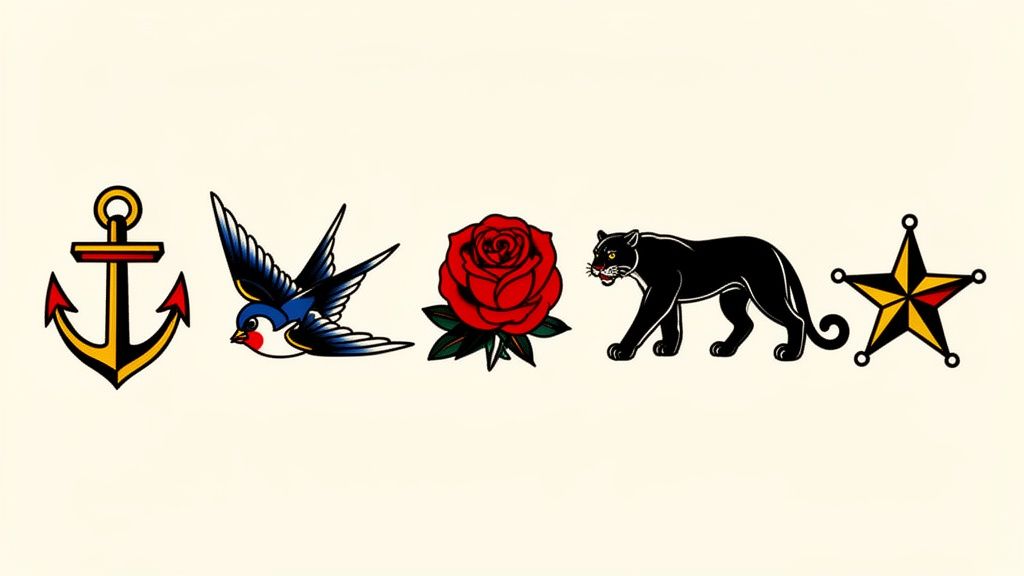
A swallow isn't just a bird. It’s a badge of honor, a marker for traveling 5,000 nautical miles at sea, and a promise of coming home safe. In the same way, an anchor is more than just a piece of nautical gear—it’s a symbol of stability, a refusal to drift, and the strength to hold fast when life gets stormy.
Anchors, Swallows, and Stars: Symbols of the Sea
The ocean was the original proving ground for American Traditional art, and its symbols are the bedrock of the style. Sailors lived by a code woven from superstition, hope, and hard-won experience. Their tattoos were their talismans, their storytellers, their armor against the unknown.
- Anchor: The ultimate symbol of staying grounded. An anchor keeps a ship steady in a raging sea, and on skin, it represents that same steadfastness. It’s about being connected to something solid—family, faith, or your own inner resolve.
- Swallow: For a sailor who had been at sea for months, these birds were the first sign that land was near. A swallow tattoo became a symbol of hope and a successful return journey. The old code was one swallow for 5,000 miles at sea, and two for 10,000, marking a seaman as experienced and capable of finding his way home.
- Nautical Star: Before modern tech, the North Star was everything. This five-pointed star, with its distinct light and dark shading, represents that celestial guide. As a tattoo, it symbolizes having a clear direction, finding your way through challenges, and never losing your path.
Tattooing itself has deep roots that stretch back thousands of years, as this chart shows. Cultures all over the world have been marking skin with meaning for millennia.
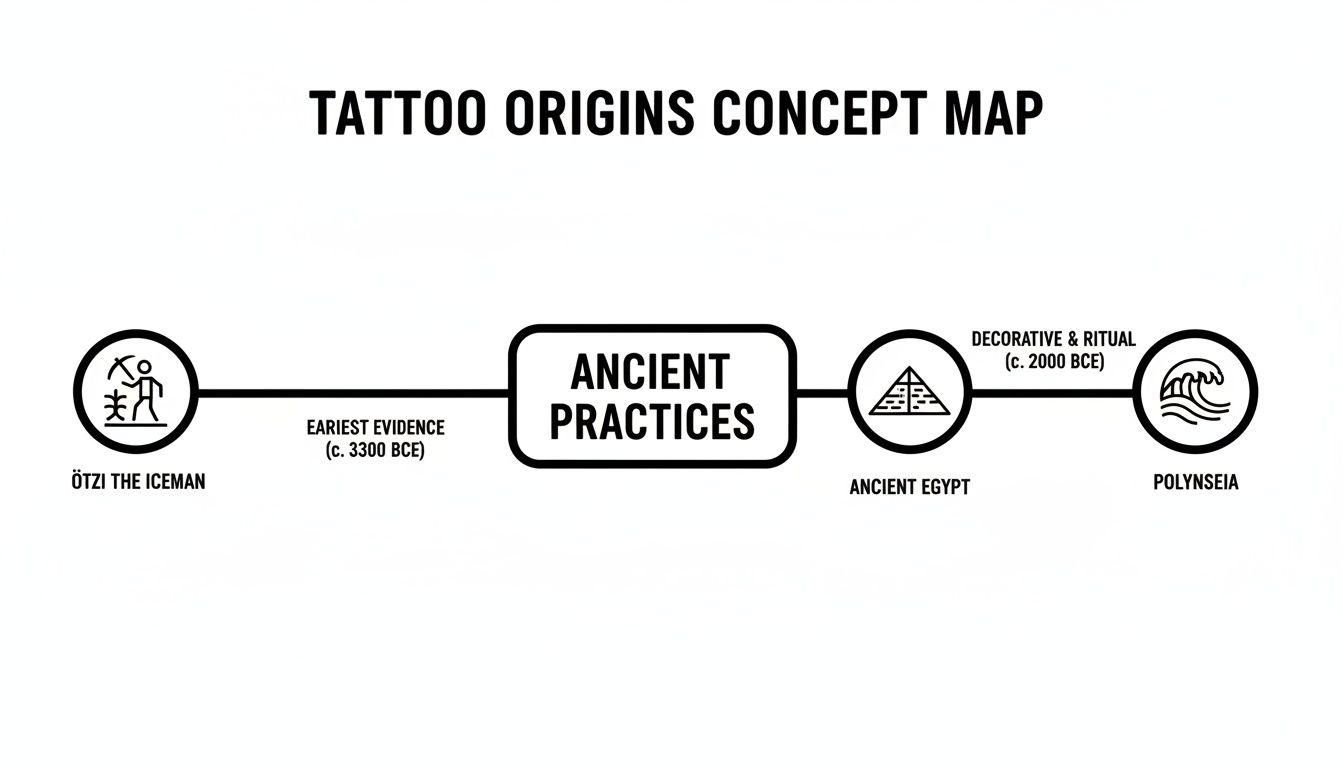
From ancient therapeutic marks to symbols of identity, it's clear the core purpose has always been about putting something truly meaningful onto the body.
Love, Courage, and Mortality on Land
While the ink may have first flowed at sea, the symbolism translated perfectly to life on solid ground. These designs tap into universal human themes: love, conflict, and coming to terms with our own mortality.
The rose is a perfect example and one of the most iconic traditional motifs out there. With its soft petals and sharp thorns, it perfectly captures the two sides of love—its incredible beauty and its potential for pain. The color can add another layer of meaning, too; red for passion, yellow for friendship.
A dagger piercing a heart is one of those classic, emotionally raw images. It can tell a story of heartbreak, betrayal, or the ultimate sacrifice, packing a lifetime of feeling into one powerful design.
Then you have the panther. Often drawn mid-pounce or climbing, it’s pure ferocity, courage, and untamed freedom. It’s a symbol of raw power and the willingness to fight for what you believe in. The skull is just as direct—an unapologetic reminder that life is finite. It’s not necessarily morbid; instead, it’s about accepting that fact and living your life to the fullest because of it.
The Dagger: A Symbol of Duality
In the American Traditional vocabulary, the dagger is one of the most versatile symbols around. Depending on what it's paired with, it can represent a whole spectrum of ideas.
- Courage and Protection: A dagger on its own is often a sign of bravery, quick thinking, and self-reliance. It’s a symbol of cutting through adversity with decisive action.
- Betrayal and Sacrifice: When that dagger pierces something—a heart, a skull—its meaning changes completely. A dagger through a heart is the classic symbol of a painful love or betrayal, while one through a skull can represent conquering death or a personal demon.
- Duality with a Rose: The dagger and rose combination is a timeless representation of life's beautiful and brutal nature. It tells the story that love and beauty (the rose) often come hand-in-hand with risk and pain (the dagger).
To get the full picture, it helps to understand the nuances of different American Traditional tattoo styles, as every artist brings their own hand to these classic motifs. The artists here at Fountainhead New York are fluent in this visual language and can help you find the perfect symbol to tell your story.
If these designs speak to you, check out our complete guide to the Traditional American Tattoo to learn even more.
The Pacific Roots of Modern Tattooing
To get to the real story of modern tattooing, you have to look past the old carnivals and sailor-filled ports and go way back—all the way to the Pacific Islands. This is the true cradle of the art form. Long before Westerners ever thought to put ink to skin for decoration, Polynesian cultures had built an incredibly complex and sacred practice around it.
Even the word itself, "tattoo," is our anglicized take on the Tahitian and Samoan word "tatau," which means "to strike." It’s a literal description of the ancient method, where artists used tools crafted from bone and turtle shell to tap pigment directly into the skin. But this was never just about looks. For ancient Polynesians, tatau was a visual language—a story etched right onto your body that told everyone your genealogy, social status, tribal connections, and spiritual strength.
These dense, geometric patterns were a testament to who you were and your place in the community. Getting a tatau wasn't something you did on a whim; it was a profound, often excruciatingly painful rite of passage that marked your journey into adulthood and cemented your belonging.
A Sacred Rite of Passage
This ancestral art developed over thousands of years. The designs for elite warriors and chiefs could cover up to 100% of the body, serving as both a mark of their high status and a form of spiritual armor. The Samoan pe'a, for example, is a traditional tattoo for men that blankets the body from the waist down to the knees. It’s an unbelievably intensive process that could take months to finish, marking a boy’s grueling transition into manhood.
This is the rich, deeply meaningful practice that Captain James Cook and his crew first documented for the Western world during their 1769 expedition. What they saw sparked a fascination that has never really faded. You can read more about how tattoos became a worldwide phenomenon and explore their incredible history.
For Pacific Islanders, a tattoo was not an accessory; it was an integral part of their being. It told the story of who they were, where they came from, and their role within their society.
When European sailors stumbled upon these traditions, they were absolutely captivated. They brought the art form—and the word "tatau"—back home with them, seeding it in port cities all over the globe. The bold, dark lines and the profound meaning embedded in Polynesian designs became the foundational DNA for what would eventually evolve into American Traditional tattooing.
This powerful legacy—the idea of weaving a personal story directly into your skin—is a principle that still drives the best tattoo artists today. It’s an honor to carry on a tradition rooted in so much history, identity, and raw courage.
Exploring the Epic Narratives of Japanese Irezumi
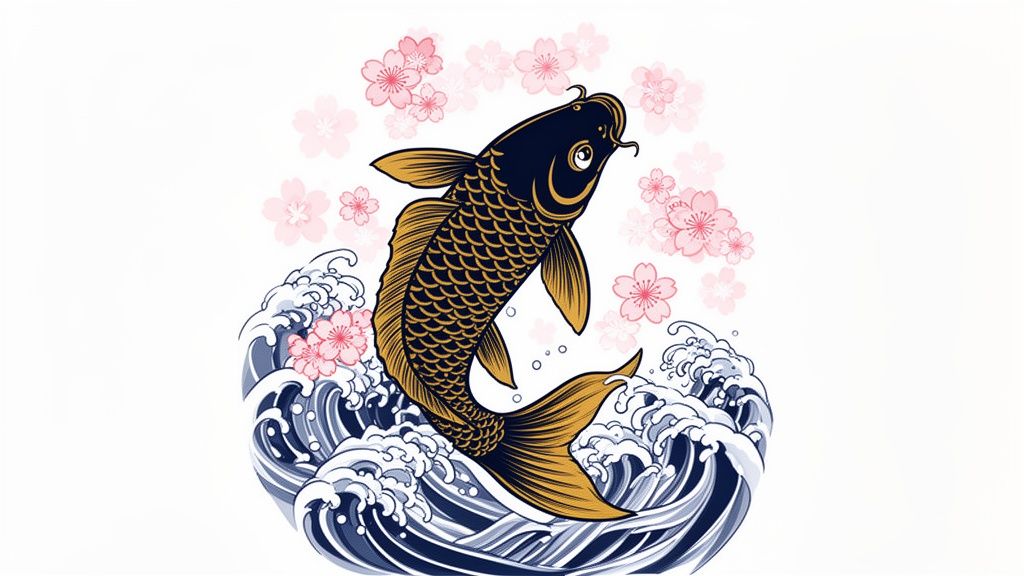
While American Traditional tattooing often focuses on powerful, standalone symbols, Japanese tattooing—or Irezumi—paints sprawling visual epics across the body. These aren't just collections of images. They are complete, flowing stories where background elements like wind bars and water are just as vital as the main characters.
An Irezumi bodysuit is a living tapestry of myth, personal struggle, and hard-won triumph. The practice itself is ancient, with roots stretching back centuries into Japanese history.
The art form traces its origins to the late 3rd century CE. By the Edo period (1603-1868), it had evolved into the intricate, full-body masterpieces we recognize today. Often hidden under kimonos, these bodysuits were worn by heroic firefighters and laborers as profound badges of honor and identity.
Core Symbols and Their Stories
The characters woven into these visual narratives are legendary. Each one brings a specific energy and traditional tattoo meaning that builds the wearer's personal story.
- The Dragon (Ryu): A creature of immense power, wisdom, and benevolence. Unlike Western dragons, Japanese dragons are seen as protectors and masters of the elements, often bringing good fortune.
- The Koi Fish: The ultimate symbol of perseverance and strength. The koi is famous for its determination to swim upstream, representing the relentless struggle against adversity to achieve a great goal.
- The Cherry Blossom (Sakura): A beautiful but poignant symbol. Its delicate petals bloom brilliantly for only a short time, reminding us of life's fleeting beauty and the Japanese concept of mono no aware—a gentle, profound appreciation for the transient nature of things.
In Irezumi, the body becomes a canvas for folklore. A koi transforming into a dragon isn't just a picture; it's a visual metaphor for achieving the impossible through sheer will and endurance.
The Art of the Bodysuit
What truly sets Irezumi apart is its commitment to creating a single, unified piece of art that flows with the body's natural lines. This is a serious undertaking, demanding immense dedication from both the artist and the client. A full bodysuit can take hundreds of hours to complete, often over many years.
The result is a powerful statement of identity and resilience. Every element is carefully chosen and placed to create a harmonious narrative that moves with the wearer, telling their story without a single word.
To see how these motifs are used in modern pieces, you can explore our guide on Japanese traditional tattoo symbolism and its most popular designs. From its deep historical roots to its global recognition as a high art form, Irezumi showcases how tattoos can create a true masterpiece of personal storytelling.
Choosing Ink That Tells Your Personal Story
You now have a solid grasp of the rich visual language of traditional tattoos. The next, and most important, step is to translate that knowledge into a piece of art that tells your story.
The most powerful traditional tattoos are born from a partnership—a collaboration between your personal narrative and an artist’s skill. This isn't about just pointing at a design on a wall. It’s about having a real conversation.
Working with Your Artist
When you come to Fountainhead New York, we believe the real magic happens during the consultation. This is where you share your ideas, your experiences, and what a particular symbol means to you. Your story is the single most important ingredient in the entire process.
A great tattoo artist is much more than a technician; they're a visual storyteller. They listen to your vision and then use their expertise to translate it into a design that isn't just beautiful, but is fundamentally built to last on skin. When you're looking at an artist's portfolio, pay attention to the clarity, the confidence of the linework, and the consistency of their style.
Here’s how to make that collaboration a home run:
- Bring Your Ideas: Come in with some concepts you're excited about, but stay open to your artist's interpretation. They have years of experience making designs flow perfectly with the human body.
- Trust Their Expertise: An experienced artist knows exactly how designs age over time. They might suggest tweaking the size or simplifying a detail to guarantee your tattoo looks incredible for decades, not just the day you get it.
- Ask Questions: Don't be shy. Inquire about their process and why they're suggesting certain elements. Understanding the "why" behind their decisions builds trust and always leads to a better final piece.
The goal is to create a timeless tattoo that holds its meaning and beauty for a lifetime. Your ink should be a true reflection of your personal journey, combining classic symbolism with your unique story.
By working closely with your artist, you ensure the final piece isn't just a cool image, but a chapter of your life written in bold lines and vivid color.
Your Questions About Tattoo Meanings, Answered
Heading into a tattoo appointment with a head full of questions is completely normal. In fact, it's a great sign. It means you’re thinking deeply about the art you’re about to wear for a lifetime. Let's clear up a few common questions we hear at the studio to help you walk in with total confidence.
Can I Change the Meaning of a Traditional Symbol?
One hundred percent, yes. While a classic anchor or swallow comes with a deep history, the most important meaning is the one you give it. Think of the traditional definition as the starting point, not the final destination.
That's where the real artistry comes in. A skilled tattooer can take a time-tested design and tweak it, combining it with other elements or shifting the context to match your personal story. The historical symbolism provides a strong foundation, but your life experience is what makes it unique.
The best traditional tattoos are layered. They give a nod to the past while telling a story that belongs only to you, mixing proven symbolism with your own journey.
Are Some Traditional Tattoos Actually Bad Luck?
You'll still hear some old sailor's tales floating around—like how getting your partner’s name tattooed is the ultimate jinx. For the most part, these are just bits of folklore from a different era.
In today's tattoo culture, the meaning is almost entirely personal. What matters most is that you choose a design that feels right and holds a positive connection for you. If you're worried about any lingering superstitions, just talk it over with your artist. We can always adjust the design to make sure it carries the exact energy you want.
How Does Placement Affect a Tattoo's Meaning?
Placement is a huge part of the story. It adds a whole other layer of intent and meaning to the piece. For example, a nautical star—a classic symbol for guidance—often feels right on a forearm, pointing the way forward. A protective panther might be placed over the heart on the chest.
There aren't any hard-and-fast rules, but talking about placement with your artist is a critical step. They have years of experience seeing how designs flow with the body and can offer advice on how a specific spot can amplify a symbol’s power and look its best.
Ready to turn your story into a timeless piece of art? The artists at Fountainhead New York are masters at translating classic symbolism into powerful, custom tattoos built to last. Book your consultation with us today and let's get started.


